Our trip to Italy – April 2017

Note: What follows is a 6 page account of the 24 days that Susan and I spent as tourists in Italy in April 2017. Hopefully it can be used by ourselves to recall those names and dates we too easily forget and for others to help plan similar vacations.

Introduction: Despite the numerous personal and business trips that we have made to Europe in the last 25 years, the only major country we have never visited was Italy. Thus, I sort of saved it for a retirement holiday and it did not disappoint!.

We decided to travel in April for two reasons – it is often a terrible month in Edmonton mostly because the expectations (for spring) and the reality (of winter) often do not align. This was borne out this year when we heard of (not sadly) two separate snowfalls of over 20 cm while we were away. We had also heard of the very hot weather and HUGE crowds in Italy during the summer. We were still quite shocked at the number of tourists and we were glad we brought sweaters and jackets, but we concluded that April is a very good month to visit Italy.

We planned the trip to visit the major tourist sights in North and Central Italy – mostly for the art, culture, and scenery. We also wanted to visit Genoa, where I had been invited to do a presentation at the National Institute for Educational Technology. Finally we wanted to try to use AirB&Bs and from previous travels, we knew that one had to book very early to insure good selection and prices. Thus, our itinerary was more or less set, when we booked four AirB&B sites in September 2016.

Venice: We decided to visit Venice first and booked our flight booked with Air Canada and they only fly nonstop from Canada to Rome, when we arrived in Rome. We took a pre-booked (cheaper than getting last-minute) a high-speed train ticket which departed 2 hours after our landing. Although we were a bit concerned with timing, we made the train from the airport directly to Venice. The scenery was great but after an all night flight, Sue mostly slept – my new policy of popping half a sleeping pill on the plane worked wonderfully and so had no problem enjoying the view as we sped along – up to 300 KPH.

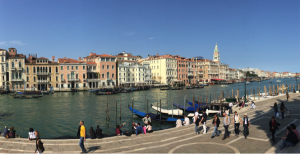
Walking out from the main train station onto the Grand Canal is a wonderful experience for all first time visitors.
We bought SIM cards for our IPhones (25Euros which gave us telephone and 4 gigs data (but no text) Sue’s worked fine but mine would not activate – problem with Apple Canada?? This data phones proved extremely valuable for Google maps and for phoning our hosts in the AirB&B – and of course for answering disputes and queries with a brief consult with Mr Google.

We bought a 2 day pass on Vaporetta boat buses (a bit expensive at 30 Euros each) but a great way to explore Venice. After the 2 days we found we could (and did) walk everywhere. Venice is like no other city we have visited because of the lack of cars and roads. Everything from garbage, to ambulances, delivery vehicles to fire engines is a boat! Thus creating a unique and very quiet environment. The Grand Canal is packed with water taxis and tourist gondolas but also with all types of commercial boats. In addition a huge cruise ship briefly blocked the view one night from St Mark’s square.

We did the usual top tourist sights, museums and churches including visits to LIDO and one of the other small islands. We also booked one walking tour with only 6 of us and a charming young Art student as guide. Our AirB&B Campo St Marco was great, full kitchen, a large eating area, bedroom and living room (which we hardly used). The large windows opening onto St Thomas Square afforded us a bird’s eye view of a bit of Venetian life. We also experienced for the first (but certainly not last time) great Italian pasta, fish and pizza. After 4 nights we took the train for a one day visit to Milan.

Milan: We left early for the 2 hour trip to Milan. We found our hotel near the train station and headed to the old town. We tried for a few minutes to buy tickets to visit the famous Douma (Cathedral) but the line up was atrocious, so we opted for a far too expensive hamburger and beer on a terrace overlooking the Doumo Square, and had a great view of a very excited champion soccer team getting photographed for over an hour. We paid the big bucks for an excellent guided walking tour which ended with 15 minutes in front of Da Vinci’s Last Supper in the Rectory of a Dominican Monastory the Basilica di Santa Maria delle Grazie. This was as our first walking tour with ear phones and it make a tremendous difference as the guide can chat away without halting to gather in the 18 tourists on this tour. He was excellent with lots of stories and time for questions. I hadn’t realized how badly the City had been damaged by British bombers during the 2nd world war. We visited the usual tourist haunts – Cathedral, opera house, Gallery, castle etc .and two hours later arrived for our 15 minutes with the last supper. Having the guide interpret the painting and its restoration (it was NOT done as Fresco on wet plaster so immediately began to fad and was re-painted by various authors and finally the Monks cut in a door which cut off Jesus feet!_. Twenty years of restoration in the late 1980-90 revealed some of the original Di Vinci paint and outlines. He also informed us that this very Monastery was the headquarters of the Italian Inquisition and that the fires burned nightly in Milan for many years – YUK!. But the expressions on the faces of the apostles, the effect of lighting in the refractory, the ‘miracle” that 2 sides of the room had been destroyed by bombs in WWII but left the painting intact, were each impressive.

Genoa: The next morning we headed for Genoa – normally a 2 hour (slower) train, which was over an hour late leaving the station in Milan. Thus, we missed a lunch for us put on by the National Ed Tech Centre folks. I did an updated presentation on Interaction modes in 3 generations of distance education pedagogy. There were about 30 people in attendance and one off-site location. They celebrated my visit and the tomorrow’s Easter break with a delicious and complex traditional Italian home made Easter cake and lemoncello – lemon liquor. The day ended with likely our best meal – with our host Francesca Pozzi and her husband Massi at a great sea-side restaurant owned by one of their friends. There was only one other couple at the restaurant and the owner had to show us pictures of the very fish we were eating and how he had caught it earlier that day. The next day they took us for our first-ever sail on a 38 Ft Bavaria sail boat in the Mediterranean. Not much wind but nice to see this largest harbor in Italy.

Our Genoa AirBnB was right downtown and turned out to be the most luxurious accommodation that we enjoyed on the trip. It was a large apartment with marble and hardwood everywhere , very modern kitchen and a great king sized bed!

We spent the following day exploring Genoa. I went to the Maritime museum while Susan got lost trying to go shopping and wound up in an interesting museum! The old town was great and quite amusing to see the faithful gathered around and praying at a full sized body of the dead Jesus on Easter Saturday – waiting for resurrection tomorrow I guess. Also heard a great guitar player outside the Cathedral, who told us he had played the Bach Cello suite just for us, as he saw us watching!

Cinque Terre: We had, from most visitors we knew, heard to Italy of the wonders of the 5 villages along the Italian Riviera that make up the CinqTerre. We had an Air B&B for 3 nights (2 days) at Manorola. It was Easter weekend and even without the cruise ships it was PACKED with mostly Italian tourists. Anyways we arrived at Manorla by train about 8:30 PM and had a bit of a time finding the AirBnB – thank goodness Manorola only has one road!!

We spent the first morning relaxing and enjoying the balcony view of the town and listening to the bells tolling for Easter morning in the Church next door. They even enticed Susan to attend Mass.  In the afternoon we headed down to wade through huge crowds at the Manorola Beach. We knew the sea trail to Riomaggiore was closed but our map showed the village was only about 3km away. What we didn’t know was that those 3 km were horizontal and didn’t count nearly an equal distance of vertical steps.  We really were not prepared for the roughness of the trail, the zillion steps and many loose rocks. But we made it!! We certainly were glad to end with Bruschetta and craft beer in Riomaggiore.  We took the 3 minute train ride back- the ticket machine was broken and the train packed so it didn’t matter much, and then hiked another km back up to our peaceful airB n B to relax and enjoy the view. We got a taste of why so many Italians are in such good physical condition
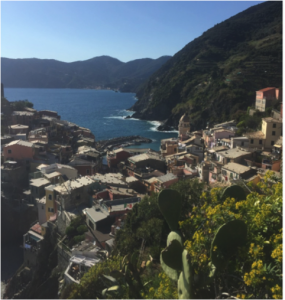
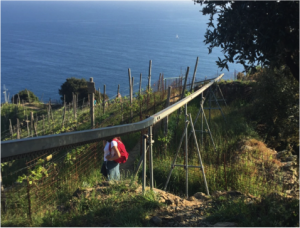
Our second and last full day in Manorola we decided to be smarter and took the local bus up 300 meters to a little town (nice church) on the ridge overlooking the sea. Then it was a still-challenging but easier walk down to the next village. The weather was nearly perfect – high of 19 degrees. There were quite a few people we passed in both directions, but it was interesting seeing the gradual rebuilding and planting of vines in the once abandoned terraces. We also looked carefully at the only mechanism used in these vineyards – the monorails that took the farmers up and grapes and olives down. We had a great lunch overlooking the sea at Corniglia and then headed along the trail to Vernazza. We enjoyed a beer overlooking the harbour and castle and then took the train home.
Florence and Tuscany: Next morning we were off to Florence and rented car so we could see some of Tuscony where we had our only one un-booked night of this trip. Two days earlier I went on Expedia and found a “members sale” for a “country hotel” for $66 Canadian near Sienna. We’ve had some less than positive experience at really cheap hotels before, so we crossed our fingers for this one. We had booked a rental car and fortunately bought our GPS with European maps. We had a wonderful drive through Tuscanny – absolutely the most stunning scenery we have seen thus far. We stopped at the mountain top town of San Gimignano. We enjoyed listening to a busker (and bought a CD) of a musician playing an new Swiss steel drum-like instrument called a Hang. The “country hotel” turned out to be a fabulous 200 year old 4 star hotel (see view from our bedroom window at Borgo San Luigi 
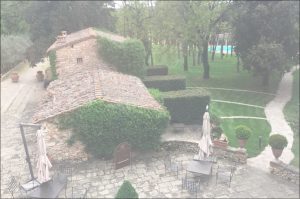
– a lot like Jasper Park lodge. They upgraded us (I guess they didn’t see how little we had paid) to a Junior Suite, that had a list price on the door of 350 Euros. We spent way too much on the hotel restaurant dinner but it turned out to be a wonderful night, and the breakfast the next morning turned out to be no charge.  We wish we had booked the place for another night or two. The following day we drove through Tuscany stopping at a couple of hill top towns including San Miniato and then visited the Leonardo de Vinci museum, in you guessed it – in Vinci!

Back to Florence and dropped off the car sans incident – thank goodness for GPS and found our Monastery – which seemed pretty Spartan after 4 stars last night!!

As others have noted Florence is an amazing City with a very rich Renaissance history. It is amazing that this landlocked town became the world centre for both Art and Banking – perhaps mostly due to the leadership of the Medici family leadership? Our stay at the Monastery was the worst accommodation of our trip. Susan had insisted on it based on one previous Monastery Stay and some latent fantasies of religious life. The room was (as expected very plain) but it was annoying to listen to the Italians arguing, or were they as Sue suggested just talking vivaciously next door late into the night and then again at 6:00 AM! We ‘ve noticed that besides extensive arm movements Italians tend to talk to each other very loudly. We also had trouble getting Internet, but Sue did do a couple of very early morning counseling sessions from the common room downstairs. Our two visiting days were spent at most of the big art galleries. We paid for “Skip the line” tickets for the Academia Gallery and were awed by the size and grace of Michelangelo’s David. The next day we visited the largest Art Gallery in Italy the Uffizi Palace and saw the sculptures and paintings accrued by generations of Medici rulers. We ended the day by enjoying the Sunset after a half hour climb up to Michelangelo Square overlooking the City.

Rome: For the final week of our visit we took the train from Florence to Rome. We had some trouble finding the AirB&B as we got mixed up between municipal trains and the Metro. I also had a very close brush with a pickpocket as during the rush and push to get into a very crowded Metro train I reached and noticed my wallet was missing. I swept my hand down and it was dangling, waiting to fall or be plucked at the waist line of my jacket – yikes – that would have put a damper on our holiday.

We did find the AirBnB and it lived up to its reputation and the reason we booked it, by a very large terrace (5th floor with elevator!) full of plants that overlooked St Paul’s Cathedral and the Vatican. It was a stunning view during the day and lit at night. We had 8 nights here and spent many a slow morning enjoying breakfast on this terrace.
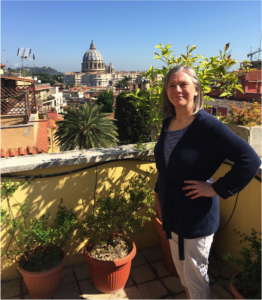
We planned a more or less unplanned visit and spent the first day exploring our neighborhood and finding a delightful neighborhood restaurant with the owners with a huge smile, great food and not a word of English! The next afternoon we braced ourselves for the crowds and visited at Peter’s Square and Basilica. We were told it is the largest Church in Christendom – and it was impressive. We also wondered through the crypt to see all the dead popes and one lonely female – a deposed Princess who had sought refuge in the Vatican in 17th century.

The rest of the week we leisurely did the main tourists sites of Rome. All were crowded with tourists, but still retained the grandeur of past ages and great art. We did our one and only hop-on hop-off bus tour – never sure is they are worth the 30 Euros each, but did get a good overview. In turn we visited the Vatican Museum, numerous churches, Spanish steps, Trevi Fountain, the Forum and Coliseum – with lots of time for relaxing in our apartment. We also really liked the winding streets, ambience, buskers and restaurants of the Travestere area (on the right bank of the Tiber.) Also took in a Saturday morning combination baroque concert/tour in the Art museum Palazzo Doria Pamphilj (30 Euros) which was really excellent. To our surprise we saw the original painting from Dutch painter Brugel of skaters on a canal – we have had a larger print of that picture hanging in our house for nearly 20 years, and didn’t really know where the original was. As compulsory, we also toured the ruins of the Roman Forum and coliseum. Both worth the visit but hordes of other tourists and a bit of a tragedy that so much of these temples and the Coliseum was recycled by later popes and the wealthy into Churches and palaces. Ironically the only temples that did survive renaissance-age savaging were the ones that had already been converted to Churches. Visiting the 2,000 year old Pantheon temple was a definite highlight, and one of the most impressive spherical works of architecture we have ever seen.

Conclusion: I’ll end with a few lessons and hints:

  1. April is likely a good month to visit Italy as we had only one day of rain, but I did wear my sweater at least part of every day. Susan admitted that she brought too many warm weather items. I can’t image the hordes of tourists when it gets busy in the summer, as there were more than I liked in the Spring.
  2. Getting a sim card with data for google maps, downloading tickets, contacting AirB&B hosts and other conveniences – is a must. We likely could have gotten by without our GPS by using Google Maps, but it was nice to have a backup.
  3. AirB&B is a great way to travel. The price of accommodations are similar to hotels (see below). The size of accommodations, kitchens, appliances and balconies are MUCH better and 3 of our 4 AirBnB’s could have slept 4 people. But you are charged a cleaning fee and making contact with host is more challenging than walking into a hotel- so they are best for stays of 3 or more nights. With AirBnBs book VERY early to get best selection and prices. Our experience booking that 4 star country hotel in Tuscony through Expedia at $66 Cdn was a real bonus but hard to repeat!.
  4. Total Costs. We ate out at least once every day at medium priced restaurants average maybe 40 Euros/meal with wine, paid around $120/night for accommodations, usually used public transportation, but did grab a taxi when really needed or desired, and didn’t skimp on museums – but also didn’t do things like 80 Euros for a half hour Gondola ride in Venice. A nice way to enjoy these once of a lifetime experiences is to delude yourself that a Euro is equivalent to $1 Canadian even though in 2017 it costs $1.50 Can for a Euro!
Airfare $2373 (Can.) Average/day
Accommodation
     AirBnB $2373 $131
   Hotel $212 $106
   Monastery $315 $105
Concerts, restaurants, tours, museum, transportation, etc. $3074 $128
Total (2 persons) $8357 $348 – $249 minus airfare

These totals compare quite favourably with costs of 3 week cruise, but one shouldn’t underestimate the time and worry of booking everything oneself – and then resolving the challenges when you get lost or show up for a train at the wrong time or the wrong station!


What the FOLC is new in this article?

Sorry, but I couldn’t resist spoofing, in the post title,  the unfortunate sound of the acronym for the “new” model proposed in this article. Now,  I’ve got it out of the way and can only suggest that if this “divergent fork of the Community of Inquiry model” is to survive, it needs a new English acronym.

This post is a critical review of  Democratizing digital learning: theorizing the fully online learning community model Todd J. B. Blayone, Roland van Oostveen, Wendy Barber, Maurice DiGiuseppe and Elizabeth Childs. International Journal of Educational Technology in Higher Education 2017 14:13
DOI: 10.1186/s41239-017-0051-4

First, let me get out the good things about this article stated. I love the fact that the authors published this in a peer reviewed,  Open Access journal (thanks to Roland van Oostveen for noting an error in my original post) . Second I love articles about the now venerable Community of Inquiry model because it is flattering to see this work live on, nicely adds to our citation rating indices and  because I share with Randy Garrison and Walter Archer an ongoing interest in constructivist models for online and blended education. And finally, as always conceptual arguments and calls for research are welcomed – especially if they follow with real research results!

First in a number of concerns with the paper. The basic claim is that the Fully Online Learning Community (FOLC) is a “divergent fork of the Community of Inquiry model”.  It seems the divergent claim is made on the basis that the revision is for FULLY online courses.  In fact no divergence is needed or called for as the original COI model was always based on fully online courses – blended courses – or at last the name hadn’t been invented in the 1990’s when we developed the COI model.  The authors may argue that the divergence stems from the integration of synchronous and asynchronous discussions. The original COI model was grounded in asynchronous threaded discussion, as the Internet did not support synchronous interaction in those days. However, Randy and I had been working since 1989 on synchronous delivery models based on group teleconferencing, (see  for example Anderson, T., & Garrison, D. R. (1995). Transactional issues in distance education: The impact of design in audio teleconferencing. American Journal of Distance Education, 9(2), 27-45.). We certainly thought the constructivist underpinnings of the COI could and would support synchronous communciations as well.

Second, is the claim that FOLC “responds to the limitations of distance learning and MOOCs (e.g., student isolation, low completion rates, etc.)”  and “the needs of transformative and emancipatory learning” and “responds to requests from some international partners for new models of learning aligned with democratic and socio-economic reforms. Both Randy and I had long argued and published about the need for distance education to use technologies to get beyond distance education, as perceived as one-way content dissemination to “education at a distance” based on social construction. Thus, the ‘new’ FOLC adds nothing new to our initial claims and desire to supplant individualistic models of correspondence models of distance education.  MOOCs and especially cMOOCs are much more than mere content dissemination as decried by these authors. Finally, the COI was and is a response to the need for new models of learning and the needs for emancipatory learning.  The only claim that is true is that the COI didn’t directly respond to the need for 21st Century learning competencies -mostly because these hadn’t been invented when we developed the COI model. Moreover, these newer ideas certainly fit within the original COI and its development and support by thousands of researchers in the past two decades.

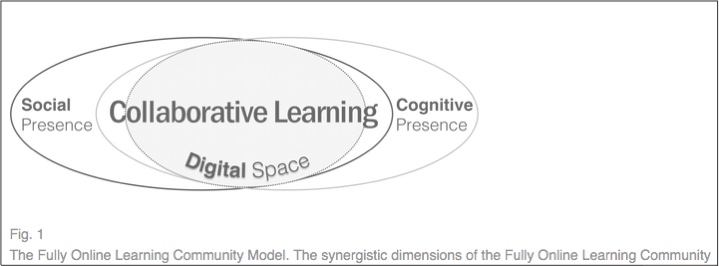
The authors present a “revised model” as below

I can’t see anything new here beyond the original three presence Venn diagram of the COI model.  Both note the collaborative learning environment, both have social and cognitive presence and teaching presence is assumed in the organization and management of the digital space as the FOLC model (like the COI) is based on formal, institutionalized education.

The paper then goes on to provide conceptual scaffolding for a number of tending educational related theories or ideas – digital space; democratized learning and collective identity and responsibility, community and authenticity.  I don’t have any problems with these conceptual arguments and they could each be used to update and strengthen the original COI model. I really don’t see anything new here except for the inclusion of references and arguments that have developed since the COI model was first introduced.

The article then goes onto to propose a research agenda which is little more than a wish list of things that could or should be researched. We criticized this type of rather adhoc model of research agenda development in our Stöter, J., Bullen, M., Zawacki-Richter, O., & von Prümmer, C. (2014).  From the back door into the mainstream: The characteristics of lifelong learners.  In O. Zawacki-Richter & T. Anderson (Eds.), Online distance education: Towards a research agenda (pp. 421-457). Athabasca: Athabasca University Press. But again, nothing wrong with this list of things to do, but nothing new either.  Finally, the authors invite others to join them in this research process – all good stuff but….

I don’t think there is enough new here to claim a “divergent fork” merely by strengthening the original argument.

Two Canadian Movies – Two Canadian Narratives

I’ve just finished watching two films about, paid for and watched – with interest, by many Canadians.

The first film, TransCanada Summer takes the viewer across the country in 1958. Throughout the trip the film celebrates the industrialization and progress resulting from the construction of the Trans Canada Highway – the longest highway in the world at that time. The second film critically looks at these roads – first the railroads then the highways, from the perspective of the First Canadians – the aboriginal natives. These Canadians were largely ignored as these same roads brought to them an invasive of settlers, profiteers and religious evangelists.

I grew up in Calgary Alberta, which was then and is now the most “American” of Canadian cities. It was settled in large part by American ranchers and farmers moving north and west for “open spaces” By either luck or design, oil was first discovered and commercially exploited in Turner Valley south of Calgary. Soon networks with American oil companies made Calgary the centre of one the major oil producing regions in North America.

Given this personal culture history, I was not much prepared for my first summer in University when I lived 450 miles north of Calgary in the Northern bush. I was a member of the Alberta Service Corp, doing a Peace Core-type immersion in Cree Country. The community of Loon Lake Alberta had, two years before my arrival, first connected to the “colonial roads” built by government and oil money. Thus, these Cree peoples were coming to terms with easy access –  both to and from their communities. Arriving were evangelical missionaries, mobile stores selling cheap trinkets and underwear and a host of new government officials in charge of everything from forests, to hospitals, to schools and to Indians. In the opposite direction, cars and taxi’s emerged from these formally isolated communities to allow a day or weekend shopping trip, booze run or an opportunity for the young people to explore beyond their traditional lands.
The first film, TransCanada Summer, by Ronald Dick (1958) is narrated by celebrated Canadian historian and broadcaster Pierre Burton. The film is a cross country road trip (with a few diversions) along the recently completed Trans Canada Highway. As in chronological stories, common in this type of North American film, the action starts in the east and proceeds West. The narrative commences with the hardy fishermen of Newfoundland building the first road across their province. It then travels across each province in turn, showing famous landmarks of mid 20 Century Canada – both natrual and human created. The narrative is decidedly pro “industrialization”. The word itself is used frequently to describe big and powerful buildings and machines with an occasional explosion as the highway is carved through mountains and over waterways. The narrator shows us giant smelters, industrial slag exiting blast furnaces and mighty shovels lifting and transporting.

I confess that I really enjoyed the 60 minute video.  Trans Canada Summer is the type of movie I would have enjoyed as a kid as my Jr High School teacher found a way to pass a Friday afternoon with bored students. Given that I was 8 years old when the film was made, I saw many of the scenes and especially the beautiful old cars I came to know (and own) as a teenager in Western Canada. The short hair cuts, long dresses and corny midway shows reminded me of the way life used to be. I also enjoyed identifying the famous landscapes – most of which I have had opportunity to visit in travels across the country.

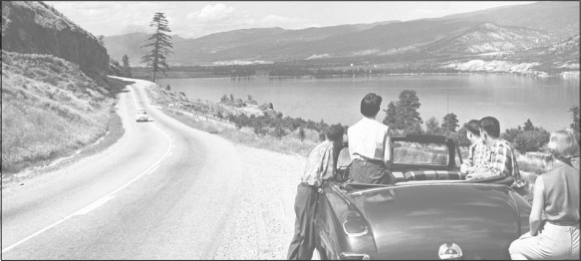
Screen Shoot from Transcanada Summer

What was most shocking in this movie was the complete absence of any mention or footage of Canada’s First Nations – they were invisible across Canada. There was one very short shot of the famous French voyager and explorer Pierre La Vérendrye with a native at his feet pointing the direction – but that was it. No commentary of the critical roles played by the First Nations in the very survival of the earliest French and English settlements.

Sign on the Railroad bridge in Garden River Ontario. Shot from Transcanada Highway

There was no mention of the pivotal role played by First Nations people in not only supplying product, but transporting the fur trade throughout Rupert’s Land – the name given to Canada by its first commercial owners the Hudson’s Bay Company from London England. It seems as if the First Nations population was totally invisible in 1958 Canada. And of course there was no visits to First Nations communities despite the fact that the TransCanada  passes through dozens of First Nations communities and reserves.

I recall that upon my return to university in Calgary, after my Service Corps summer, I was asked by a social worker if I would ‘befriend’ a First Nations student from the Blackfoot reserve near Calgary. It is almost unbelievable today, but he was one of only two registered Indian students in the whole University in 1970. So it perhaps no real surprise that First Nations were invisible, both to filmmakers and to the general population in the middle of the last century.
The second film, Colonization Road was shot in 2016 and tells quite a different story of the roads and railroads that “built” Canada. To set the context it is important to note that Canada as a government and as a people are struggling to come to terms with its colonial history and most especially the past and current role of First Nations peoples in this history. A national attempt at reinterpretation and re-engagement was triggered by the national Truth and Reconciliation Commission (TRC) which researched, produced documents and held public meeting across Canada from 2008 to 2015. The TRC was officially struck to examine and reconcile with the tens of thousands of First Nation’s children who were legally abducted from the care of their parents and forced to live in mostly Church-run residential schools. The Commission brought to the public eye horrific stories of sexual, physical and cultural abuse as the missionaries attempted to take the Indian out of their young charges. Native language, clothing, spirituality, songs and attitudes were ruthlessly supplanted by Christian and capitalist ideas of correct behavior. These schools left a legacy of parents bringing up kids today who had never been properly parented themselves with resulting chaos and generations of suffering. The Commission ended in 2015 with a list of recommendations – some for governments but many for individuals and communities to begin the process of reconciliation based upon an accurate understanding of the truth of these first Canadians.
The second contextual factor to set the current Canadian scene is the huge increase in First Nations populations from around 200,000 in 1960 to around 1,600,000 in 2016 . Thus, both increase of knowledge of our colonial past plus rapidly increasing populations are forcing Canadians to come to know, appreciate and work together with these first citizens of Canada.
In Colonization Road comedian and narrator Ryan McMahon visits some of communities across Ontario where they still have roads named Colonization Road. Governments of the day thought that if they pushed a road through the ‘empty wilderness’ then immigrant settlers would take the opportunity to buy cheap land, create villages and towns, build churches and schools and civilize the extensive Canadian bush. In total over 160,000 km of Colonization roads were built across mostly Northern Ontario land in the 1850’s. And it largely worked. Except they forgot one thing – the ‘empty’ land was already occupied by First Nations peoples living sometimes on smaller reserves but always using the land as traditional hunting grounds. Michelle St. John, director of Colonization Road writes “I think we’ve all been raised here in Canada with the settler narrative as one of triumph and a patriotic Canadian identity, but there is a flip-side to that story — and that story is ongoing.”

From the perspective of many of those interviewed the Colonization Roads were the conduit for not only white farmers, but for miners, loggers, gamblers and missionaries to enter and quickly usurp their land. This same strategy was used by later governments in Western Canada but then using the railroad to colonize and civilize Western Canada. Colonization Road visits communities that and more importantly tells the stories and reactions to First Nations citizens today and the stories from their parents about live both before and after colonization – and much of it is not pretty.
Both of these movies are worth watching – TransCanada Summer for a look at the natural beauty, the value of mid-century white Canadians and the narrative that both sets and reflects the noninvolvement of Canada’s First Nations in the economic development of the country then and continuing today. Colonization Road is both funny (thanks to First Nations comedian Ryan McMahon) and inspiring, as it gives voice to some of those people who experienced and suffered from the colonization of our great country.

The complete version of TransCanada Summer can be streamed
Here is the 2 minute trailer from Colonization Road.

Colonization Road Trailer from Frog Girl Films on Vimeo.


Is Google Scholar a Filter Bubble?

A major  goal of net-based  mass media is to customize the feed that is delivered to each viewer received a unique screen that matches their interest and more importantly their likelihood of purchasing some product or viewing some paid for message.  This phenomenon was labeled as “filter bubble” by author Eli Pariser – meaning that certain results are filtered out creating a bubble of unawareness that surrounds each of us.

I remember my first vivid encounter with these covert filters when I was building a web site some years ago for the Westwood Unitarian Congregation. I was flattered when I noticed that a Google Search started turning my site up not only on the first page of search returns but increasingly in first or second place. I naively imagined that our site was becoming the most popular Unitarian destination in Canada.  Sadly,  I came to realize that this top end response  was only being enjoyed by myself. Google searches filters had determined that I really liked that site (based on my subsequent keystrokes) and thus presented a filtered result of searches for Canada and Unitarian.  Obviously the search engine had established a personal profile for me and was feeding me what it thought would be of most interest to me.

More recently, the use of filters by Facebook to provide customized news feeds to individual users has raised both technical and ethical issues. The diagram below by TechCrunch demonstrates a small part of the filter system used by Facebook and other media outlets.

Facebook Filter bubbles

One can argue the value of these filters (how many ads for women’s perfume do I really need or want to see?) but they come a cost of reducing the variability that exists throughout societies and may leave us blind to ideas or events that we may  have both interest and expertise.

This is no more critical a problem than in academic research.  When doing any quality work and especially that associated with PhD study, the candidate as an obligation to purview all of the relevant literature.  Long gone are the days when this could be accomplished by a few afternoons in the periodical section of the library. Today this means searching through the academic databases – extracting and reading everything relevant to the topic.  This can be done using proprietary search indexes such as Social Science Citation Index (SSCI) or rival product Scopius, however I have long argued that these indexes discriminate against both new Journals in the discipline and especially those that are Open Access.

Google Scholar is my first choice for such searches for a number of reasons. First it providing broader coverage than its competitors that includes documents from the grey literature (conference papers, reports, white papers etc.). Second it indexes far more journals in the educational discipline than either Scopius or SSCI. Third, empirical tests have shown that the results are not significantly different when using any of these indexes (see Harzing, A.-W. K., & Van der Wal, R. (2008). Google Scholar as a new source for citation analysis. Ethics in science and environmental politics, 8(1), 61-73.)  Finally, and critically importance for scholars in developing countries and those non affiliated with a relatively rich university, is that access to Google Scholar search is free of charge (unlike SSCI).

So tying these two threads together (choice of search engine and covert filtering), leads to an obvious and important question. Does Google Scholar filter results?  Or can one expect different search results to arise when different scholars with different experiences, interests and use profiles?

I was pleased to hear that has question has been addressed and the results did not displease me (ie they made it past my filtering to be presented to you, in this blog!!). The study:

Yu, K., Mustapha, N., & Oozeer, N. (2016). Google Scholar’s Filter Bubble: An Inflated Actuality? Research 2.0 and the Impact of Digital Technologies on Scholarly Inquiry, 211.

compared Google Scholar research results using variety of default and advanced settings  (see abstarct below) and it concluded “that the filter bubble phenomenon does not warrant concern.” Unfortunately the chapter and the book are not open access however the main points can be seen from the Google Book abstract or the publishers preview.

Thus, my faith in and appreciation for the service provided by Google Scholar has increased.


ABSTRACT:

This chapter investigates the allegation that popular online search engine Google applies algorithms to personalise search results therefore yielding different results for the exact same search terms. It specifically examines whether the same alleged filter bubble applies to Google’s academic product: Google Scholar. It reports the results from an exploratory experiment of nine keywords carried out for this purpose, varying variables such as disciplines (Natural Science, Social Science and Humanities), geographic locations (north/south), and levels (senior/junior researchers). It also reports a short survey on academic search behaviour. The finding suggests that while Google Scholar, together with Google, has emerged as THE dominant search engine among the participants of this study, the alleged filter bubble is only mildly observable. The Jaccard similarity of search results for all nine keywords is strikingly high, with only one keyword that exhibits a localized bubble at 95% level. This chapter therefore concludes that the filter bubble phenomenon does not warrant concern.


Quality in Online Learning Presentation

I was asked to do a video conferencing talk to a meeting of three Mexican Universities yesterday. They are attempting to come up with a common set of criteria to define and measure the quality of their online courses.

QualityPerhaps I was not the best person to ask, as I have very mixed feelings about quality control systems dealing with emerging  technologies and pedagogies.  In particular, I hate it when quality standards impeded innovation and opportunity for experimentation. I hope I got across the complexity- if not a solution!   I illustrated the challenges of defining quality by presenting the different quality measures associated with each of the Three Generations of Distance Education pedagogy from a 2011 article by Jon Dron and myself.
I did however end with a plug for one of the most respected non-profit quality consortia Quality Matters, but I fear I didn’t clearly answer my own title question – Quality Online Teaching and Learning – Is it really different than campus-based education?  It Depends! – not least of which depends on the pedgaogy employed

Here are the slides I used:

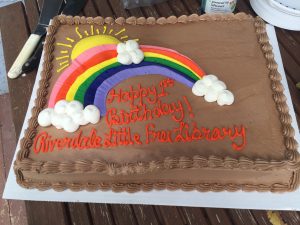
1st Birthday – Riverdale’s Little Free Library

IMG_4262My Little Free Library celebrated its birthday with a party for its patrons on Saturday. Unfortunately, the weather wasn’t terrific, but the rain held off long enough for cake, music and wine!
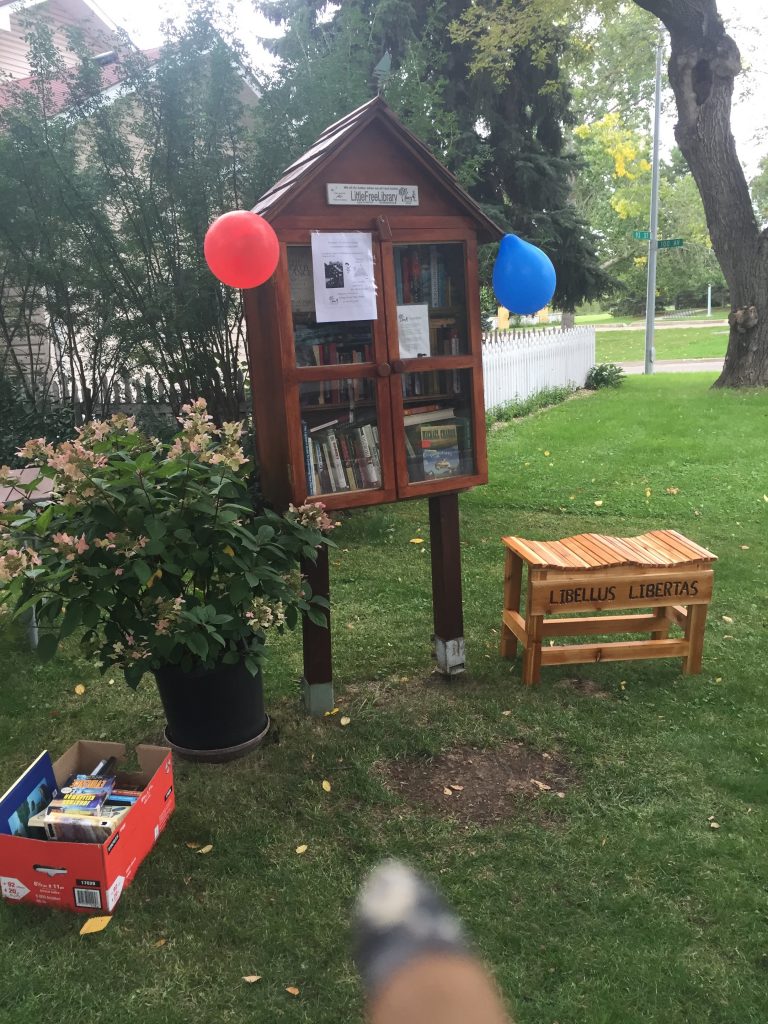
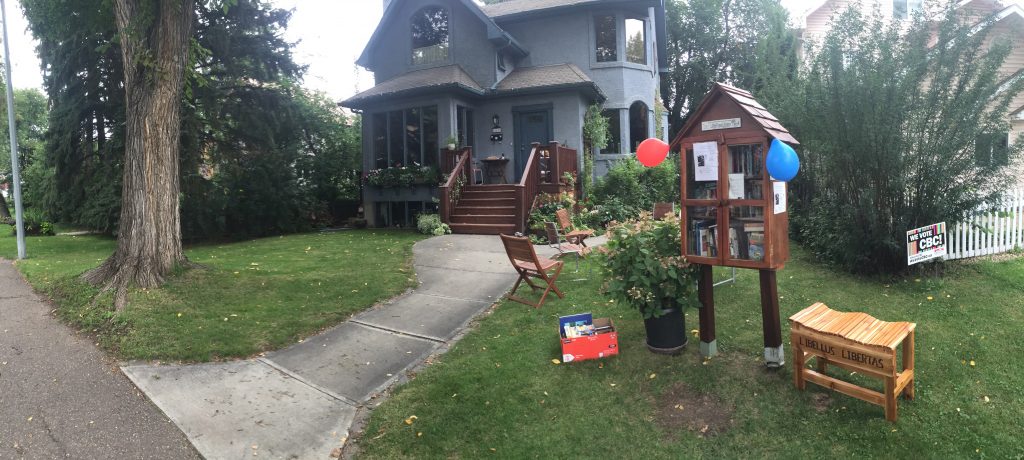
IMG_4271

The only challenge is that the party goers each bought books and the Library is already FULL!  I had to open Riverdale Little Free Library Annex #1 – a cardboard box (see photo above). I am confident though that we will be getting a run on reading as the proverbial winter chill sets into Alberta.

I built a new reading bench and carved “Libellus Libertas” which I think and hope is Latin for Books Free – as in ‘take a free book’ or ‘books are freedom’

IMG_4275

Reflecting on the 1st year I can make a few observations:

  1. Physical maintenance on the building has been minimal. I spruced up the exterior (for the party) with a quick coat of varnish, I had left over from another project. I’ve had to replace one of the door knobs and that’s about it.
  2.  The upstairs, library studio flat had no bird tenants although it was guarded by a fat sparrow for a week or so this spring.
  3. The Head Librarian has become a promiscuous reader, as he has started way more books than he finishes and is currently reading 6 books.
  4. The collection size has remained quite steady (current glut not withstanding). I’ve culled about 20 books that weren’t moving, but most seem to disappear in about 2-4 weeks.
  5. I’ve met many more neighbours and been thanked for the library by many.

So all in all a great 1st year. This winter, I plan to build at least one more library.

Downe’s great summary article, but…….

The good news is that Stephen Downes has posted the  full text from a chapter he wrote for New Models of Open and Distance Learning in Open Education: from OERs to MOOCs, Editors: Mohamed Jemni, Kinshuk, Mohamed Koutheair Khribi,  2016.

This is good news for two reasons – the first is that the full Springer book retails for $139 – but you can get it as an ebook for ONLY $109!!. This means the text is basically unavailable to the vast number of practitioners and scholars who would likely find it of great use.   The second reason is that it is a really good historical summary – describing the dance of education and technology as they have evolved with each other over the past half a century.
The bad news is that the very first sentence of the chapter (and first of the whole book!) is blatantly false.  Stephen writes “Historically most learning that has ever taken place has taken   place in a classroom with a teacher giving instruction and students reading books and writing on paper.”

Surely Stephen is not arguing that he “learned” to program the Painted Porch Mud in the 1980’s; devised Connectivism, or co-invented MOOCs by sitting in a “classroom with a teacher giving instructions”! In fact only a very tiny fraction of the “learning” that has ever taken place historically and of course 100% pre-historically, has occurred in a classroom. Only beginning in  the 19th Century have a few children of rich minorities been able to learn part of what they learned in life in a classroom. For the vast majority there were no classrooms for them to attend.   Even more so today, learning takes place from Google and Wikipedia searchers, from mass media, from social connection and the innumerable historical and pre-historic ways of learning – observation, apprenticeship, story-telling, guided practice and many more ways of learning.

Obviously Stephen’s mistake is to conflate learning with formal education. It is common enough because it is in the interests of teachers, educators and professors to promote their work context and their own self-interest by elevating education to encompass all forms of learning- but it does not. That is why it is especially strange to find this slip from Stephen Downes who has build a career and inspired many, based upon his championing of learning – and not only that subset that happens in classrooms. It is especially ironical that within the essay Stephen covers formal and non formal learning and argues that both have benefited from the wealth of online resources and communities.

Having gotten this irritation out of my system, let me strongly recommend this chapter. It helps if you mentally do a cut and paste and switch ‘education’ for ‘learning’. Perhaps Stephen will do it for us.

As with all of Stephen’s writing you get very clear, precise and knowledgeable argument, illustration and rationale.  And similarity with all his writing as you always get a good dose of “Downism” – where Stephen injects his personal insights, experiences, opinions and convictions.  The sections on PLE’s and PLN’s are especially good as is Stephen’s overview of connectivism. Strangely, this overview chapter ends without a summary or conclusion, but PERHAPS you have to cough up the $139 for that. So as not to make the same mistake with this post, let me again recommend this article for anyone trying to figure how both ‘learning’ and ‘education’ have evolved to both exploit and create technologies and pedagogies to make the most of our networked world.


Front Lawn Fun-Raiser concert

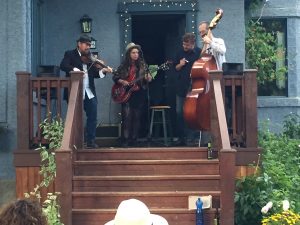
Susan and I were really pleased to host a fine evening of music last evening here in Riverdale. Our neighbour Cam Neufeld is touring this summer with IMG_3983Jez Hellard & The Djukella Orchestra (Jez and bassist Nye Parsons). Jez and Nye are from the UK and royally entertained us with  a rich collection of origional and traditional  tunes.IMG_3998
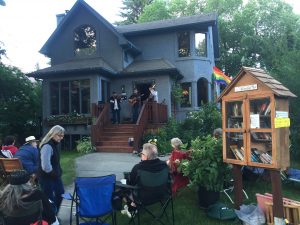


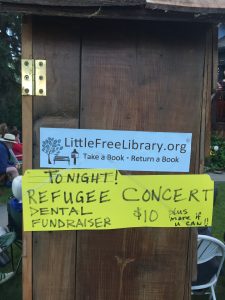
The concert was a fund-raiser in support of the two Syrian families that have been sponsored here in Riverdale. So always good to be able to support a good cause, while having a great time and listening to some fine music. As you can see the Little Library did double duty as a welcome sign.IMG_3994


Order of Athabasca University

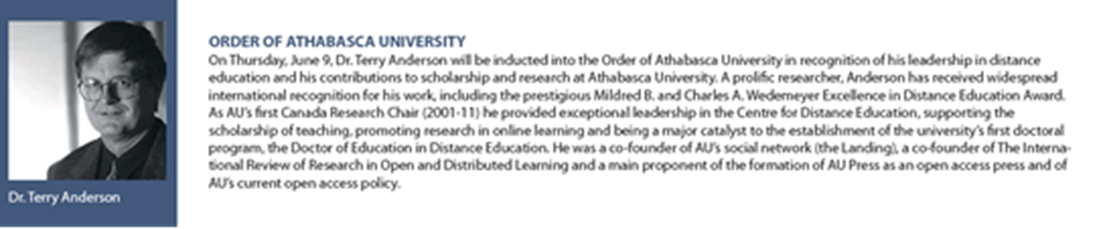
Yesterday at Convocation in Athabasca, I was deeply honoured by my former colleagues at Athabasca by being installed into the Order of Athabasca University. Most other members have been individuals from the community who have made exceptional contributions to the University. I was the first Faculty member (other than Dominique Abrioux, who also served as President) to be so honoured.  The hupalo started with the blurb below published in the Edmonton and Calgary daily newspapers.image003

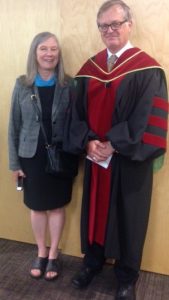
It continued at Convocation where Rory McGreal made a terrific and over flattering introductionIMG_0928 to me at the beginning of the  ceremonies. Rory’s introduction contained comments from Mark Brown, Alan Tait, Morten Paulsen and Wayne Macintosh – thanks to each of you.  The life stream of the whole convocation ceremony is streamed at goo.gl/ZziwsG . Rory and my part begins around Minute 53

The celebrations ended  with a banquet. All very moving, and I am trying hard to not leave with a swollen head! But thanks to all who have helped make my time at Athabasca very personally rewarding and recognized!!

It was also flattering to have AUPress over 40% discount on three of my authored, edited or co-authored books.IMG_3962


I was asked to do a 3 minute speech which I addressed to the graduates and to the wider Athabasca Community. Here is the text;

Madame Chair;  Mr. President;  Distinguished guests;  Members of the Platform party;  GraduandsLadies and gentlemen:

Thanks to each of you!

I think I am the first faculty member (who wasn’t also a president) to win this award, and so I feel very deeply honored for your recognition—of not just my contributions—but of our work, together, here at Athabasca University.

Today is a day primarily for the graduates—and thus, I would like to use this time on the stage to congratulate each of them—and their family members and friends networks that you created —who have helped to get them here today.

All of my research has been focused on the distance learning experience. One of the most common questions is:

“Is distance education as good as campus-based education?”

Well … my colleagues and I have been asking this question for more than 30 years! And in roughly 90 per cent of studies, the results have shown that there is NO significant difference in learning outcomes.

And even when there is a difference it is likely to be in favour of distance learners. However, there is certainly more to being educated than just simply ‘learning outcomes.”

What distance education students build—and usually in larger doses than campus students—is self-efficacy. The belief in yourself and the knowledge that you can succeed in the tasks you set for yourself.

Distance learning builds knowledge and belief in yourself and an empowered understanding that you can achieve your goals.

You didn’t earn a distance education degree without being—or getting—good at creating and meeting deadlines and producing quality output—usually without the help of peers or classmates.

And so, today I celebrate your earned increase in self-efficacy!

But, to be sure, this graduation milestone does not mark the end of your learning. Technological and social change continues to happen—and more rapidly than in it changed in the past.

Luckily, I know this for sure: Because of your experience with AU, you are armed with the confidence and the knowledge that you can learn—and learn successfully.

You have self-efficacy. You can succeed—and you will succeed—as life-long learners.

Finally, I want to speak to my colleagues and friends in our broader Athabasca University community:

Bear with me as I don my sailor’s cap,—one of the pleasures of retirement! —obviously, as an institution, we’re continuing to sail through some rough waters. We are facing weather winds and that are very hard to predict. However,  “the glass is rising”. Certainly there is value and risk in every decision we make.

But I want to continue to urge us to use the ever-increasing power of networks—and importantly, our own networking skills—to work together to build a new kind of university: A university that is not like the Athabasca University of 1970, nor that of 2016, for that matter.

But one that marries academic knowledge, collegial support and governance with cost-effective ways to study and teach. Alone, and together, we need to support and create better and more effective personal, academic, administrative and community networks.

These networks have demonstrated they produce the power to be critical components of the new ‘net-era’ university—and thus, they are a challenge for each of us to navigate—but a necessary one.

Oh, have I mentioned the Athabasca Landing yet?

Thank you very much!