Subscribe to the Virtual Canuck

Hi Friend

I hope you are interested in subscribing to the Virtual Canuck. As you can see by browsing the site, I publish on a number of topics – Distance education, travel and personal stories. I publish less than once a month. I don’t sell or market anything. I just do this blog for fun and for my own records.

If you subscribe below, you will get an email each time something is published.

I don’t sell or share email addresses to anyone. I welcome your feedback.

Terry


A Rant on Underuse of Nuclear Power Generation

The real cost of solar and wind energy

December 2025

Let me begin this post by emphasizing that I am a BIG supporter of renewable energy – wind, solar and hydro. I think it is critically important for human and ecosystem survival to reduce (and certainly not increase) the amount of CO2 we dump into the atmosphere.

However, many fellow environmentalists underestimate the cost of solar and wind and refuse to look at viable zero carbon solutions due to ideological blinders.

The headlines often proclaim that the cost of electricity per kilo watt hour (KWH) is now cheaper for solar than for almost any other means to produce grid quantities of energy. However, this initial low-cost installation masks real and increasing costs.  These costs are related to the familiar restraint that ‘sometimes the wind doesn’t blow and the sun doesn’t shine’. Other times the wind blows stronger, and the sun shines longer than our capacity to effectively put this energy to use. When this happens those managing the grid are forced  to shut down portions of the alternate energy production. In a sense wasting the energy and at best not producing the electricity that the technologies could be producing. This is referred to as ‘energy curtailment’ – when alternate energy production is intentionally reduced so as not to overload the grid.

Estimates of the global amount of curtailment vary and are increasing annually. Globally curtailments are estimated at about 3% (Novan & Wang, 2024) of total alternate energy production. However, there are huge regional and national variations and further, the amount of curtailment has been increasing as more energy from wind and especially solar comes on line. See figure 1
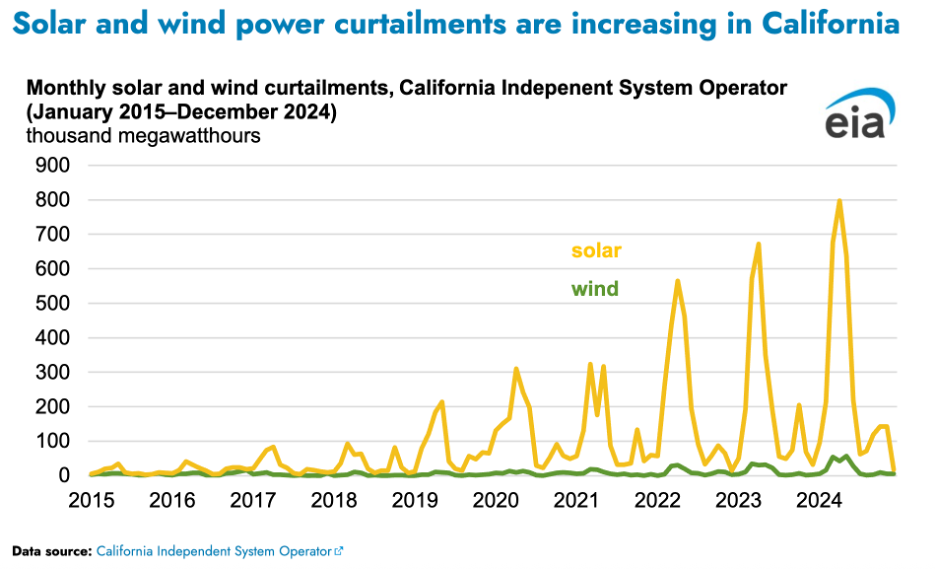
Thus reliable, 24 hour a day backup power must be built to match with large wind and solar generation. The use fossil-fuel producers to serve as backup is very expensive. No one wants to build a methane or coal fueled plant that only operates for a portion of the day. Almost all power coal, petroleum and nuclear power plants only become efficient when producing at near capacity levels, 24 hours a day.

So how do we integrate and even expand wind and solar energy without having to waste increasing amount of energy? An obvious answer is to increase the size (think national or contentment or intercontinental scale) grids such that wind or sun in one region can be matched with cloudy conditions, doldrums or nighttime in other areas. But this can be very expensive, and transportation of electricity is not without cost. A second option is to build very large batteries that can store this excess energy until it is needed. But we know from the costs (money and environmental) of creating batteries for electric cars and trucks that battery construction is not inexpensive and not without environmental cost. Further, the scale needed for grid batteries is much larger, than for vehicles. A third and viable solution in some regions is hydro storage. Pumping water uphill to storage lakes and then using the downflow to power generators when more power is needed.  Unfortunately, not every geography has large wind and solar capacity located close to hills or mountains where this water can be stored.

If one were to talk to the Alberta Premier or members of her government, the perfect solution is to burn more of Alberts’s ‘clean’ natural gas – which I prefer to call methane. These proponents seem to think that burning methane (or other petroleum products), coupled with the environmental cost and energy expenditures to bring these to market, though much cleaner than coal, is harmless. However, the major contributor to rising CO2 levels in Canada is oil and methane mining, production and distribution.

Is there an Alternative?

So where does that leave us? Maybe tidal power in very specific locations or the elephant in the room – nuclear power generation.

We all fear major blowout or explosions and release of harmful radiation from nuclear power plants. There has been three major and very well publicized nuclear accidents in 50 plus years of nuclear power generation. Chernobyl (1986) with 79 confirmed deaths, 3,000 est. from long term radiation deaths, Three Mile Island (1979) – 0 deaths; Fukishimo (2011) 1 confirmed, 2,300 deaths from stress and evacuation.  These numbers are tiny compared to the 120,000 deaths annually in the USA alone  (National Institute of Health, 2023) from air pollution caused by coal energy production. Yes, nuclear waste must be disposed of and uranium mines need to be cleaned up when they cease production, but again compared to coal or oil, these are minor challenges.

So why don’t we use nuclear technology more?  Ignoring the conspiracy theories (perhaps true) that big oil and petro states do NOT want to see the end of petroleum burning, There are more than a few challenges that must be overcome before widescale use.

The most frequently sited reason is that the construction of nuclear power stations is expensive and take a long time – or at least they used to. In North America, only 1 commercial nuclear plant has been commissioned in the 25 years of this century, thus the data we use to calculate costs and time required, is based on 20th century technology and construction techniques.  These two Plant Vogle reactors came online in 2023-24, years late and 3 times over budget for a cost of about $15,000 US per KWH. By comparison equally large South Korean and Chines reactors are coming online for between $1,800-$2,300 per KWH.  The Koreans have also built commercial scale reactors in less than 3 years. (data from ChatGPT)

The hype machine has, in the past few years, been championing the potential of new types of nuclear reactor SMRs (Small Modular Reactors).  These systems promise all sorts of potential benefit – factory manufacture using standardized components, recycling of spent fuel, passive safety systems that guarantee shut down in case of any environmental or man-made emergency and low-cost transportation by truck, rail or ship. These SMRs are also designed and sized for all sorts of commercial, mining, residential and military applications.

These “potential” reactors, especially those with radically different designs, from the pressurized water-cooled designs in use today,  have been criticized because so few (only one so far in China) have been constructed and are in operation today. Of course, USA, UK and Russia have been building small reactors for decades to power war ships and submarines. But commercial power production cannot rely on zillion dollar defense budgets.

Rather than innovate, governments and industry has focused for the past 4 decades on building safer (backups, for the backups, for the backups) older designs rather than innovating and building new reactors using new technologies.  This is changing.  But resistance is still strong.

Looking specifically at the Alberta context, where I live, we are home to the Alberta oil sands, third largest proven oil reserves in the world and the largest single producer of CO2 emissions in Canada. The high cost of extraction and processing, coupled with the added CO2 produced when the product is burned in homes and highways, means Alberta has a HUGE carbon footprint. Trial ballons for nuclear power in Northern Alberta have been raised twice but opposition from the petro industry, environmentalists and at best tepid support from government has, to date, stalled any real planning much less construction.

The Environmental Movement is Changing Course on Nuclear (slowly).

After shutting down all the nuclear plants in Germany, the government was forced to reactivate a number of coal mines due to the Russian oil and methane curtailment. The Germans as well as most EU countries are rethinking their energy production strategies. The Green party in Finland has adopted a pro-nuclear power policy but most other green parties in Europe remain opposed. Green Peace remains opposed as does the Canadian Coalition  for Nuclear Responsibility. However the Canadians for Nuclear Energy are strong nuclear power advocates and especially of the Canadian designed and built CANDU reactors.

Summary

Nuclear power isn’t perfect – no energy source is pollution free. However, some (wind, solar, hydro and nuclear) power generation systems do not directly produce C02 minimal other harmful emissions. Thus, if we are to continue building a society that enjoys (and is dependent) on power generation for  sustainability and convenience – we must continue to deploy carbon free production systems – including nuclear. Wind and solar need reliable backup.

References:

Novan, K., & Wang, Y. (2024). Estimates of the marginal curtailment rates for solar and wind generation. Journal of Environmental Economics and Management, 124, 102930. https://doi.org/10.1016/j.jeem.2024.102930
A Most Memorable Trip to Lisbon

Six weeks ago I received a very surprising email from Prof. Carla Padel de Oliviera the Rector of Universidade Aberta (Portugal Open University).  She invited Susan and me  to come to Lisbon where I was to be awarded a Doctorat Honoris Causa

Of course, the first thing I had to do was to ask Google what this degree was all about. I found it is the equivalent of the Honourary Doctorate awarded at most Canadian Universities.  In Google’s words ”The Doctorat honoris causa (D.hc) is an award conferred by a University to individuals who have made outstanding achievements in fields like academics, culture, or humanitarian efforts, or have made significant contributions to the state, nation, or world.”

Once I recovered from the shock I recalled my 4 or 5 visits, over the years, to Universidade Aberta and the colleagues and friends I have met as a member of an International Advisory Committee for LE@D – the University’s  Distance Education and eLearning Laboratory.  I also played a very minor roles in a couple of EU research projects led by the University.

To be honest, like many academics, I had held a very secret ambition or maybe just a faint hope, that I would someday be awarded such an honour. It is perhaps the nicest way to finish any academic career. However,  I never shared this aspiration with anyone and never stayed awake at night plotting to get such an award.  One does not fill out an application for such a degree. But when and if and when it happens – well, what can you say but “muito abrigada.” (MANY thanks in Portugese)

This all happened a few weeks just before Susan and I left for a three-week holiday and conference of the World Conference of the International Council for Distance Education in New Zealand. This was a great holiday but five days after we arrived home, we were due to leave for Portugal. A first order of business was to get my suit dry cleaned, shoes polished and to develop a Graduate Research seminar for the Masters and Doctoral students in e-learning research at the University. I understood that I didn’t have to do much in the actual award ceremony. However, after I arrived, I found that a response to the award was expected – but no more than 25 minutes!  I am a professor, so I can usually profess about almost anything without too much trouble for less than 25 minutes. Beyond that, I didn’t know what to expect – but I thought I could at least tell a few stories and say a heart-felt thanks.

The Trip and Lisbon

The trip with Air Canada was thankfully unremarkable except that the passport machines at the airport in Lisbon refused to accept my passport.  The same thing happened on the way home, necessitating long lines to talk to a human Customs Agents. Perhaps  my passport is getting as tired of International travel as I am, though the passport gets to be reborn in 2027!

We arrived, on time, after eleven hours in the air, on a sunny Sunday morning in Lisbon.  I managed to prebook an Uber ride to the hotel, which turned out be remarkably easy and the driver was very friendly.  Sadly, I didn’t get the message that the University had a driver waiting to pick us up. I’m not used that type of service.

Casa de Sao Mamede

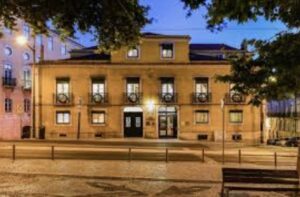
Our hotel was located in an 18th century mansion – the Casa de Sao Mamede on Rue de Escola Politicnia – not far from the University of Lisbon and next door to the Palace that houses the executive offices of Universidade Aberta.  Our room had 12 foot ceilings, 14 inch stone walls and a number of small ‘reading rooms”. The only thing missing was an elevator, but the staircase was broad and richly carpeted. We have stayed in too many ‘modern hotels’ – so this one was a real treat.

Lisbon Christmas market

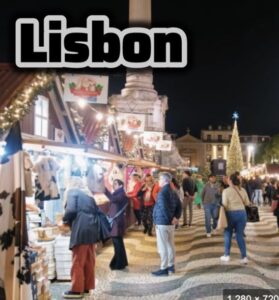
After a brief nap, we headed to the old town and a visit of a European Christmas Market. Of course, we had some hot mulled wine and managed to NOT buy any more Christmas ornaments,  nor pay for a photo with Santa’s elves. We noticed and appreciated the 30 deg. C. increase in temperature from Edmonton – though Lisboners were complaining of the cold!

After unpacking, we realized that we had forgotten to pack my suit jacket, so the first item of business on Monday was to find a men’s clothing store and buy a new suit jacket. I have been trying to de-clutter my closet of sports coats (without a great deal of success) since I retired. Luckily, I managed to resist purchasing the 1,000 Euro jacket and escaped – down only 100 Euros. The closet now has a new sibling.

We ended the afternoon at the Lisbon Botanical Gardens.

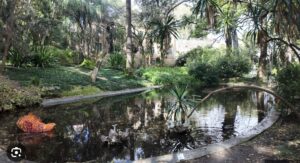
Lisbon Botanical Gardens

It was the most ‘well labeled” botanical garden that we had ever visited and featured Europe’s largest collection of palm trees – over 70 species ranging from 5 foot bushes to 25 meter giants. That night we dined with our major host and the director of the LE@D centre, António Teixeira and his wife Maria do Carmo at a traditional Portuguese restaurant. I’ve learned to like eating squid!


The Award Ceremony

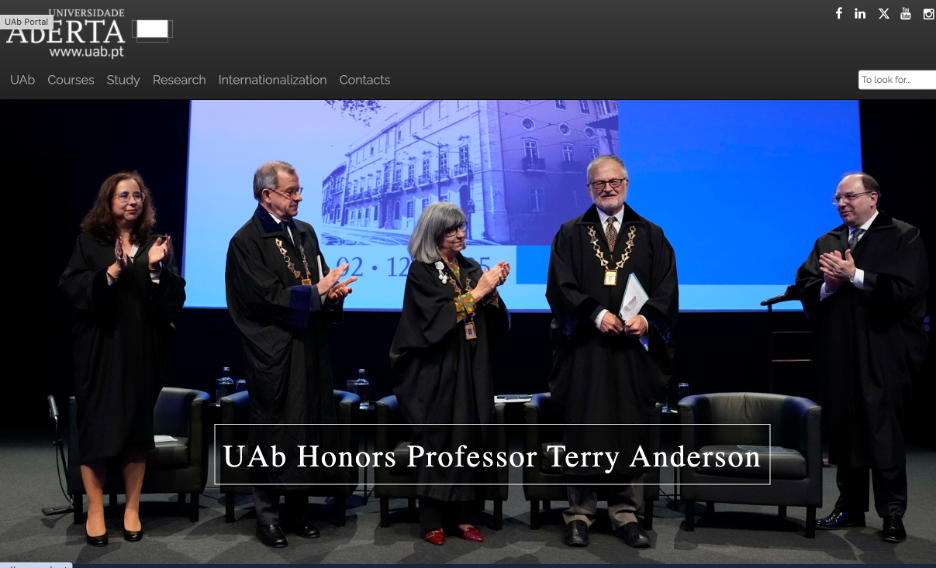
Tuesday was the big ceremony. We slept in and after a walk Susan helped me practice my speech. The Award Ceremony was held on Universidade Aberta Day- an annual celebration of the University’s founding – this year their 37th. As typically, the hundred or so gowned academics all lined up to proceed into the Hall – only here they file in not by faculty, but in order of rank at the University. The procession was led by the Rector and myself, followed by other members of the platform party. A great 8 piece choir welcomed us in.

Unlike most Canadian convocation award ceremonies, there were no students receiving graduation certificates. The Rector first gave a speech (thankfully with a paper English translation copy for me). This was followed with achievement awards to two Masters degree graduates and two PhD graduates and certificates were awarded to retiring staff members. Finally, the Portuguese Secretary of State for Higher Education brought greetings and congratulations to the University on its anniversary from the government.

The second half began with the singing of the University Anthem, in harmony, by the choir. My friend Antonio Teixeira then introduced me (in Portuguese), so I am not sure what he said, but no doubt it was somewhat over-exaggerated. Next, a faculty member from Porto, Isabel Huet e Silva, whom I had not met gave an equally long overview of my career and contributions to distance education and e-learning. She told me that she had spent a few hours going through my 35-page CV. When they had asked me for a copy of this CV, I didn’t think they really needed, or wanted, the “the full meal deal” – so I sent a two-page AI generated summary. But she wanted the whole thing.

Then it was my turn.

The Rector and her assistant “gowned me” and presented me with graduate certificate and a chain (representing the Doctor degree) to hang around my neck – then the  podium was mine.

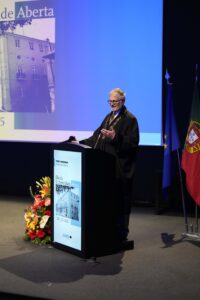
 I confess to being a wee bit teary-eyed, but managed  to get though the speech. I was a bit overwhelmed with the long, standing ovation and clapping from the 200 or so attendees that concluded the event.  The ceremony ended with another choir selection and we marched out.

Luckily,  outside the hall, I was handed a glass of port and survived the reception line – with many congratulatory comments and photos.

Screenshot

The day ended with drinks and a dinner hosted by the Rector with a number of the Vice Rectors, the platform party, and of course Susan and I.

What a day!  I learned that the University had only awarded 8 of these degrees in its 35-year history. I joined Canadians Sir John Daniel and my friend Tony Bates with this honour, but I note that I am the first recipient of this award, from Universiade Aberta, who was not born in Europe.

Graduate Seminar

The next day, I gave a graduate student seminar. It was entitled “Encontro com o Professor Terry Anderson – Projecting the Futures of Research in Open, Distance and Digital Education.” Of course I talked too much, however, the 80 or so attendees  (70 via zoom, including a couple of long-time Portuguese friends from elsewhere in the world) seemed to enjoy the talk. It was based partially on slides I had created with help from my friend Rory McGreal and AI). The talk focused on the impact of Generative Artificial Intelligence (AI) on educational research production and publication. I have posted the slides on Slideshare. There were lots of good questions.

One of the problems with getting old and now talking about AI in education, is that many of these students have read my earlier articles and books. And now, they want to know what impact AI will have on those ideas.  Great questions, but ones I haven’t really thought about – I suppose (and hope) leaving them lots of papers to write!

Finally, Lina Margado, a former Director of the LE@D centre who had first invited me to the University years ago, gave me a photo album, documenting my visits to the University over the years. – An invaluable memory gift!

Conclusion

On the way home, I was reminded of a  graffiti message that I had read 38 years ago when I was working on my Master’s degree at the University of Oregon. It was inscribed on the grout (with other grouty quotes), between the tiles in a stall in the men’s bathroom in a pub near the university. It read:

“Some men strive for groutness, others have it thrust upon them”.  

 I hope I will always remain humble enough to count myself in the later group.

PS.  The University invited a number of diplomats to this event (Lisbon is the capital of Portugal). The Canadian ambassador didn’t show, but Susan was seated beside the Turkish Ambassador. At the end of the ceremony he turned to her and said ‘I assume you are Terry’s wife?”  “We have a saying in my country: ‘Behind every strong man, there is a strong woman’. This is true in Canada as well as Turkey and I am a very lucky guy!


Susan and I make it to Our 44th Anniversary

I’m really pleased to be celebrating 44 years of marriage with Susan my lover and long suffering partner.  We’ve seen a few rocky moments, but always came back to the realization that we needed and wanted each other. And for that I am very grateful.

I was too much of a hippy to were a suit (much less a tux) in those days. The weather was cold (I wish I could say unseasonably) but now that we are back in Edmonton the low forecast for this Sunday is -29C, I guess it was normal – but bloody cold!

We went out with our friends Kathleen and Rory McGreal  – a good time was had by all!


This “January in Jasper”

A trip to Jasper – After the Fire

Every year in January, Susan and I  take a short trip to celebrate our wedding anniversary- this year our 43rd!  As often or not, we head for the Rocky Mountains and the nearest mountain town of Jasper. Alberta.

This year, we expected an unappreciated change in this “mountain jewel”.  In August, a huge wildfire had swept through the Athabasca Valley, reaching and engulfing the area around the town. Sadly, the fire didn’t stop at the town’s edge and when it was finally extinguished about 30% of the town was reduced to  smoldering ruins.

We couldn’t help but be disaster tourists as we  slowly drove through the hardest hit western part of town.  First we saw the ruins of the historic Anglican Church.

The building reminded me of  the remains of European Church that time alone had reduced to stone corner and foundation. The churches walls, floor and arched ceiling trucked to the landfill and only these stones and a a pile of twisted metal from heating and fixtures remained

The adjacent suburb was mostly flattened ground with piles of rubble and two large excavators loading these piles into trucks. Remarkedly, the devastated area was marked by individual houses and one whole street that seemed untouched. Vehicles outside these surviving houses showing residents had returned – perhaps with a sense of survivor guilt.  We later heard that firefighters had bulldozed certain houses (some already alit) to create fire breaks that allowed neighbors homes to be spared.

All that was left of the Esso service station and convenience store was the Esso sign and two iron ceiling beams.  The Maligne Lodge and our favorite coffee shop now sadly a bulldozed, scarred empty lot.

Downtown Jasper, as expected of a major tourist destination, is full of restaurants, mountaineering stores, souvenirs and gift. stores  and historic hotels. Sprinkled in of course are municipal buildings, banks, library and other services for a town of  5,000 residents.

The commercial buildings seemed intact and open for business, with two exceptions, In the middle of both main streets were blocks of 4-5 two story buildings that were now either empty or covered with scaffolding.  This scaffolding was the only evidence we could see of active rebuilding in the whole town.  It seems that, as in the suburbs, flying embers had set alight one of more buildings in the downtown core and firefighters had destroyed these to prevent spreading the wildfire spreading.

We then headed to the most famous hotel in Jasper, the luxurious Jasper Park Lodge. This hotel had been built to accommodate  well healed visitors travelling on the newly constructed CN cross Canada Railroad. Unlike many of the other luxury railway hotels, the Jasper Park Lodge was not constructed like a medieval castle, but rather consists of a main lodges and 30-40 smaller cabins – that vary in size and cost from hotel studios to multi room log cabins.

We usually stayed at the Lodge for our anniversary but this year we just couldn’t see our selves paying $400 plus a night for the privilege of acting rich. However, we couldn’t  resist a couple of visits to the main lodge to enjoy an expensive lunch or two.

In our hike around the lake that fronts the Lodge, we marveled at how close the fire had come. The lodge building were was completely surrounded (though with a buffer of 3-400 meters) by blackened stumps where once the fir forest had thrived.  the next day we hiked up the Maligne canyon to really visual the forest destruction. In years past we usually put our ice cleats on and hiked through the frozen canyon marvelling athe ice encrusted rock walls. This year however the hike trough the canyon itself was closed as 3 of the wooden bridges and many guard rails  that surrounded the canyon had been destroyed.  Further down the river at the 6th bridge we walked through the forest, amazed at the  blackened trunks, mostly still standing. WSe could see the work that had already done by Parks Canada staff to clear this trail of fallen trees and other debris.  Very few of the trees had actually burned though – but all had lost their needles and many leaned on their denuded neighbours for support.

On most of the mountains surrounding the town, the fire had climbed up to the tree line. Blackening all the trees. Of course, fire in the forested mountains is partof the cycle of nature. The problem is this cycle revolves on time scales not set by humans.  It will likely be far past my lifetime before Jasper’s mountain slopes return to their emerald majesty.

Despite the tragedy of this wildfire, the spirit of Jasper lives on. Fortunately the Marmot Basin ski hill was not burnt and though electrical and other utilities suffered, the Hill opened for skiers on time. The Town also is shaking off the tragedy. We attended the annual Street Party that finishes “January in Jasper” celebrations. The temperature – about -15C with wind was a wee bit chilly, but bonfires, propane heaters and our Riverdale friends from Major Love warmed the crowd with their music.

Despite the challenges that lay in front for residents, flora and fauna of Jasper National Park, irt remains a jewel in the Rockies and this will not be our last visit.

My Home Solar Finances

Not my roof, but similar system

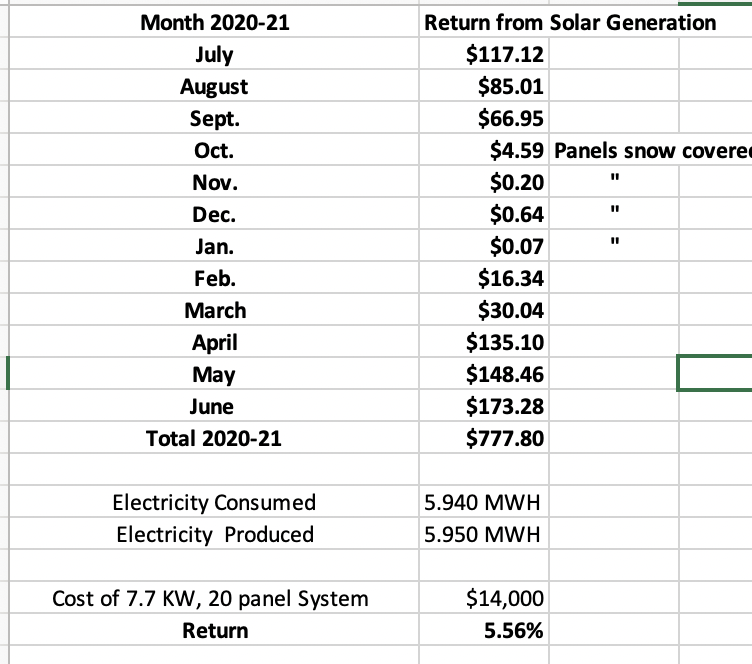
Almost two years ago I installed solar collectors on our Edmonton home and garage. Neither location was perfect- one facing WSW rather than South and one partially covered with shadow from trees an a neighbouring house. Nonetheless, I was able to install 20, 385 watt panels for a total capacity (under full sun) of 7.7KW. The total cost was around $18,000 Can and I received about $4,000 government incentive – so $14000 investment. For the first few months I stuck with my old supplier and saw minimal returns and terrible documentation of my micro-generation.

So last year I switched to a small energy coop the  Alberta Cooperative Energy which has a great deal for micro-producers. I  sell (and buy) electricity to the grid at a much higher rate ($.25 KWH) when my collectors are producing during the summer- yielding a nice monthly payment. During the winter I revert to standard rates in Alberta (~.06 KWH).

The annual bills from ACE revealed that we had  used 5.940 MWHs from the grid and generated 5.950 MWHs to put back in!  Self sufficiency – sort of. Of course in dark and cold Northern Alberta winter, we were consuming much more than we produced.

A further look at bills showed the financial payback detail.  The first full year produced an annual return of 5.56%! Too bad the panels were snow covered for 4 months!

This return is tax free and appeals to my inherently frugal mentality.

I hope this data inspires others to make their own solar investments.

Most Eco Solstice Tree

Most Eco Solstice Tree

In the perennial seasonal debate about the best kind of Solstice/Christmas tree we have been around the choices labyrinth.  From the trees we harvested on our own land near Joussard, to ones we’ve purchased at the local Kinsman lot, to cheap ones from IKEA, through to a few years with a rummage-sale artificial tree – we’ve hosted many a tree Each option has usually conflicting eco and money encumbrances.  Not to denigrate any other choice, but I think we have found a near perfect solution – at least for us.

Each year, for the past five seasons ,I have harvested the crowns from a seven-cedar hedge that we planted 20 years ago.  Standing precariously on our recycled wooden stepladder and armed with Susan’s Jr. Forest Warden pruning saw, I detach two of the tallest crowns.  In the picture below you see in the middle, Solstice Tree 2020, waiting for its big day inside, next year.

The individual tree crowns are a whee bit skinny, so I now harvest two crowns and wire them together.


Despite the fact that it took Susan some time to get the bead garlands “just right”, even when I thought they were ‘good enough” two hours earlier,  I think the tree looks great!

We don’t want the cedar hedge  to grow too tall, so as to block the solar panels and of course the zero cost appeals to my frugal nature.  Add to that the zero transportation costs and the fun of growing your own, makes me think we have the perfect Solstice Tree.

Happy Solstice, Christmas and  any other tradition that your are celebrating this season.

And of course, all the best in the New Year!

Sorry, Riverdale is Full

Sorry, Riverdale is Full

The Economist USA – April 20, 2019, has an article on urban development that gives an interesting analysis that can usefully be applied to my home community of Riverdale. The article Sorry, We’re full looks at the context of San Fransisco – one of the most expensive neighbourhoods in the world, but with striking similarities to Riverdale ‘discussions’ during the past year or so.

Riverdale is a small river valley community bordering on downtown Edmonton. It once was home to coal miners and other working class families. Extensive residential development on the former industrial brickyard has taken place. In addition more than half of the original houses have now been replaced by infills. This has resulted in social media fuelled arguments and discussions about population density, green space and affordability in Riverdale.

The Economist article describes three perspectives that residents tend to look at potential development issues. The first group are referred to as the “Landed Gentry” – those who got in earlier when prices were lower and are striving to maintain the existing culture and land values in the community. The second group are referred as “Left Wing Activists” to whom gentrification is to be avoided by creating affordable living opportunities for all citizens. Finally, there is the “Market-Orientated Urbanists” who want us to fix the housing shortage by building more. Ironically each of these three types jockey for the title of liberal and even progressive.

Each of us has components of all three characterizations lurking in our psyche, but it isn’t too hard to label myself and most of my neighbours that are active in the community or on social media.

All three have valid arguments.
Only by willing to compromise and treating each other with respect in the process, will we arrive at the best combinations of housing and thus community in Riverdale, San Fransisco and many other places faced with growing populations.

IMG_3994

Our Guatemalan Adventure

Our long time friends Ted and Joanne Koopmans invited us to come along and house-sit a house that a friend of theirs had made available for 4 weeks in February. The prospect (and reality) of -30 weather in Edmonton in February, was but one reason we accepted their invitation. We also hoped we would learn and perhaps contribute a bit to our NGO host.

Ted and Joanne were Mennonite Central Committee (MCC) volunteers in Indonesia in the late 1980’s and still maintained contacts with MCC. Our host, Mark Richard had lived for many years in Guatemala and had started a wheelchair factory in association with the Christian, US based NGO Hope Haven International who has distributed over 130,000 wheel chairs globally . (Check out their impressive Google Earth graphic). He was in the United States for a few weeks in February and invited Ted to house sit.

We arrived in Guatemala City and were met by the regional manager from MCC who drove us to an MCC guest house for the evening. The next morning we had a great visit with MCC staff member and a walk to the MCC offices.  There we were introduced to the 15 or so projects they were involved with here and in El Salvadore. Each project was managed by a partner organization and was typically related to agricultural production, education, or handicraft coops. They also showed us slides of the challenges and opportunities in Guatemala which is plagued with near obscene levels of wealth disparity, very high unemployment, corruption and narco gangs . We learned that the biggest source of foreign income for the country was remittances from those who have been migrated to Canada or the US. These hard economic facts underscore the challenges of Trumps proposed immigration policies and the need to develop local economic opportunities.

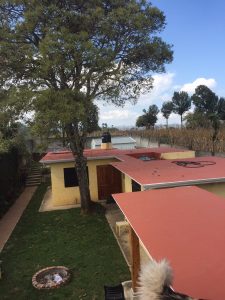
We then were picked up by a young driver from Mark’s organization and headed to Xenacoj and our home for the next 10 days.  Mark lives alone but has a large house in a walled compound that also houses a guest house and dormitory for his many visitors.  The house came with 3 large dogs (one tail in the picture at left!)
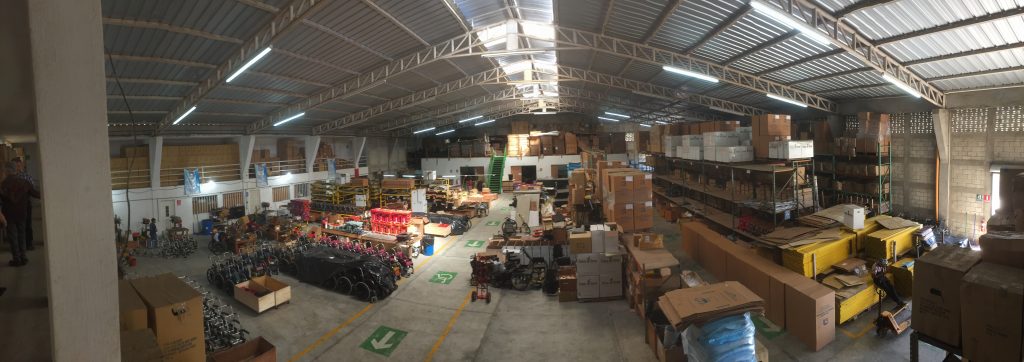
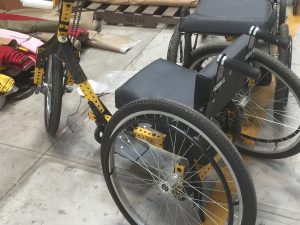
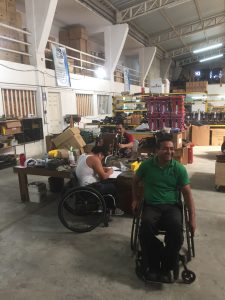
Later that afternoon we headed to the wheelchair factory.  We were quite blown away by the scale of the factory- this was no mom and pop shop outfit.  The factory manufactures two lines of wheel chairs – both  designed to be fully adjustable so as to grow with the occupant and to be repaired with local materials. They also refurbish wheelchairs donated from North America.

The Factory

Hand Cranked Model

Standing Board

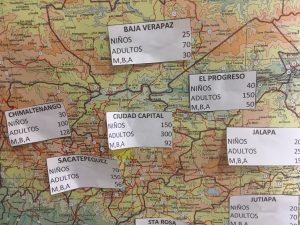
Current unmet need for wheelchairs 

Workers at the Factory

Ted on a Bumblebee

The following day, we took it easy -enjoying the house. Ted, Susan and I went for a hike to the nearest town of Xenacoj. The town was only about 4 K away – but up and down the equivalent of a 23 story building (according to Google Health). I’ve come to appreciate the challenges of transportation in Guatemala as everywhere we have been thus far has been trough deeply cut ravines, up and down hills. There is lots of agriculture, most of which is one the sides of hills and sometimes gullies.

We enjoyed a pop overlooking the main square market and church and then bought some vegetables and chicken from women at the stalls dressed in bright traditional clothing. I bought an (expensive) bottle of wine to celebrate our arrival, but alas Susan slipped and fell on the way home and into a now wine-red ditch beside the road.  Rather than attempt

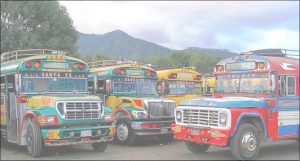
Chicken Buses

the ups and downs of the hike home we jumped on a ‘chicken bus’ and for some reason the drivers helper asked for .20 fare from all of the others in the crowded bus- but not from us. Likely the three who could most afford it rode for free!  The chicken buses are used school buses imported from the US – some still bearing the name of the school division on the side. Soon after their arrival though most are re decorated with metres of chrome- running on all sides, as well as flashing lights and various insignia and religious statues – quote colorful, bu always crowded and zooming up and down the hills

We spend the evening watching the Olympics via CBC streaming video and Marks hi dev screen. We had assumed we’d be without such creature comforts, but we were able to cheer the Canadians on to a few medals.

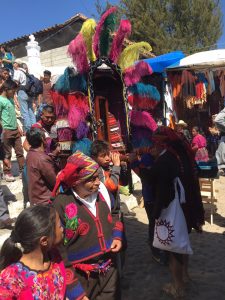
The next day our young driver Josue, arrived early for an overnight trip north. We were

Religious Procession

heading for ChiChiCastenango, a town about 60 kms north. ChiChi holds one the largest markets in Central America. The streets in the centre of the town were closed and the locals set up temporary stalls. These sold everything from vegetables and treats, to shovels, pails and of course at least 20 varieties of corn which became tortillas- the staple food of Guatemala. It was also Sunday so we watched a couple of processions with relics and statues paraded around to the accompaniment of a drum, oboe like flute and fire crackers. We only bought a few things – but not for lack of invitations to purchase from the vendors.

At six o’clock the roads finally opened and we were able to get to our 2 star hotel. On a final walk around town, I found a smart phone on the street and with Josue’s help we were able to text the owners friends and 30 minutes later a very grateful owner appeared to reclaim the phone.

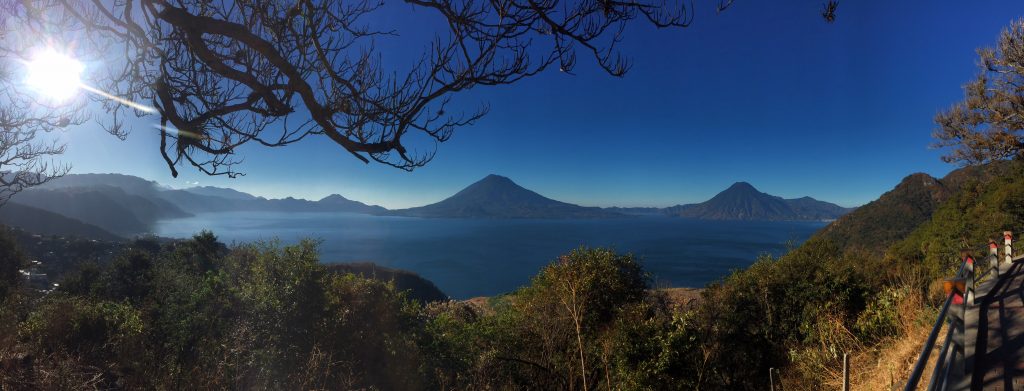
The next day we were up early to head to Lake Atitlan. one of the most picturesque and popular tourist sites in Guatemala.  The road down to the coastal town of Panachel was unbelievably steep and twisty – we were very glad to not be driving. Heading for the lake front we took a wrong turn and ended up on a very narrow street with barely room for one vehicle and of course we met a car coming the opposite way- necessitating a nerve-racking reversal of 500 metres or so!

Lake Atitlan

The lake is surrounded by about 7 small villages- a few of which are only accessible by boat. With a fair bit of bargaining, we hired one of the 20 passenger, fibreglass  water taxis and were soon heading across the lake to Santiago Atitlan. The wind had come up and the boat ride was a bit nerve racking as we rode up and over whitecaps and came crashing down on the far side.  If we had of known that the return trip would be even rougher, we might have enjoyed the ride there a bit more. It is quite amazing that the fibreglass boats can stand the abuse.

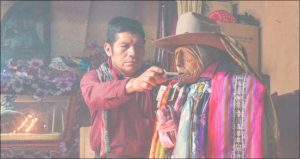
Saiago, is a beautiful town on the lakeside with a host of tourist related craft booths lining the main street. The aggressive sales were a bit much.  We stumbled upon a house

Maximon pauses for a smoke

with a preChristian cult (Maximon) in which a 400 year old (supposedly) idol could intercede with various gods for any request. Fortunately Maximon speaks EVERY language and for $4.00 allows his picture to be taken.

Next we hopped aboard a couple of Tuktuks (3 wheeled taxis) for a short trip to the Peace Park. This small park was a memorial to the 14 people killed when the Army open fire on a crowd of between over 1,000 civilians, who were protesting the Armies drunken abuse of San Diago citizens. This event was a turning point in both national and international resistance to the Army abuses of civilians during the guerilla wars.  As results the Army is prohibited from entering the region, except to guard specific visiting public figures.

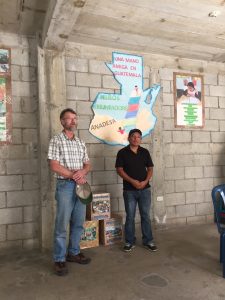
Next to the park we visited ANADESA the New Dawn Association of Santiago Atitlan. This

Ted Translating at ANADESA

Cool building at COOP

cooperative was formed after the MCC had been involved in relief work following a devastating mud slide that killed over 1,000  people following Hurricane Stan  in 2005. MCC stayed on the support a Cooperative that focused on supporting women, providing education for children and youth and providing a centre for handicraft production.  The members of the coop gave us an impromptu talk (with Ted translating). We bought a few handicrafts.  It occurred to me that a visit from a volunteer artist type might be very useful in inspiring the manufacture of different handicrafts than those sold throughout the town.

We returned that night to our ‘home’ grateful to have seen a lot, survived the traffic. However, without Ted’s Spanish (acquired mostly through 4 years of study – much with Duolingo App on his iPad) this trip would have been MUCH more challenging. Maybe time for me to get a bit multi-lingual!  We have a few more days here. Time to visit the museums in the capital and to put in a day or so of volunteer work at the wheelchair factory.


An attempt at a North Country Fair History Wiki

Hi folks

This coming year marks the 40th North Country Fair – the Annual Solstice Celebration held in Northern Alberta.  A very long time ago, I had the idea of turning our annual community celebration of the Solstice into a more public and BETTER celebration. The vibrant community of “back-to-the landers” in the Lesser Slave Community  managed to create a public celebration, pay the bills (consistently), introduce hundreds of musicians to the crowd and vice-versa, so as to create a Sunsational Annual Solstice Event.

The Fair now owns its own huge track of land on the Driftpile River Valley, south of Lesser Slave Lake. Each solstice over 5.000?? people converge in the Driftpile River valley  to make music, celebrate friends and family and the gift of life. The site is also leased by other community and music groups.

For many the North Country Fair has been an extraordinary experience – as they have met (or born) life changing events. People have been born, married and even died at the Fair!

The spirit of the Fair has been described (both with and without mental enhancements) as mind blowing, wet, Wow!, frustrating, very groovy and many more.

We want to capture and share these experiences. For ourselves and others.

The NCFwiki invites all of those who have interest and who have experienced the Fair to share their stories, photos and memories.  The site uses a popular wiki, content management system (TikiWiki) to organize, search and retrieve Fair stories, programs, photos and more.

The way a wiki works (with WikiPedia being the single best example) is that some of those who have experienced the Fair, take it upon themselves to add to the Fair Wiki. Some (usually less than 2%) become active editors  – editing, nudging, suggesting and in other ways helping to curate the archive.

I have set up a preliminary shell for the Wiki. I’ve also added a view stories, scanned a few programs and posters, linked a few newspaper articles and photos and proved – at least to myself, that this could work. But it needs loving labour!!

We know have, what anyone who has lived in Northern Alberta knows well, a ‘cold start’ problem. Did I ever tell you the story of warning a frozen truck on Hippy Hill when the propane Tiger Torch ignited the engine block??). I digress.

In order to be useful a social network site (like a wiki) has to be used.

To be used it has to be useful.

So, I have created a shell (much like Wikipedia did years ago) but I know from other  experiences, that it is much easier to create a wiki shell than to populate it and for it to achieve critical mass.  The TIKIWiki system has many other community features that could be activated to acknowledge and honour contributors, as well as crowd tools like “likes”.  These could be added.

I hope you will take a few moments to check out the site at virtualcancuk.ca/NCFwiki . The site needs design expertise (I have very limited skills in this area)  but mostly it needs people who value the Fair enough to contribute.

The current site of the wiki is on my own self-funded blog. The plan is to transfer the ownership of the wiki (if successful) to the official LSLNCCA community association site.

How to Contribute:

Wikipedia works by self-selected individuals registering (and being authorized by me) as “editors” and then they have the permissions necessary to both add their own and edit the contributions of others.

Thus, the final work becomes a community effort. Of course, this gives rise to arguments and discussions of quality, authenticity, veracity, organization schemes and much more. And these have NOT all been thought through, but the important thing now is to get a critical mass of contributions, such that Fair Folks find it of value.

Some potential contributors may not wish to bother with learning the technical details of creating and managing contributions. This is understandable, but I do encourage  Fair friends to stretch  their personal net skills by learning to contribute to a public archive, such as this WIKI. You may well love the experience of sharing.  However, if you wish you may also send emails with attached content to myself, and I or other volunteer editors will  figure out how to add them.

A wiki usually contains both unique content and links to external contact.  So for example, Eric Marks has created many photos of the Fair and he has uploaded these to Flickr . Eric or others could add these directly to the wiki manually, thus ensuring they last if Flickr were to close down, but that is a significant task, so for now they are just linked (see an example here).

Please email me if you have questions or wish to help with this exciting project.

Terry