An encounter with the Chinese health system

You can tell when a blogger is getting old by the percentage of their posts relating to health issues- and especially their own. This is one of that genre.

About three months ago a painful bump appeared on my heel, and after a couple of weeks of denying its existence, Susan talked me into going to see my family Doc.  He didn’t give me a name but said it was fairly common, suggested some stretching exercises  and booked me with a specialist. Rather miraculously (in Canada) I was able to see the specialist a week later.  The specialist told me it was a case of Achilles Bursitis, and booked for x-rays and an ultrasound. Of course I rushed off for an appointment with Dr. Google and found that indeed I (and you) have a number of cushion pads called bursae that shield the moving tendons from the bones of our joints. When they get inflamed you call it bursitis.  The specialist prescribed some anti-inflammatory cream and I got used to (almost) a dull pain as we trotted around Italy last month.

So landing in China for a month, I thought, why not see what Chinese medicine can do for me.  My first stop was at the hospital conveniently located on the University Campus. A 5 minute wait and a short examination and I had another tube of anti-inflationary cream. (Total cost about $7.00 for the cream and I some small payment via my new Jiangnan University staff card).  I learned from Chinese colleagues that the University hospital used western medicine, so they helped me get an appointment at the major Chinese medicine hospital in the centre of Wuzi.

So this morning we headed downtown for an 8:oo AM appointment. Unfortunately, my colleague had mistakenly made the appointment for the following day, so we decided to just see if we could ‘walk in”. This entailed showing my passport and lining up for 5 minutes to pay a cashier $12 to see the doctor.  2o minutes later we were standing at the open door as the doctor finished a session with an earlier patient (the Chinese don’t bother about patent/Dr privacy the way we do in Canada).  He quickly examined my heel and (through Zhijun’s interpretation) asked about my “western diagnosis” and the Internet gave us a Chinese translation of the afore mentioned malady.

He wanted to see an x-ray, so back we went to the line up at the cashier (waited about 15 minutes) paid $22 and we were on our way to radiology department. Another 10 minute wait and I was on the x-ray table. The equipment and safety of operator looked pretty much the same as my recent experience in Canada – with a much shorter wait time. Then it was back to the doctor (another 10 minute wait) and he was examining the x-ray on his computer. As expected the bones were fine, just the inflamed bursai.

He then punched in 3 prescriptions on his computer, printed them out and we were back in the cashier line (another 10 minute wait). I paid another $12 and went to the dispensary, waited 5 minutes and was given a bag with my prescriptions – a tube of herbal anti-inflammatory cream (made at the hospital), 8 packets of herbs (also made up at the hospital) with which I was to make a tea and soak my foot 3 times a day and a 24 tablets of an internal anti-inflammatory.  I may not take the internal pills as I was able to get a second opinion from Dr Google – who noted the drug  is associated with stomach problems.  The final stop was back to the radiology department to pick up the 11″ by 14″ x-ray.  I think it will be a nice souvenir and I’ve never known anyone else who has their own foot xray!

So, I still have bursitis, but as I write my foot is having a bath and the room smells like a wet autumn woods. The hospital experience cost me about $46 and two hours of my time – without an appointment.  It was, all in all, an interesting experience and I was impressed with the service and brusk but efficient operations of the staff.  However, I am certain that  this would have been an entirely different experience, without the translation services from my good friend and ex-PhD student Zhijung.

Only time (and perhaps a later blog post) will tell if the treatments work.

Classical Chinese Dance and Music Concert

Did I ever tell you about the time I starred in a Classical Chinese Dance and Music presentation?

Last night my host here at Jiangnan University invited to go with her to the annual performance of the students in the classical fine arts program here at the University. We got great seats in the campus performance center, which is a fairly large concert hall seating perhaps 1500 people and it was about ¾ full. The set was of the stone arch bridge and simulated streams that characterize this campus.

The program consisted of a mixture of dance and classical songs each based upon well known Chinese poems. Of course I didn’t understand the language but  Zhijun was able to find English translations of some of the poems. So I got to appreciate the often melancholy but also occasionally joyful emotions, movement and sounds created by the dancers and musicians.

Traditional Chinese Guzheng

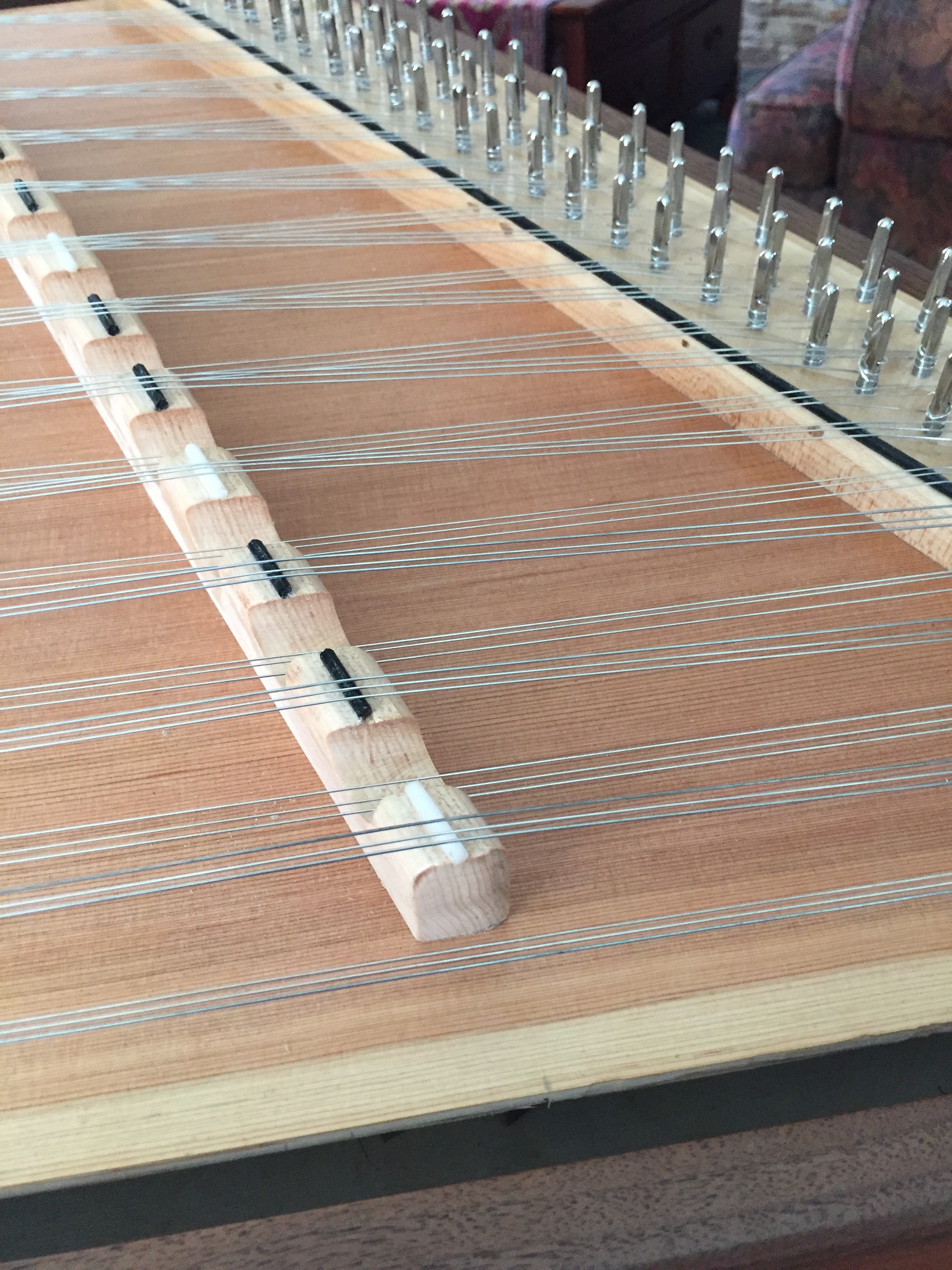
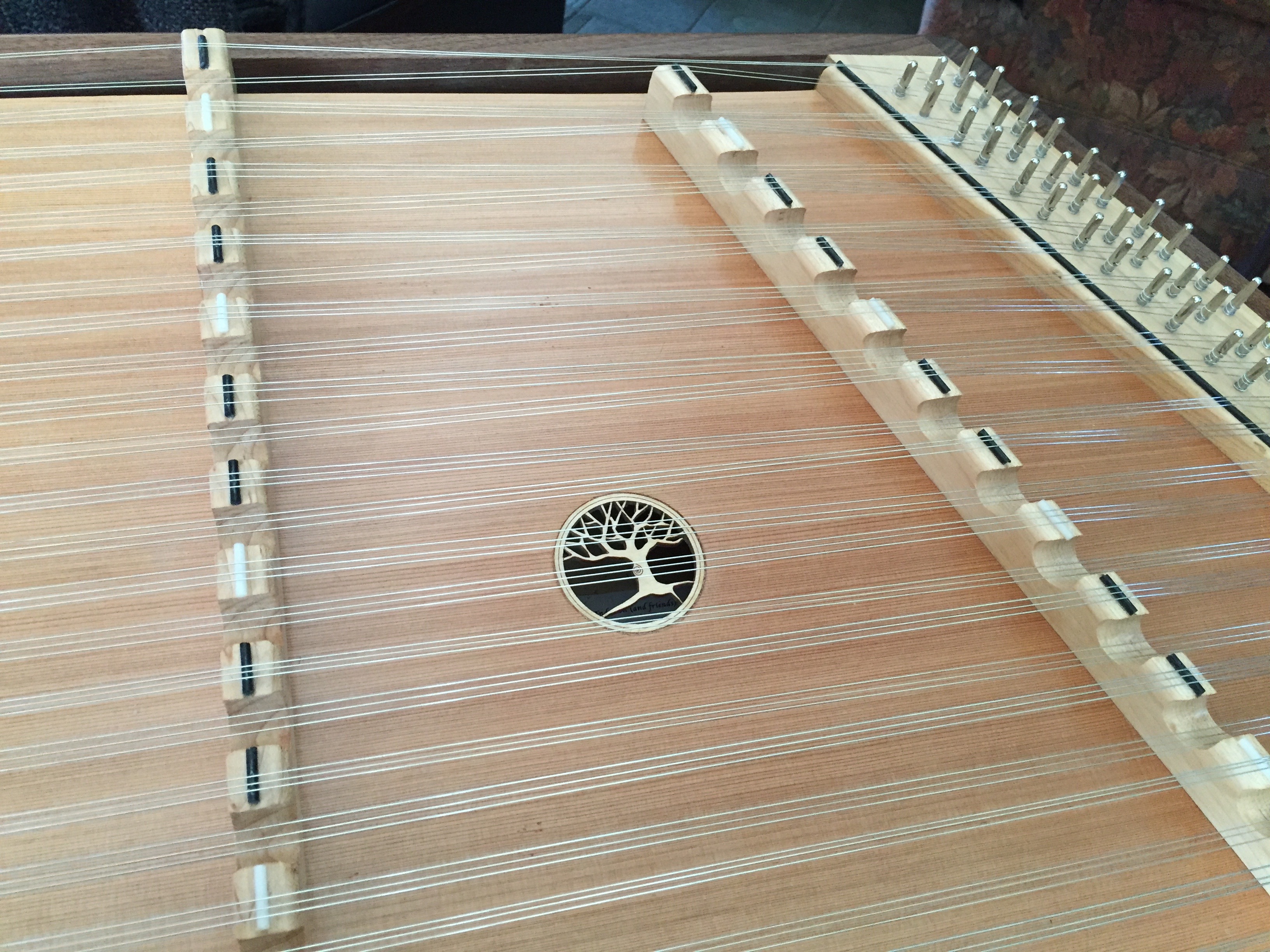
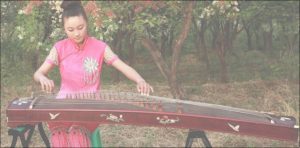
I was especially interested in two of the traditional instruments. One, the guzheng was not unlike the hammer dulcimer that I’ve been building and playing the last few years. It had about 20 strings but rather than  being struck with hammers, it was plucked. supposedly “Guzheng’s sound touches the Heavens above and the Gods and spirits below.”

Guqin, China’s oldest instrument.

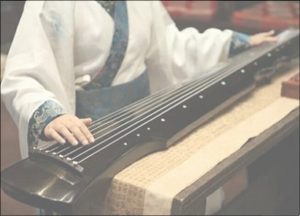
The second instrument is called a Guqin, not unlike a zither. It too was played horizontally, and plucked or stroked by the musician. It however had a fret board so each of the seven strings could be shortened by the musician to create higher notes and eerie slides. According to TopChinaTravel  “Chinese ancient scholars have to acknowledge four art, including play the Guqin, play Chinese chess, write good calligraphy and draw painting”

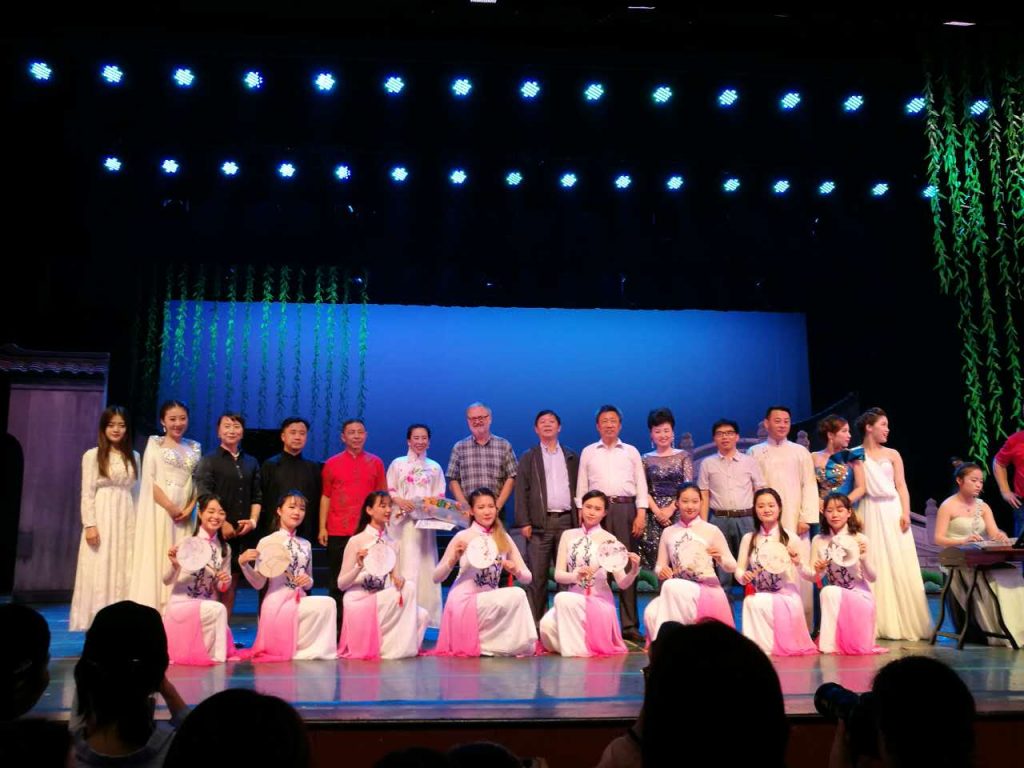
A bit surprisingly at the end the audience very briefly clapped and then proceeded to exit the auditorium. Meanwhile the cast was still all on stage, the director accepting a bouquet of flowers and everyone doing a final bow – to the quickly emptying auditorium. My colleague Zhijun asked if I wanted to go up and take a picture of the musical instruments. I thought that was a good idea, so we proceeded up near the front waiting for the photos to be completed and cast to disburse. However, soon the director noticed me standing there and came down and insisted that I come up and get my picture taken with the cast. And not only that, but I was dragged up beside her, right in the center of the cast. Then the official photographer arrived and seemed to take forever  snapping pictures and me looking and feeling pretty goofy as if I was really desperate to get my picture taken.

Crashing the photos take at Jiangnan concert

Likely you won’t have to guess “Where’s Elmo” to see me in the picture. After the photos were finally done, I was able to take my picture of the instruments  and get off that huge stage.

As I look at this photo I realize I don’t exactly blend in with the crowd. Last Sunday I was visiting one of the ‘ancient villages” near Wuzi, and a little 4 year old boy came up and asked my colleague if I was a “real foreigner”. This prompted me to think well maybe I am starting to look just a little bit Chinese, but tonight’s photo proves that I’ve a long way to go.

Teaching at Jiangnan University, Wuxi China

My 4 week trip to China is a week done, and I thought I would document the trip to date (you know us old guys have trouble remembering the details!).

Four years I received a request to host and sponsor a PhD student from Bejing Normal School. Zhijun Wang soon worked her way into our hearts and proved to be a very helpful and capable student.  After her thesis on connectivism and her graduation, and a new baby, she accepted a faculty job at Jiangnan University. A year later she invited me to teach her Masters degree students for a month in the Department of Educational Technology, where she has just recently been appointed a very young department chair. The course I am teaching is called Advanced Research Methods – but it isn’t that advanced (which is fine, as neither am I!). We are focussing on the hot methodology of ‘design-based research’.

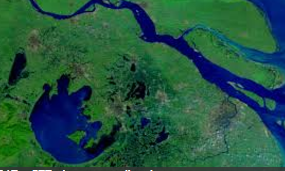
Satellite shot of Lake Tau with Yangtze river at top, Shanghai at mouth of the river

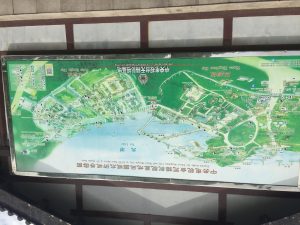
Wuzi is located about 70 km west of Shanghai and is one of those Chinese cities of 6.2 million people that almost nobody I know had ever heard off.  This is (I think) my 6th trip to China and I have to say that Wuzi is by far the prettiest large city that I have visited. The City is located on the ancient Grand Canal on the edge of Tai Lake one of the largest lakes in China. The relatively new University campus is on the lakeshore on the Western outskirts of the City.  The campus (like the old City Centre is bisected by a number of  canals and small rivers – complete with lily pads, fish and the the odd scenic bridge. The day I arrived the air was pretty thick (not nearly as bad as the Beijing soup, but a bit disconcerting).  However a rain fall the second day cleared away the smog and has been clear skies the rest of this week.

Student residences on the jiangnan campus

I’ve been accommodated in “foreign teacher” apartments that are quite spacious, one bedroom suites. The other teachers here are from all over the place, with maybe the largest component from Australia. Today I enjoyed a United Nations type talk over beers in our courtyard – and yes the Trumper was talked about.

I’ve been met for breakfast and most lunches by grad students who want to practice their English and it is really a treat to get to talk and ask questions about the ‘real China’.  On Thursday four students took me to Three Kingdoms theme park.

You’ve probably noticed how much Chinese people enjoy watching ancient warriors (with or without supernatural powers) battle each other and win princesses. Well, many of those movies were shot on the 86 acre or site built for that purpose and when not actively making films – the tourists descend. However Wuzi is quite far off the international tourist circuit and I think I was the only ‘big nose’ foreign tourist at the park that day. We toured the palaces (all built of stone) on the model of the Forbidden City in Bejing, the parks, castles and docks. We also watched a pitched battle between sword and various other weapon-carrying soldiers galloping around on horses. The speed and acrobats of the horseman was impressive, but the rides for visitors after the performance were pathetic by Calgary cowboy standards – the saddles all had big steel handles to hold onto while an employee took the reins and led the riders (walking) around the arena.

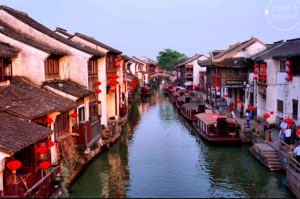
Last night Zhijung and a colleague took for dinner in the “ancient canal zone” which was very impressive. Lots of restaurants and bars and people out for a Friday evening stroll.

Ancient canals of Wuxi

We also saw a group of 20 or so amateur musicians playing  traditional Chinese  instruments and singing opera ballads.  We ended the evening with a 45 minute boat ride through the central part of town and saw the usual spectacular high rise buildings (most lit up) and a new Mosque and a very old Buddhist temple – which still has monks.

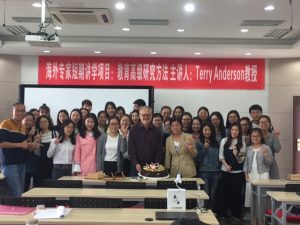
My course is going well and they ended class on Friday by bringing in a birthday cake for me and singing (with not quite right tune, nor words)


I finally got it together to buy a Virtual Private Network (VPN) that allows me to use the Internet and makes the sites visited think I am located in a selection of cities around the world- one of which I choose. This allowed me

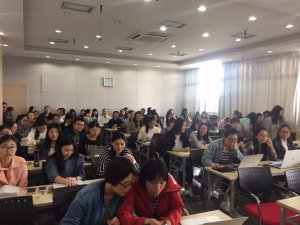
First day of Class

to watch a couple of NHL games streamed on CBC (which CBC restricts to Canadian sites). Fortunately the Oilers lost on Thursday, so I do not need to be too compulsive about watching the remainder of the playoffs. More importantly, the VPN allows me to access the numerous sites that are blocked in China – including Google, Google Scholar, Facebook, Twitter YouTube, Netflicks and many more. It is interesting to see the extensive use of WeChat and I am told many other equivalent net applications that are Chinese – no Google and Facebook domination here!

I  have been delivering my classes in English(of course), but I cut and paste Google translation of the text into Chinese characters beside, the English text. And having Zhijung as a ready translator really helps as well.

This morning one of the Faculty took me to visit historic town of Dankou. Near the entrance a little boy asked my Chinese Colleague if I was a ‘real foreigner’ – I guess I must be looking more Chinese now, if he couldn’t tell.  The town was nice to walk through – no cars and lots of boats on the canal. I also saw a man returning from fishing with 4 cormorants in the boat. Each of the birds went fishing with string on their leg and a ring around their neck so as not to swallow the catch.

Next weekend, we are off to China’s old capital of Nanjing for a couple of nights as a tourist and then visiting and giving a talk at Jiangsu Open University. All for now

Our trip to Italy – April 2017

Note: What follows is a 6 page account of the 24 days that Susan and I spent as tourists in Italy in April 2017. Hopefully it can be used by ourselves to recall those names and dates we too easily forget and for others to help plan similar vacations.

Introduction: Despite the numerous personal and business trips that we have made to Europe in the last 25 years, the only major country we have never visited was Italy. Thus, I sort of saved it for a retirement holiday and it did not disappoint!.

We decided to travel in April for two reasons – it is often a terrible month in Edmonton mostly because the expectations (for spring) and the reality (of winter) often do not align. This was borne out this year when we heard of (not sadly) two separate snowfalls of over 20 cm while we were away. We had also heard of the very hot weather and HUGE crowds in Italy during the summer. We were still quite shocked at the number of tourists and we were glad we brought sweaters and jackets, but we concluded that April is a very good month to visit Italy.

We planned the trip to visit the major tourist sights in North and Central Italy – mostly for the art, culture, and scenery. We also wanted to visit Genoa, where I had been invited to do a presentation at the National Institute for Educational Technology. Finally we wanted to try to use AirB&Bs and from previous travels, we knew that one had to book very early to insure good selection and prices. Thus, our itinerary was more or less set, when we booked four AirB&B sites in September 2016.

Venice: We decided to visit Venice first and booked our flight booked with Air Canada and they only fly nonstop from Canada to Rome, when we arrived in Rome. We took a pre-booked (cheaper than getting last-minute) a high-speed train ticket which departed 2 hours after our landing. Although we were a bit concerned with timing, we made the train from the airport directly to Venice. The scenery was great but after an all night flight, Sue mostly slept – my new policy of popping half a sleeping pill on the plane worked wonderfully and so had no problem enjoying the view as we sped along – up to 300 KPH.

Walking out from the main train station onto the Grand Canal is a wonderful experience for all first time visitors.
We bought SIM cards for our IPhones (25Euros which gave us telephone and 4 gigs data (but no text) Sue’s worked fine but mine would not activate – problem with Apple Canada?? This data phones proved extremely valuable for Google maps and for phoning our hosts in the AirB&B – and of course for answering disputes and queries with a brief consult with Mr Google.

We bought a 2 day pass on Vaporetta boat buses (a bit expensive at 30 Euros each) but a great way to explore Venice. After the 2 days we found we could (and did) walk everywhere. Venice is like no other city we have visited because of the lack of cars and roads. Everything from garbage, to ambulances, delivery vehicles to fire engines is a boat! Thus creating a unique and very quiet environment. The Grand Canal is packed with water taxis and tourist gondolas but also with all types of commercial boats. In addition a huge cruise ship briefly blocked the view one night from St Mark’s square.

We did the usual top tourist sights, museums and churches including visits to LIDO and one of the other small islands. We also booked one walking tour with only 6 of us and a charming young Art student as guide. Our AirB&B Campo St Marco was great, full kitchen, a large eating area, bedroom and living room (which we hardly used). The large windows opening onto St Thomas Square afforded us a bird’s eye view of a bit of Venetian life. We also experienced for the first (but certainly not last time) great Italian pasta, fish and pizza. After 4 nights we took the train for a one day visit to Milan.

Milan: We left early for the 2 hour trip to Milan. We found our hotel near the train station and headed to the old town. We tried for a few minutes to buy tickets to visit the famous Douma (Cathedral) but the line up was atrocious, so we opted for a far too expensive hamburger and beer on a terrace overlooking the Doumo Square, and had a great view of a very excited champion soccer team getting photographed for over an hour. We paid the big bucks for an excellent guided walking tour which ended with 15 minutes in front of Da Vinci’s Last Supper in the Rectory of a Dominican Monastory the Basilica di Santa Maria delle Grazie. This was as our first walking tour with ear phones and it make a tremendous difference as the guide can chat away without halting to gather in the 18 tourists on this tour. He was excellent with lots of stories and time for questions. I hadn’t realized how badly the City had been damaged by British bombers during the 2nd world war. We visited the usual tourist haunts – Cathedral, opera house, Gallery, castle etc .and two hours later arrived for our 15 minutes with the last supper. Having the guide interpret the painting and its restoration (it was NOT done as Fresco on wet plaster so immediately began to fad and was re-painted by various authors and finally the Monks cut in a door which cut off Jesus feet!_. Twenty years of restoration in the late 1980-90 revealed some of the original Di Vinci paint and outlines. He also informed us that this very Monastery was the headquarters of the Italian Inquisition and that the fires burned nightly in Milan for many years – YUK!. But the expressions on the faces of the apostles, the effect of lighting in the refractory, the ‘miracle” that 2 sides of the room had been destroyed by bombs in WWII but left the painting intact, were each impressive.

Genoa: The next morning we headed for Genoa – normally a 2 hour (slower) train, which was over an hour late leaving the station in Milan. Thus, we missed a lunch for us put on by the National Ed Tech Centre folks. I did an updated presentation on Interaction modes in 3 generations of distance education pedagogy. There were about 30 people in attendance and one off-site location. They celebrated my visit and the tomorrow’s Easter break with a delicious and complex traditional Italian home made Easter cake and lemoncello – lemon liquor. The day ended with likely our best meal – with our host Francesca Pozzi and her husband Massi at a great sea-side restaurant owned by one of their friends. There was only one other couple at the restaurant and the owner had to show us pictures of the very fish we were eating and how he had caught it earlier that day. The next day they took us for our first-ever sail on a 38 Ft Bavaria sail boat in the Mediterranean. Not much wind but nice to see this largest harbor in Italy.

Our Genoa AirBnB was right downtown and turned out to be the most luxurious accommodation that we enjoyed on the trip. It was a large apartment with marble and hardwood everywhere , very modern kitchen and a great king sized bed!

We spent the following day exploring Genoa. I went to the Maritime museum while Susan got lost trying to go shopping and wound up in an interesting museum! The old town was great and quite amusing to see the faithful gathered around and praying at a full sized body of the dead Jesus on Easter Saturday – waiting for resurrection tomorrow I guess. Also heard a great guitar player outside the Cathedral, who told us he had played the Bach Cello suite just for us, as he saw us watching!

Cinque Terre: We had, from most visitors we knew, heard to Italy of the wonders of the 5 villages along the Italian Riviera that make up the CinqTerre. We had an Air B&B for 3 nights (2 days) at Manorola. It was Easter weekend and even without the cruise ships it was PACKED with mostly Italian tourists. Anyways we arrived at Manorla by train about 8:30 PM and had a bit of a time finding the AirBnB – thank goodness Manorola only has one road!!

We spent the first morning relaxing and enjoying the balcony view of the town and listening to the bells tolling for Easter morning in the Church next door. They even enticed Susan to attend Mass.  In the afternoon we headed down to wade through huge crowds at the Manorola Beach. We knew the sea trail to Riomaggiore was closed but our map showed the village was only about 3km away. What we didn’t know was that those 3 km were horizontal and didn’t count nearly an equal distance of vertical steps.  We really were not prepared for the roughness of the trail, the zillion steps and many loose rocks. But we made it!! We certainly were glad to end with Bruschetta and craft beer in Riomaggiore.  We took the 3 minute train ride back- the ticket machine was broken and the train packed so it didn’t matter much, and then hiked another km back up to our peaceful airB n B to relax and enjoy the view. We got a taste of why so many Italians are in such good physical condition
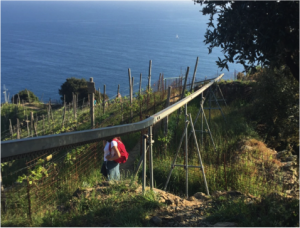
Our second and last full day in Manorola we decided to be smarter and took the local bus up 300 meters to a little town (nice church) on the ridge overlooking the sea. Then it was a still-challenging but easier walk down to the next village. The weather was nearly perfect – high of 19 degrees. There were quite a few people we passed in both directions, but it was interesting seeing the gradual rebuilding and planting of vines in the once abandoned terraces. We also looked carefully at the only mechanism used in these vineyards – the monorails that took the farmers up and grapes and olives down. We had a great lunch overlooking the sea at Corniglia and then headed along the trail to Vernazza. We enjoyed a beer overlooking the harbour and castle and then took the train home.
Florence and Tuscany: Next morning we were off to Florence and rented car so we could see some of Tuscony where we had our only one un-booked night of this trip. Two days earlier I went on Expedia and found a “members sale” for a “country hotel” for $66 Canadian near Sienna. We’ve had some less than positive experience at really cheap hotels before, so we crossed our fingers for this one. We had booked a rental car and fortunately bought our GPS with European maps. We had a wonderful drive through Tuscanny – absolutely the most stunning scenery we have seen thus far. We stopped at the mountain top town of San Gimignano. We enjoyed listening to a busker (and bought a CD) of a musician playing an new Swiss steel drum-like instrument called a Hang. The “country hotel” turned out to be a fabulous 200 year old 4 star hotel (see view from our bedroom window at Borgo San Luigi 
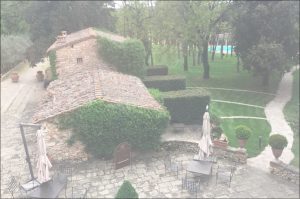
– a lot like Jasper Park lodge. They upgraded us (I guess they didn’t see how little we had paid) to a Junior Suite, that had a list price on the door of 350 Euros. We spent way too much on the hotel restaurant dinner but it turned out to be a wonderful night, and the breakfast the next morning turned out to be no charge.  We wish we had booked the place for another night or two. The following day we drove through Tuscany stopping at a couple of hill top towns including San Miniato and then visited the Leonardo de Vinci museum, in you guessed it – in Vinci!

Back to Florence and dropped off the car sans incident – thank goodness for GPS and found our Monastery – which seemed pretty Spartan after 4 stars last night!!

As others have noted Florence is an amazing City with a very rich Renaissance history. It is amazing that this landlocked town became the world centre for both Art and Banking – perhaps mostly due to the leadership of the Medici family leadership? Our stay at the Monastery was the worst accommodation of our trip. Susan had insisted on it based on one previous Monastery Stay and some latent fantasies of religious life. The room was (as expected very plain) but it was annoying to listen to the Italians arguing, or were they as Sue suggested just talking vivaciously next door late into the night and then again at 6:00 AM! We ‘ve noticed that besides extensive arm movements Italians tend to talk to each other very loudly. We also had trouble getting Internet, but Sue did do a couple of very early morning counseling sessions from the common room downstairs. Our two visiting days were spent at most of the big art galleries. We paid for “Skip the line” tickets for the Academia Gallery and were awed by the size and grace of Michelangelo’s David. The next day we visited the largest Art Gallery in Italy the Uffizi Palace and saw the sculptures and paintings accrued by generations of Medici rulers. We ended the day by enjoying the Sunset after a half hour climb up to Michelangelo Square overlooking the City.

Rome: For the final week of our visit we took the train from Florence to Rome. We had some trouble finding the AirB&B as we got mixed up between municipal trains and the Metro. I also had a very close brush with a pickpocket as during the rush and push to get into a very crowded Metro train I reached and noticed my wallet was missing. I swept my hand down and it was dangling, waiting to fall or be plucked at the waist line of my jacket – yikes – that would have put a damper on our holiday.

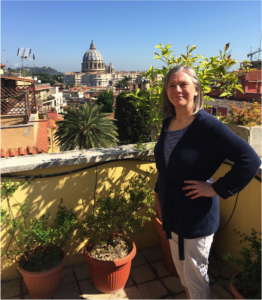
We did find the AirBnB and it lived up to its reputation and the reason we booked it, by a very large terrace (5th floor with elevator!) full of plants that overlooked St Paul’s Cathedral and the Vatican. It was a stunning view during the day and lit at night. We had 8 nights here and spent many a slow morning enjoying breakfast on this terrace.
We planned a more or less unplanned visit and spent the first day exploring our neighborhood and finding a delightful neighborhood restaurant with the owners with a huge smile, great food and not a word of English! The next afternoon we braced ourselves for the crowds and visited at Peter’s Square and Basilica. We were told it is the largest Church in Christendom – and it was impressive. We also wondered through the crypt to see all the dead popes and one lonely female – a deposed Princess who had sought refuge in the Vatican in 17th century.

The rest of the week we leisurely did the main tourists sites of Rome. All were crowded with tourists, but still retained the grandeur of past ages and great art. We did our one and only hop-on hop-off bus tour – never sure is they are worth the 30 Euros each, but did get a good overview. In turn we visited the Vatican Museum, numerous churches, Spanish steps, Trevi Fountain, the Forum and Coliseum – with lots of time for relaxing in our apartment. We also really liked the winding streets, ambience, buskers and restaurants of the Travestere area (on the right bank of the Tiber.) Also took in a Saturday morning combination baroque concert/tour in the Art museum Palazzo Doria Pamphilj (30 Euros) which was really excellent. To our surprise we saw the original painting from Dutch painter Brugel of skaters on a canal – we have had a larger print of that picture hanging in our house for nearly 20 years, and didn’t really know where the original was. As compulsory, we also toured the ruins of the Roman Forum and coliseum. Both worth the visit but hordes of other tourists and a bit of a tragedy that so much of these temples and the Coliseum was recycled by later popes and the wealthy into Churches and palaces. Ironically the only temples that did survive renaissance-age savaging were the ones that had already been converted to Churches. Visiting the 2,000 year old Pantheon temple was a definite highlight, and one of the most impressive spherical works of architecture we have ever seen.

Conclusion: I’ll end with a few lessons and hints:

  1. April is likely a good month to visit Italy as we had only one day of rain, but I did wear my sweater at least part of every day. Susan admitted that she brought too many warm weather items. I can’t image the hordes of tourists when it gets busy in the summer, as there were more than I liked in the Spring.
  2. Getting a sim card with data for google maps, downloading tickets, contacting AirB&B hosts and other conveniences – is a must. We likely could have gotten by without our GPS by using Google Maps, but it was nice to have a backup.
  3. AirB&B is a great way to travel. The price of accommodations are similar to hotels (see below). The size of accommodations, kitchens, appliances and balconies are MUCH better and 3 of our 4 AirBnB’s could have slept 4 people. But you are charged a cleaning fee and making contact with host is more challenging than walking into a hotel- so they are best for stays of 3 or more nights. With AirBnBs book VERY early to get best selection and prices. Our experience booking that 4 star country hotel in Tuscony through Expedia at $66 Cdn was a real bonus but hard to repeat!.
  4. Total Costs. We ate out at least once every day at medium priced restaurants average maybe 40 Euros/meal with wine, paid around $120/night for accommodations, usually used public transportation, but did grab a taxi when really needed or desired, and didn’t skimp on museums – but also didn’t do things like 80 Euros for a half hour Gondola ride in Venice. A nice way to enjoy these once of a lifetime experiences is to delude yourself that a Euro is equivalent to $1 Canadian even though in 2017 it costs $1.50 Can for a Euro!
Airfare $2373 (Can.) Average/day
Accommodation
     AirBnB $2373 $131
   Hotel $212 $106
   Monastery $315 $105
Concerts, restaurants, tours, museum, transportation, etc. $3074 $128
Total (2 persons) $8357 $348 – $249 minus airfare

These totals compare quite favourably with costs of 3 week cruise, but one shouldn’t underestimate the time and worry of booking everything oneself – and then resolving the challenges when you get lost or show up for a train at the wrong time or the wrong station!


Two Canadian Movies – Two Canadian Narratives

I’ve just finished watching two films about, paid for and watched – with interest, by many Canadians.

The first film, TransCanada Summer takes the viewer across the country in 1958. Throughout the trip the film celebrates the industrialization and progress resulting from the construction of the Trans Canada Highway – the longest highway in the world at that time. The second film critically looks at these roads – first the railroads then the highways, from the perspective of the First Canadians – the aboriginal natives. These Canadians were largely ignored as these same roads brought to them an invasive of settlers, profiteers and religious evangelists.

I grew up in Calgary Alberta, which was then and is now the most “American” of Canadian cities. It was settled in large part by American ranchers and farmers moving north and west for “open spaces” By either luck or design, oil was first discovered and commercially exploited in Turner Valley south of Calgary. Soon networks with American oil companies made Calgary the centre of one the major oil producing regions in North America.

Given this personal culture history, I was not much prepared for my first summer in University when I lived 450 miles north of Calgary in the Northern bush. I was a member of the Alberta Service Corp, doing a Peace Core-type immersion in Cree Country. The community of Loon Lake Alberta had, two years before my arrival, first connected to the “colonial roads” built by government and oil money. Thus, these Cree peoples were coming to terms with easy access –  both to and from their communities. Arriving were evangelical missionaries, mobile stores selling cheap trinkets and underwear and a host of new government officials in charge of everything from forests, to hospitals, to schools and to Indians. In the opposite direction, cars and taxi’s emerged from these formally isolated communities to allow a day or weekend shopping trip, booze run or an opportunity for the young people to explore beyond their traditional lands.
The first film, TransCanada Summer, by Ronald Dick (1958) is narrated by celebrated Canadian historian and broadcaster Pierre Burton. The film is a cross country road trip (with a few diversions) along the recently completed Trans Canada Highway. As in chronological stories, common in this type of North American film, the action starts in the east and proceeds West. The narrative commences with the hardy fishermen of Newfoundland building the first road across their province. It then travels across each province in turn, showing famous landmarks of mid 20 Century Canada – both natrual and human created. The narrative is decidedly pro “industrialization”. The word itself is used frequently to describe big and powerful buildings and machines with an occasional explosion as the highway is carved through mountains and over waterways. The narrator shows us giant smelters, industrial slag exiting blast furnaces and mighty shovels lifting and transporting.

I confess that I really enjoyed the 60 minute video.  Trans Canada Summer is the type of movie I would have enjoyed as a kid as my Jr High School teacher found a way to pass a Friday afternoon with bored students. Given that I was 8 years old when the film was made, I saw many of the scenes and especially the beautiful old cars I came to know (and own) as a teenager in Western Canada. The short hair cuts, long dresses and corny midway shows reminded me of the way life used to be. I also enjoyed identifying the famous landscapes – most of which I have had opportunity to visit in travels across the country.

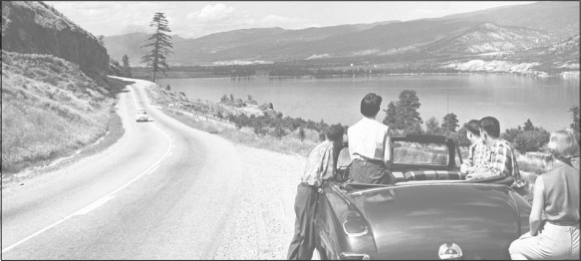
Screen Shoot from Transcanada Summer

What was most shocking in this movie was the complete absence of any mention or footage of Canada’s First Nations – they were invisible across Canada. There was one very short shot of the famous French voyager and explorer Pierre La Vérendrye with a native at his feet pointing the direction – but that was it. No commentary of the critical roles played by the First Nations in the very survival of the earliest French and English settlements.

Sign on the Railroad bridge in Garden River Ontario. Shot from Transcanada Highway

There was no mention of the pivotal role played by First Nations people in not only supplying product, but transporting the fur trade throughout Rupert’s Land – the name given to Canada by its first commercial owners the Hudson’s Bay Company from London England. It seems as if the First Nations population was totally invisible in 1958 Canada. And of course there was no visits to First Nations communities despite the fact that the TransCanada  passes through dozens of First Nations communities and reserves.

I recall that upon my return to university in Calgary, after my Service Corps summer, I was asked by a social worker if I would ‘befriend’ a First Nations student from the Blackfoot reserve near Calgary. It is almost unbelievable today, but he was one of only two registered Indian students in the whole University in 1970. So it perhaps no real surprise that First Nations were invisible, both to filmmakers and to the general population in the middle of the last century.
The second film, Colonization Road was shot in 2016 and tells quite a different story of the roads and railroads that “built” Canada. To set the context it is important to note that Canada as a government and as a people are struggling to come to terms with its colonial history and most especially the past and current role of First Nations peoples in this history. A national attempt at reinterpretation and re-engagement was triggered by the national Truth and Reconciliation Commission (TRC) which researched, produced documents and held public meeting across Canada from 2008 to 2015. The TRC was officially struck to examine and reconcile with the tens of thousands of First Nation’s children who were legally abducted from the care of their parents and forced to live in mostly Church-run residential schools. The Commission brought to the public eye horrific stories of sexual, physical and cultural abuse as the missionaries attempted to take the Indian out of their young charges. Native language, clothing, spirituality, songs and attitudes were ruthlessly supplanted by Christian and capitalist ideas of correct behavior. These schools left a legacy of parents bringing up kids today who had never been properly parented themselves with resulting chaos and generations of suffering. The Commission ended in 2015 with a list of recommendations – some for governments but many for individuals and communities to begin the process of reconciliation based upon an accurate understanding of the truth of these first Canadians.
The second contextual factor to set the current Canadian scene is the huge increase in First Nations populations from around 200,000 in 1960 to around 1,600,000 in 2016 . Thus, both increase of knowledge of our colonial past plus rapidly increasing populations are forcing Canadians to come to know, appreciate and work together with these first citizens of Canada.
In Colonization Road comedian and narrator Ryan McMahon visits some of communities across Ontario where they still have roads named Colonization Road. Governments of the day thought that if they pushed a road through the ‘empty wilderness’ then immigrant settlers would take the opportunity to buy cheap land, create villages and towns, build churches and schools and civilize the extensive Canadian bush. In total over 160,000 km of Colonization roads were built across mostly Northern Ontario land in the 1850’s. And it largely worked. Except they forgot one thing – the ‘empty’ land was already occupied by First Nations peoples living sometimes on smaller reserves but always using the land as traditional hunting grounds. Michelle St. John, director of Colonization Road writes “I think we’ve all been raised here in Canada with the settler narrative as one of triumph and a patriotic Canadian identity, but there is a flip-side to that story — and that story is ongoing.”

From the perspective of many of those interviewed the Colonization Roads were the conduit for not only white farmers, but for miners, loggers, gamblers and missionaries to enter and quickly usurp their land. This same strategy was used by later governments in Western Canada but then using the railroad to colonize and civilize Western Canada. Colonization Road visits communities that and more importantly tells the stories and reactions to First Nations citizens today and the stories from their parents about live both before and after colonization – and much of it is not pretty.
Both of these movies are worth watching – TransCanada Summer for a look at the natural beauty, the value of mid-century white Canadians and the narrative that both sets and reflects the noninvolvement of Canada’s First Nations in the economic development of the country then and continuing today. Colonization Road is both funny (thanks to First Nations comedian Ryan McMahon) and inspiring, as it gives voice to some of those people who experienced and suffered from the colonization of our great country.

The complete version of TransCanada Summer can be streamed
Here is the 2 minute trailer from Colonization Road.

Colonization Road Trailer from Frog Girl Films on Vimeo.


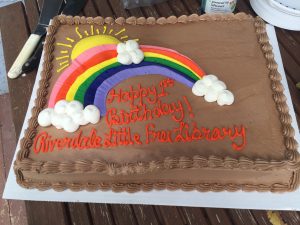
1st Birthday – Riverdale’s Little Free Library

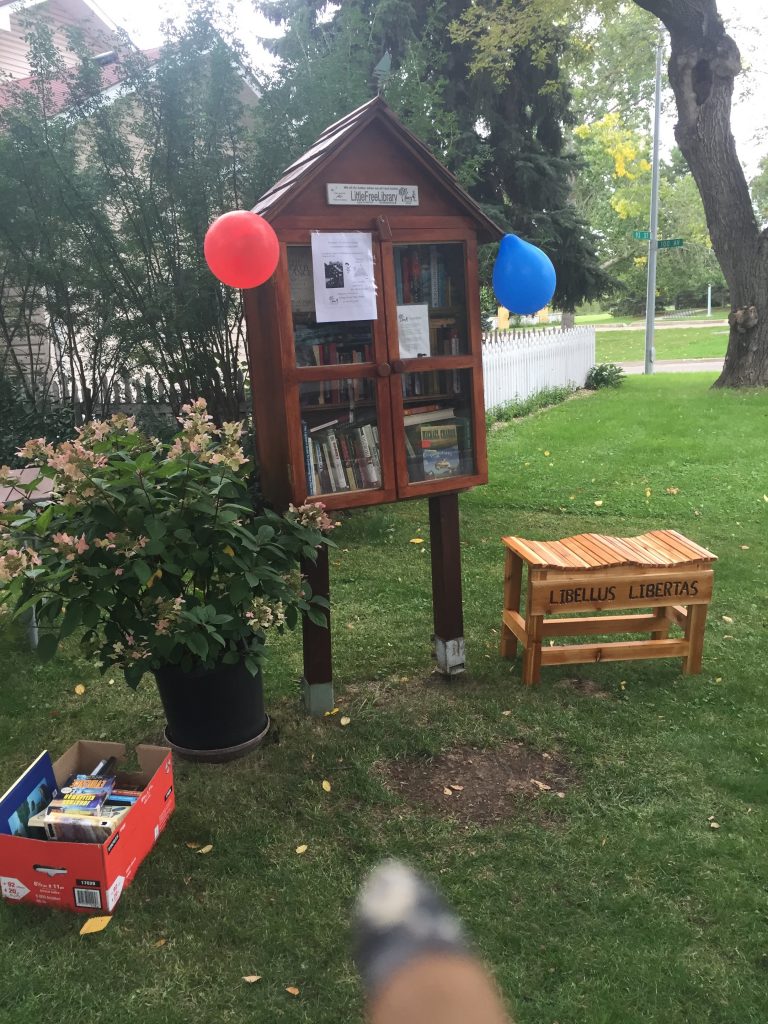
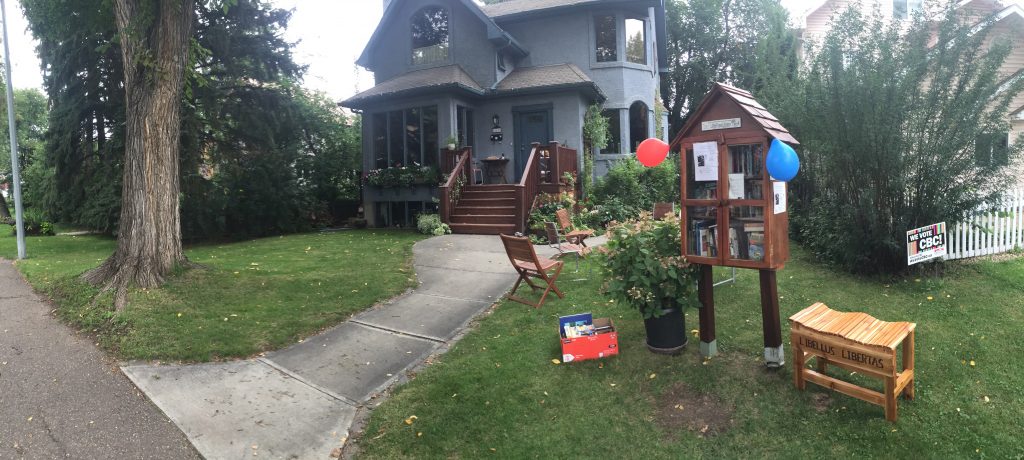
IMG_4262My Little Free Library celebrated its birthday with a party for its patrons on Saturday. Unfortunately, the weather wasn’t terrific, but the rain held off long enough for cake, music and wine!
IMG_4271

The only challenge is that the party goers each bought books and the Library is already FULL!  I had to open Riverdale Little Free Library Annex #1 – a cardboard box (see photo above). I am confident though that we will be getting a run on reading as the proverbial winter chill sets into Alberta.

I built a new reading bench and carved “Libellus Libertas” which I think and hope is Latin for Books Free – as in ‘take a free book’ or ‘books are freedom’

IMG_4275

Reflecting on the 1st year I can make a few observations:

  1. Physical maintenance on the building has been minimal. I spruced up the exterior (for the party) with a quick coat of varnish, I had left over from another project. I’ve had to replace one of the door knobs and that’s about it.
  2.  The upstairs, library studio flat had no bird tenants although it was guarded by a fat sparrow for a week or so this spring.
  3. The Head Librarian has become a promiscuous reader, as he has started way more books than he finishes and is currently reading 6 books.
  4. The collection size has remained quite steady (current glut not withstanding). I’ve culled about 20 books that weren’t moving, but most seem to disappear in about 2-4 weeks.
  5. I’ve met many more neighbours and been thanked for the library by many.

So all in all a great 1st year. This winter, I plan to build at least one more library.

Front Lawn Fun-Raiser concert

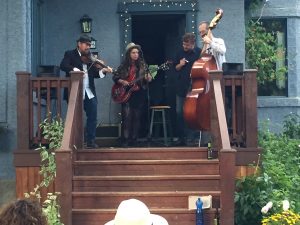
Susan and I were really pleased to host a fine evening of music last evening here in Riverdale. Our neighbour Cam Neufeld is touring this summer with IMG_3983Jez Hellard & The Djukella Orchestra (Jez and bassist Nye Parsons). Jez and Nye are from the UK and royally entertained us with  a rich collection of origional and traditional  tunes.IMG_3998
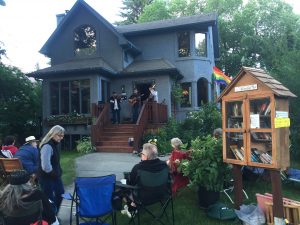


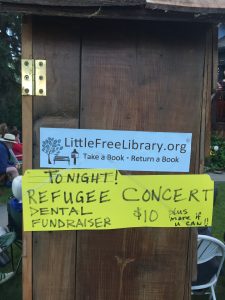
The concert was a fund-raiser in support of the two Syrian families that have been sponsored here in Riverdale. So always good to be able to support a good cause, while having a great time and listening to some fine music. As you can see the Little Library did double duty as a welcome sign.IMG_3994


Order of Athabasca University

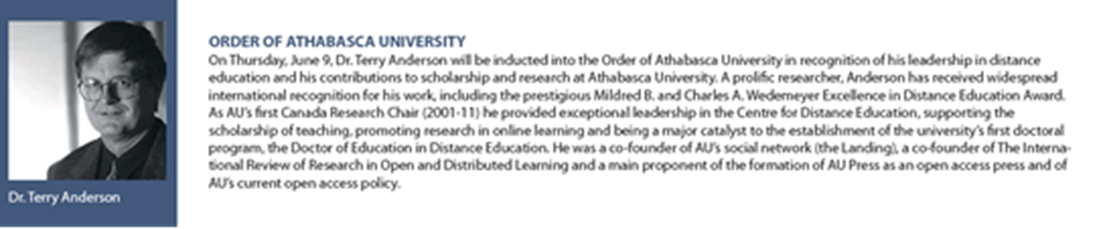
Yesterday at Convocation in Athabasca, I was deeply honoured by my former colleagues at Athabasca by being installed into the Order of Athabasca University. Most other members have been individuals from the community who have made exceptional contributions to the University. I was the first Faculty member (other than Dominique Abrioux, who also served as President) to be so honoured.  The hupalo started with the blurb below published in the Edmonton and Calgary daily newspapers.image003

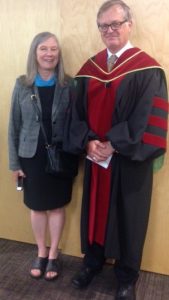
It continued at Convocation where Rory McGreal made a terrific and over flattering introductionIMG_0928 to me at the beginning of the  ceremonies. Rory’s introduction contained comments from Mark Brown, Alan Tait, Morten Paulsen and Wayne Macintosh – thanks to each of you.  The life stream of the whole convocation ceremony is streamed at goo.gl/ZziwsG . Rory and my part begins around Minute 53
The celebrations ended  with a banquet. All very moving, and I am trying hard to not leave with a swollen head! But thanks to all who have helped make my time at Athabasca very personally rewarding and recognized!!

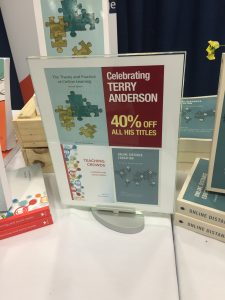
It was also flattering to have AUPress over 40% discount on three of my authored, edited or co-authored books.IMG_3962


I was asked to do a 3 minute speech which I addressed to the graduates and to the wider Athabasca Community. Here is the text;

Madame Chair;  Mr. President;  Distinguished guests;  Members of the Platform party;  GraduandsLadies and gentlemen:

Thanks to each of you!

I think I am the first faculty member (who wasn’t also a president) to win this award, and so I feel very deeply honored for your recognition—of not just my contributions—but of our work, together, here at Athabasca University.

Today is a day primarily for the graduates—and thus, I would like to use this time on the stage to congratulate each of them—and their family members and friends networks that you created —who have helped to get them here today.

All of my research has been focused on the distance learning experience. One of the most common questions is:

“Is distance education as good as campus-based education?”

Well … my colleagues and I have been asking this question for more than 30 years! And in roughly 90 per cent of studies, the results have shown that there is NO significant difference in learning outcomes.

And even when there is a difference it is likely to be in favour of distance learners. However, there is certainly more to being educated than just simply ‘learning outcomes.”

What distance education students build—and usually in larger doses than campus students—is self-efficacy. The belief in yourself and the knowledge that you can succeed in the tasks you set for yourself.

Distance learning builds knowledge and belief in yourself and an empowered understanding that you can achieve your goals.

You didn’t earn a distance education degree without being—or getting—good at creating and meeting deadlines and producing quality output—usually without the help of peers or classmates.

And so, today I celebrate your earned increase in self-efficacy!

But, to be sure, this graduation milestone does not mark the end of your learning. Technological and social change continues to happen—and more rapidly than in it changed in the past.

Luckily, I know this for sure: Because of your experience with AU, you are armed with the confidence and the knowledge that you can learn—and learn successfully.

You have self-efficacy. You can succeed—and you will succeed—as life-long learners.

Finally, I want to speak to my colleagues and friends in our broader Athabasca University community:

Bear with me as I don my sailor’s cap,—one of the pleasures of retirement! —obviously, as an institution, we’re continuing to sail through some rough waters. We are facing weather winds and that are very hard to predict. However,  “the glass is rising”. Certainly there is value and risk in every decision we make.

But I want to continue to urge us to use the ever-increasing power of networks—and importantly, our own networking skills—to work together to build a new kind of university: A university that is not like the Athabasca University of 1970, nor that of 2016, for that matter.

But one that marries academic knowledge, collegial support and governance with cost-effective ways to study and teach. Alone, and together, we need to support and create better and more effective personal, academic, administrative and community networks.

These networks have demonstrated they produce the power to be critical components of the new ‘net-era’ university—and thus, they are a challenge for each of us to navigate—but a necessary one.

Oh, have I mentioned the Athabasca Landing yet?

Thank you very much!

Success with FlyKly Wheel and Kickstarter – at last

Despite what may be an idealistic techno-solution, I was attracted the FlyKly video when I first saw it advertised two years. The video shows a cool European 20+ cruising along on his electric assisted bike and then EASILY able to take it off (theft issues?) and or share the wheel with his girl friend. The unique thing about this design is that the battery and all controls are right in the hub of the powered back wheel. I thought my wife just might also be interested in an electric assist on her commute to her counseling office. So….

I got out my Visa card and soon I had contributed to the KickStart folks for nearly $500 – a big amount in those day even if the Canadian dollar was at near parity with the US dollar.   Then the wait. Weeks, turned into months, turned into years. The good news was that the original company had merged/been bought out by a company with a better battery. So redesign and longer waits!! Finally an email note that they were shipping! Then a second note saying that US and European customers would get the first shipments – Don’t they like Canadians??? Promised dates for delivery slide by. Finally not 2 days after I wrote a nasty email asking if they were just a rip-off company – my FlyKly Smartwheel arrived.

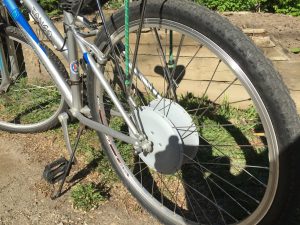
IMG_3841First surprise, my last bike had been stolen and in the meantime I had upgraded to one with disc brakes- the FlyKy wheel doesn’t work with disc brakes. Second surprise, I had ordered the wrong size! Both Susan’s and my bike have 28” wheels and I had ordered a 26” wheel. So shopping on Kiiji, I found a pretty good used mountain bike for $90.
Finally a test drive! But alas, the new wheel was ‘skipping” on almost every revolution of the wheel. After expending all my knowledge about chain skipping, I knew it was time for a bike shop visit. But then horrors – I lost the wheel’s electric charger. It had to be either in the house or in the garage and I thought it had to show up someplace. Months pass and sadly it is still missing, so I very reluctantly paid $159 US plus $50 shipping to order what I thought should be $20 charger. A few more months go by… Finally it arrives and I’m off to the bike store. It turns out the chain was not tensioned properly when the cassette of gears was removed from the mountain bike. So $35 for a chain tensioner and $30 labour and I was set to go.

Well it’s a wonderful invention! The wheel parameters, by which one sets the amount of electrical assist, maximum speed for the assist and the amount of braking (and recharging when pedaling backwards on down hills) are controlled via an App on my smart phone and connect via Bluetooth. The wheel itself as no controls – it starts by itself after a few seconds pedaling. It gives a very nice push, and goes into neutral when you stop pedaling. Unfortunately, the chain doesn’t synch with the three gears on the front crank and so I am stuck with a one-speed bike. However it does really well on the hills and cruising on the flat at a good speed is easy to manage.

Of course I’ll have to see how it survives and the BlueTooth connection from the Iphone is not very good, but it works! So all told I’m in for about $900 Canadian and I see they are now retailing for $999 US. My first Kick Starter experience and despite the delays it may be a winner!

My New Hammer Dulcimer – FINISHED

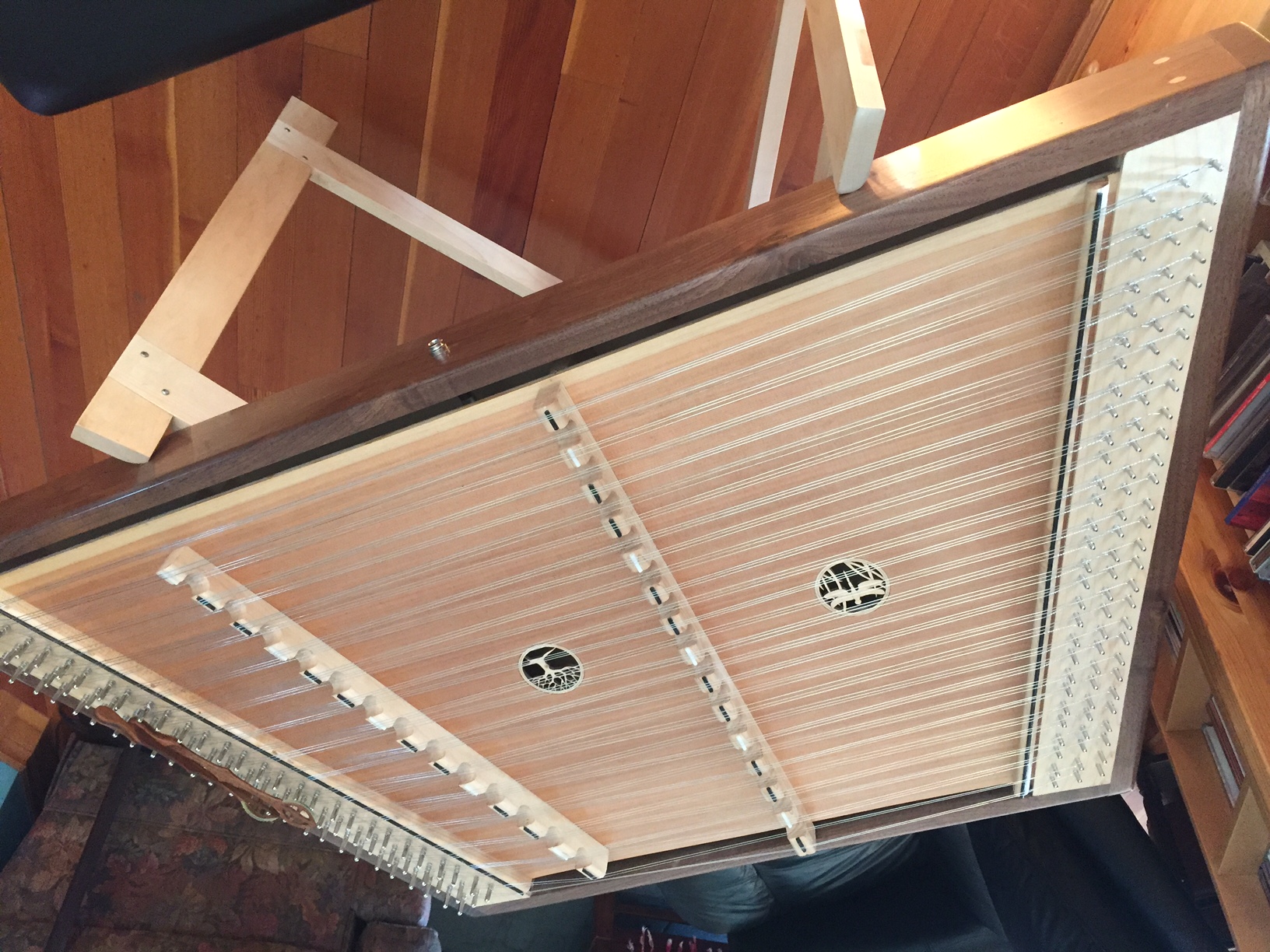
After nearly exactly 3 months on and off work my new 15/14 hammer dulcimer is finished. I’ve have been playing my Dusty Strings 13/12 dulcimer (the numbers stand for the number of notes (or courses) on each bridge) for the past three years. For those not very familiar with this instrument Ardie Davis has a description and a nice American-slanted history article. It is a great starter instrument, IMG_3709but I began to crave a lower register,  more sound and an opportunity to revive my wood shop. This project met all three goals.

It isn’t really necessary to take 3 months to build a hammer dulcimer and I wish I had of taken better attention to the actual time taken.  But needless to say, this project was working on ‘retirement time’. For me that meant renovating the downstairs bathroom, moving through 2 of my Grad students defenses, skiing with my brothers and three writing “beyond LMS” articles for Contact North besides building a dulcimer.

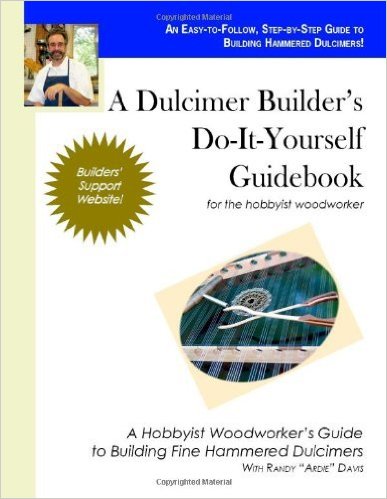
adrie davis hammer dulcimerBeing both an amateur woodworker and a very amateur dulcimer player, I asked Mr Google to recommend a set of plans or a good book. Luckily Ardie Davis has a great, ‘step-by-step” book that I followed quite religiously. The rest of this post is likely only of interest to those thinking about constructing a hammered dulcimer and thus I go into more detail than the average reader will likely find of much interest.

As Northern Alberta is not known for the quality (nor quantity) of our hardwoods the first move (after a good reading of the book) was a trip to the commercial hardwood store. Exotic wood like walnut, sugar maple and baltic spruce are NOT cheap, but for $170 I walked away with 3 large hunks of rough cut wood (one walnut, 2 hard, sugar maple) and a 1/2 sheet 5/16″ baltic birch plywood. These hunks of wood were all that my 30 year old 3/4 horse table saw could handle (note to self – buy a new table saw!) but fortunately with a trip to a friends thickness planer they came out OK. I cut one pin block twice and it was still too short (sigh), so I had to glue on a thin piece, which you likely wouldn’t notice, except I’ve just told the world.

The sound board is the most important part of the dulcimer as it supports the 2 bridges and resonates under the strings giving the volume to the instrument. This design has a “floating sound board” meaning that it fits into dado slots on the sides and has a 1/2 gap at top and the bottom. This design allows maximum vibration of the sound board and lots of space for the sound to emerge. I was very fortunate to be given a piece of old growth, quarter sawn cedar, which a friend’s father had milled 30 years ago on Gambier Island off British Columbia. The grain was incredibly straight and we managed to cut it down to 1/4″ thick pieces and then laminate two together to make the 20″ wide sound board. Thank heavens for access to a thickness sander which did a terrific job on this heirloom cedar.

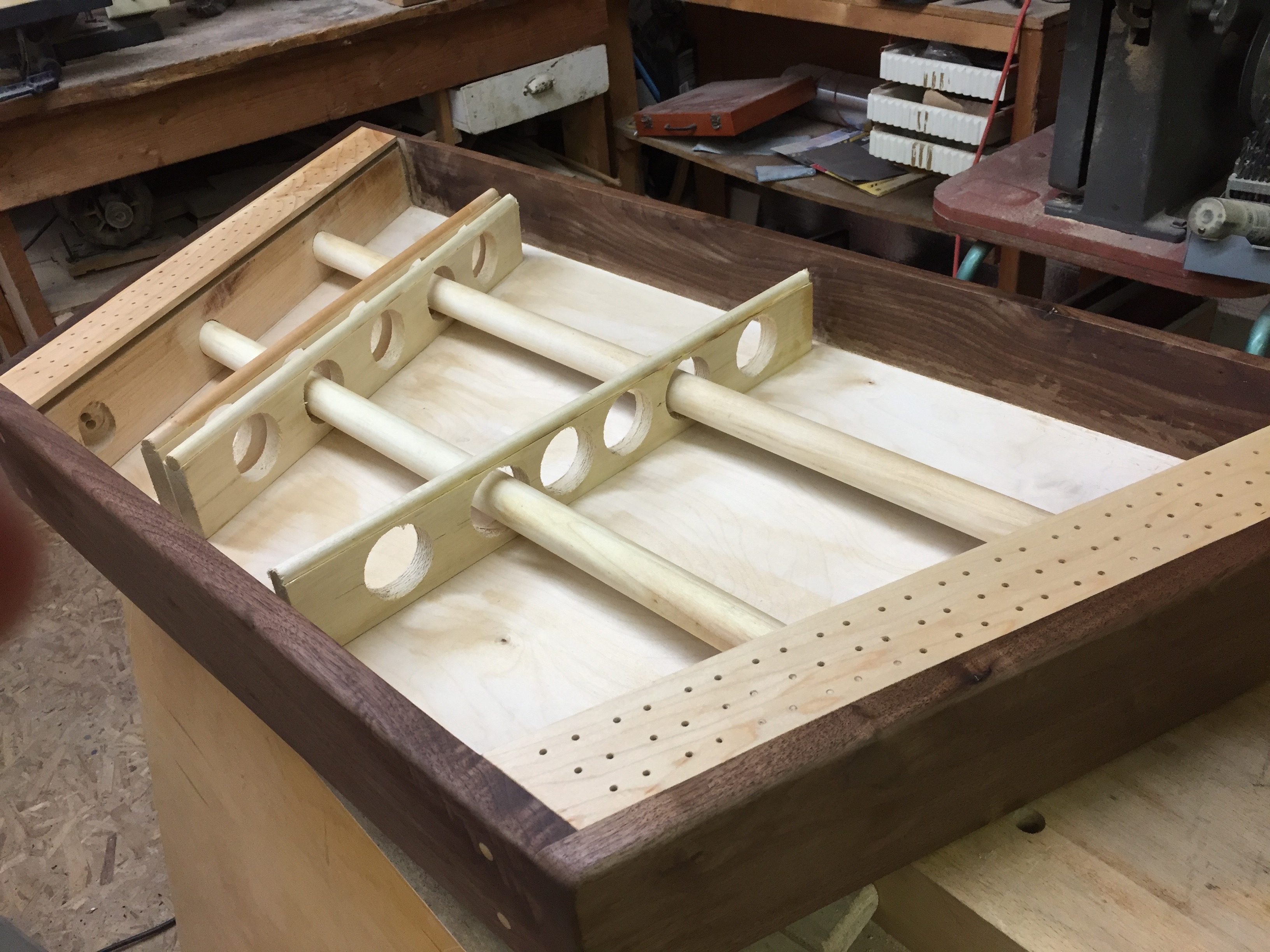
Following Ardie’s instructions carefully, I managed to cut and then glue up the 2 walnut end rails, side rails and the side pin blocks. Thankfully I had invested in 6 more bar dulcimer innardsclamps – you never have too many clamps! These outside pieces enclose the Baltic birch plywood bottom in dado slots (also bought a very nice new dado blade!). Notice from the picture that 2 one inch hardwood dowels were inserted before the 4 sides were glued together. These are designed to take the load on the pin blocks  when the 87 strings are finally tuned up. You can also see the three bridge supports – the only local wood (Aspen poplar) that a friend had milled in Northern Alberta. The bridge supports are needed, as besides lateral tension the strings also push the bridge down and would likely distort the soundboard without support.

Next came the making of the bass and treble bridges and the two side bridges also from the sugar maple. The sound bridges have holes drilled in them so that the strings can move across from one side bridge all the way to the opposite pin block without hitting any IMG_3705vibration ending pieces of the second bridge. I made the bridges slightly different than Ardie recommended and followed the design from my smaller dulcimer and others I have seen (see photo). I also didn’t thread the strings through the side bridges as Ardie recommends but led them on top under a piece of black devron plastic rod.

Next came adding a few screws and covering plugs, routing the rails and then hours of sanding!

I struggled with the decorative rosettes. On a floating sound board dulcimer like mine, it isn’t really necessary to have a sound hole to let the sound out, but they look so nice! So a good friend and I spent an afternoon on his CNC milling machine, taking some groovy pictures off the net and then importing the JPEGs into the machine’s software. Unfortunately, the cutter bits we had available were not fine enough and we eventually gave up and I ordered to two very nice rosettes ($14, US each) from the good folks at MusicMakers.

I ordered the hardware – tuning pins, hitch pins, and strings and received great service from James Jones Instruments ($168 US). How the low Canadian dollar hurts! Drilling the holes for the tuning pegs was relatively straightforward -AFTER you find the correct bit.  Ardie recommends a #15 drill bit, which is not metric, and not American but an obscure machinists’ standard – sizes not carried by the local hardware stores. Fortunately, IMG_3704asking around, I found a friend who lent me a set of these specialized bits. The holes have to be exact as the very fine thread of the tuning pin has to dig into enough wood to provide a stable and long lasting bite into the wood, without requiring a guerilla sized arm to turn.

Finally, I was  ready to start finishing (after more sanding). I decided to use MinWax Wipeon Poly and put on about 15 coats. Each coat dried quickly and although the finish isn’t factory perfect (I did it in my dusty wood shop) it looks OK. Ardie’s design allowed me to finish the soundboard before assembly and install it later, which was nice.

At this point I considered the value of installing a pickup to plug into my small guitar amp. I wasn’t sure it would really need the amplification, but if I didn’t do it now, I would never be able to get the amplification directly off the soundboard AND have it nicely concealed. So, I purchased a K&K  2 head acoustic pickup ($100) and installed the jack through the bottom rail.

While the finishing was taking place, I constructed the stand from maple according to the design Ardie recommends. In retrospect I should have made an adjustable stand that I could use standing up or sitting down, but this one works OK.

Finally the day for the big string up! 87 strings makes for a whole day of twisting, turning and coaxing wires around twice as many pins. I should have ordered a few spares of the top thin wires as one broke immediately and a second the following day. However, with 3 strings per note, you can get away with a few missing strings! The tuning seemed to take forever as the strings stretched and the whole dulcimer creaked! My trusty tuning app on the IPhone was indispensable for this task. Numerous times,  I would finally get the last strings in tune, only to find that the ones I had started with had all gone out of tune – sigh.

But eventually they stabilized and WOW what a sound compared to my smaller dulcimer.

All in, the instrument cost about $500 – in addition to providing rationale for buying a new (to me) router, router table and two new saw blades. The retail cost of such a dulcimer is around $1500 Canadian – and the pleasure of playing is priceless!

Lessons learned:
1. Don’t build an obscure instrument before the Internet – these long tail hobbies need a way to connect with suppliers and advice.

2. Use what social capital you have to beg and borrow both local expertise and tools.

3. Don’t strive for perfection – it is supposed to be a fun job!!