Success with FlyKly Wheel and Kickstarter – at last

Success with FlyKly Wheel and Kickstarter – at last

Despite what may be an idealistic techno-solution, I was attracted the FlyKly video when I first saw it advertised two years. The video shows a cool European 20+ cruising along on his electric assisted bike and then EASILY able to take it off (theft issues?) and or share the wheel with his girl friend. The unique thing about this design is that the battery and all controls are right in the hub of the powered back wheel. I thought my wife just might also be interested in an electric assist on her commute to her counseling office. So….

I got out my Visa card and soon I had contributed to the KickStart folks for nearly $500 – a big amount in those day even if the Canadian dollar was at near parity with the US dollar.   Then the wait. Weeks, turned into months, turned into years. The good news was that the original company had merged/been bought out by a company with a better battery. So redesign and longer waits!! Finally an email note that they were shipping! Then a second note saying that US and European customers would get the first shipments – Don’t they like Canadians??? Promised dates for delivery slide by. Finally not 2 days after I wrote a nasty email asking if they were just a rip-off company – my FlyKly Smartwheel arrived.

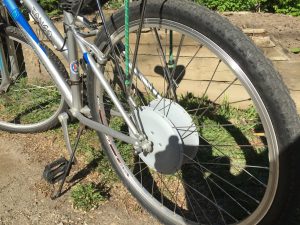
IMG_3841First surprise, my last bike had been stolen and in the meantime I had upgraded to one with disc brakes- the FlyKy wheel doesn’t work with disc brakes. Second surprise, I had ordered the wrong size! Both Susan’s and my bike have 28” wheels and I had ordered a 26” wheel. So shopping on Kiiji, I found a pretty good used mountain bike for $90.

Finally a test drive! But alas, the new wheel was ‘skipping” on almost every revolution of the wheel. After expending all my knowledge about chain skipping, I knew it was time for a bike shop visit. But then horrors – I lost the wheel’s electric charger. It had to be either in the house or in the garage and I thought it had to show up someplace. Months pass and sadly it is still missing, so I very reluctantly paid $159 US plus $50 shipping to order what I thought should be $20 charger. A few more months go by… Finally it arrives and I’m off to the bike store. It turns out the chain was not tensioned properly when the cassette of gears was removed from the mountain bike. So $35 for a chain tensioner and $30 labour and I was set to go.

Well it’s a wonderful invention! The wheel parameters, by which one sets the amount of electrical assist, maximum speed for the assist and the amount of braking (and recharging when pedaling backwards on down hills) are controlled via an App on my smart phone and connect via Bluetooth. The wheel itself as no controls – it starts by itself after a few seconds pedaling. It gives a very nice push, and goes into neutral when you stop pedaling. Unfortunately, the chain doesn’t synch with the three gears on the front crank and so I am stuck with a one-speed bike. However it does really well on the hills and cruising on the flat at a good speed is easy to manage.

Of course I’ll have to see how it survives and the BlueTooth connection from the Iphone is not very good, but it works! So all told I’m in for about $900 Canadian and I see they are now retailing for $999 US. My first Kick Starter experience and despite the delays it may be a winner!

What’s So New about the New Atheists?

What’s So New about the New Atheists?
atheist data cloud

Image from https://allahbepraisedlettheglassberaised.wordpress.com/

Last week I gave the Sunday sermon at Westwood Unitarian Congregation here in Edmonton.  While trying to organize my book shelves, I noticed that I had nine different books on Atheism – many by authors labelled as “New Atheists”.  In most Unitarian Churches members are allowed and encouraged to present a sermon on a topic that they find of interest and hopefully of relevance to the other members. I therefore created this talk.

Atheist Sermon text

Atheist Sermon text

The talk was generally well received and as always, the author learned as much or more than the listeners through the preparations.

The work is about 10 PDF pages and took 30 minutes to present, so you may wish to just skim it.

As always your comments and questions are welcomed!

My New Hammer Dulcimer – FINISHED

My New Hammer Dulcimer – FINISHED

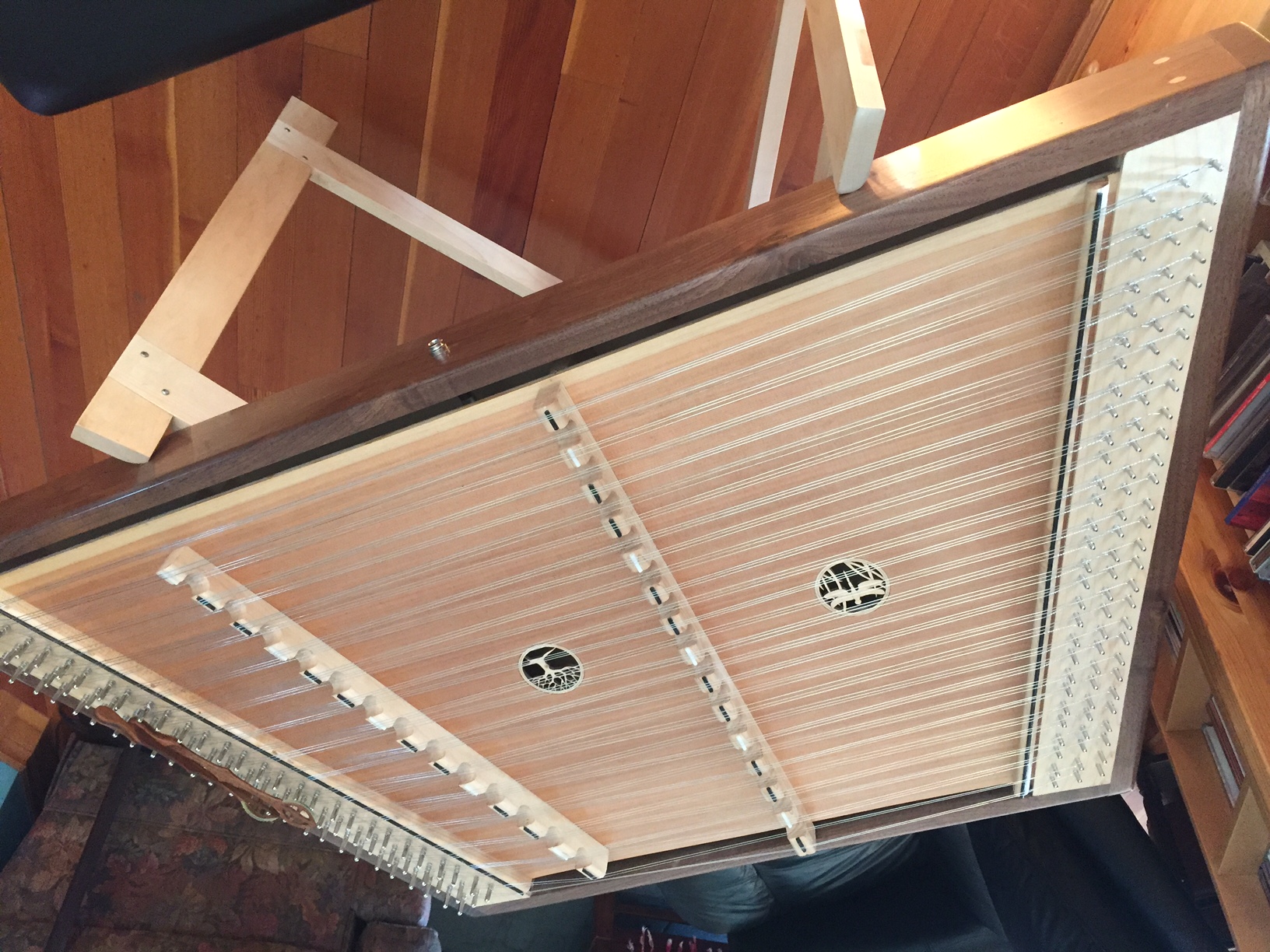
After nearly exactly 3 months on and off work my new 15/14 hammer dulcimer is finished. I’ve have been playing my Dusty Strings 13/12 dulcimer (the numbers stand for the number of notes (or courses) on each bridge) for the past three years. For those not very familiar with this instrument Ardie Davis has a description and a nice American-slanted history article. It is a great starter instrument, IMG_3709but I began to crave a lower register,  more sound and an opportunity to revive my wood shop. This project met all three goals.

It isn’t really necessary to take 3 months to build a hammer dulcimer and I wish I had of taken better attention to the actual time taken.  But needless to say, this project was working on ‘retirement time’. For me that meant renovating the downstairs bathroom, moving through 2 of my Grad students defenses, skiing with my brothers and three writing “beyond LMS” articles for Contact North besides building a dulcimer.

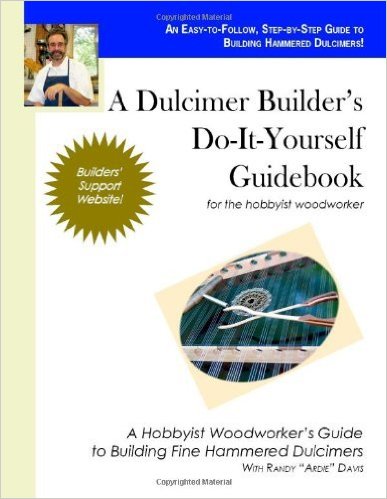
adrie davis hammer dulcimerBeing both an amateur woodworker and a very amateur dulcimer player, I asked Mr Google to recommend a set of plans or a good book. Luckily Ardie Davis has a great, ‘step-by-step” book that I followed quite religiously. The rest of this post is likely only of interest to those thinking about constructing a hammered dulcimer and thus I go into more detail than the average reader will likely find of much interest.

As Northern Alberta is not known for the quality (nor quantity) of our hardwoods the first move (after a good reading of the book) was a trip to the commercial hardwood store. Exotic wood like walnut, sugar maple and baltic spruce are NOT cheap, but for $170 I walked away with 3 large hunks of rough cut wood (one walnut, 2 hard, sugar maple) and a 1/2 sheet 5/16″ baltic birch plywood. These hunks of wood were all that my 30 year old 3/4 horse table saw could handle (note to self – buy a new table saw!) but fortunately with a trip to a friends thickness planer they came out OK. I cut one pin block twice and it was still too short (sigh), so I had to glue on a thin piece, which you likely wouldn’t notice, except I’ve just told the world.

The sound board is the most important part of the dulcimer as it supports the 2 bridges and resonates under the strings giving the volume to the instrument. This design has a “floating sound board” meaning that it fits into dado slots on the sides and has a 1/2 gap at top and the bottom. This design allows maximum vibration of the sound board and lots of space for the sound to emerge. I was very fortunate to be given a piece of old growth, quarter sawn cedar, which a friend’s father had milled 30 years ago on Gambier Island off British Columbia. The grain was incredibly straight and we managed to cut it down to 1/4″ thick pieces and then laminate two together to make the 20″ wide sound board. Thank heavens for access to a thickness sander which did a terrific job on this heirloom cedar.

Following Ardie’s instructions carefully, I managed to cut and then glue up the 2 walnut end rails, side rails and the side pin blocks. Thankfully I had invested in 6 more bar dulcimer innardsclamps – you never have too many clamps! These outside pieces enclose the Baltic birch plywood bottom in dado slots (also bought a very nice new dado blade!). Notice from the picture that 2 one inch hardwood dowels were inserted before the 4 sides were glued together. These are designed to take the load on the pin blocks  when the 87 strings are finally tuned up. You can also see the three bridge supports – the only local wood (Aspen poplar) that a friend had milled in Northern Alberta. The bridge supports are needed, as besides lateral tension the strings also push the bridge down and would likely distort the soundboard without support.

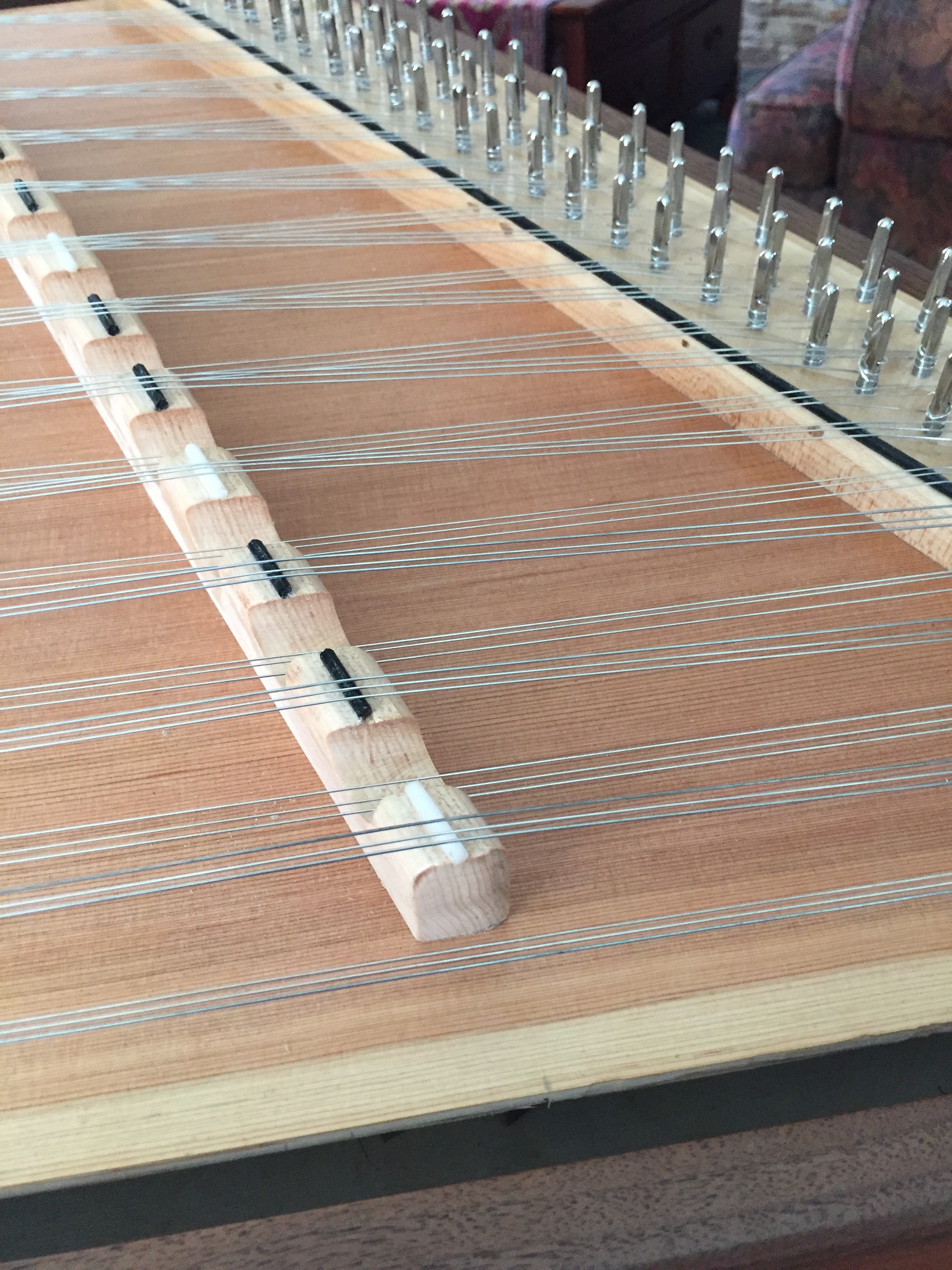
Next came the making of the bass and treble bridges and the two side bridges also from the sugar maple. The sound bridges have holes drilled in them so that the strings can move across from one side bridge all the way to the opposite pin block without hitting any IMG_3705vibration ending pieces of the second bridge. I made the bridges slightly different than Ardie recommended and followed the design from my smaller dulcimer and others I have seen (see photo). I also didn’t thread the strings through the side bridges as Ardie recommends but led them on top under a piece of black devron plastic rod.

Next came adding a few screws and covering plugs, routing the rails and then hours of sanding!

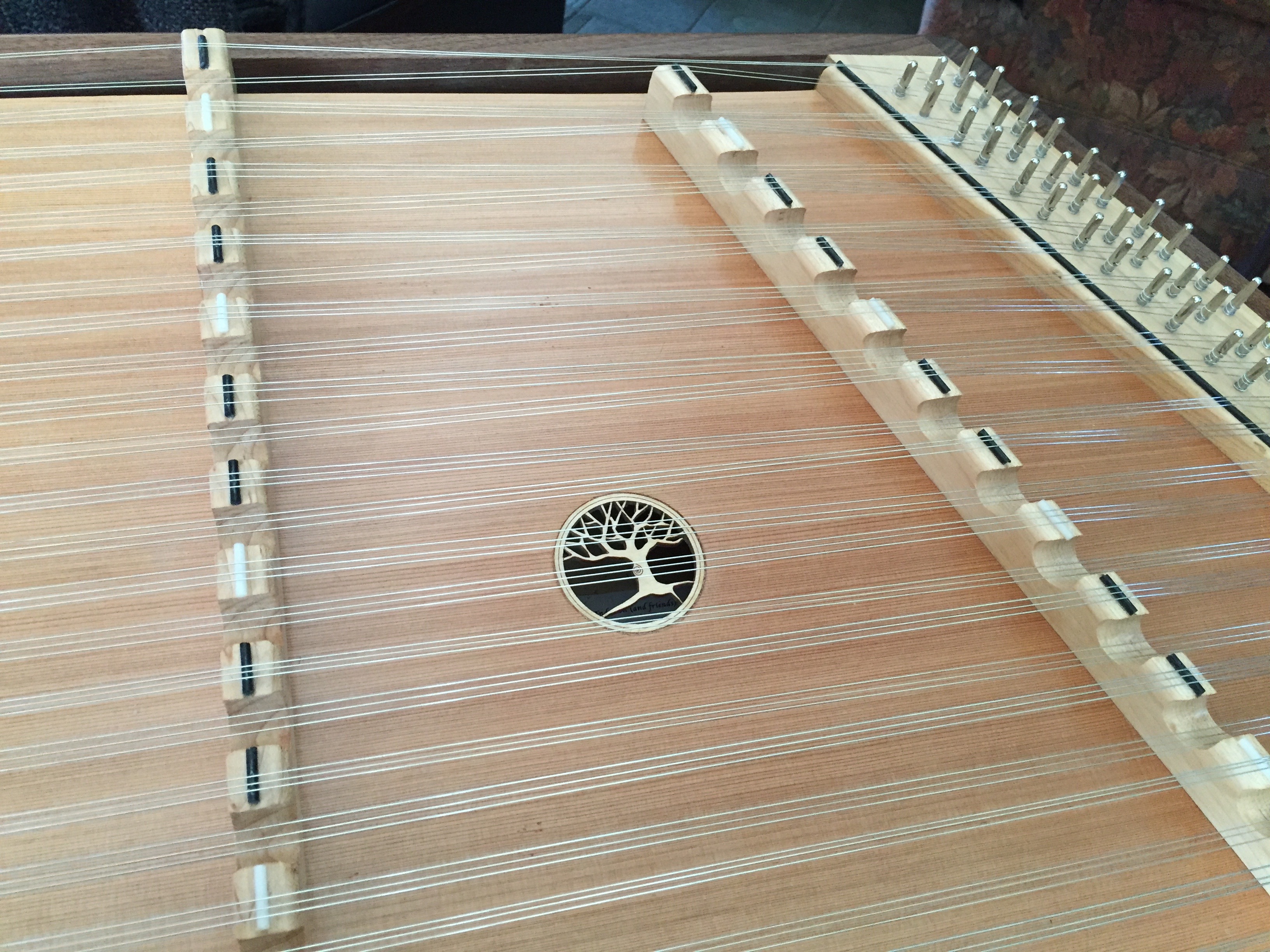
I struggled with the decorative rosettes. On a floating sound board dulcimer like mine, it isn’t really necessary to have a sound hole to let the sound out, but they look so nice! So a good friend and I spent an afternoon on his CNC milling machine, taking some groovy pictures off the net and then importing the JPEGs into the machine’s software. Unfortunately, the cutter bits we had available were not fine enough and we eventually gave up and I ordered to two very nice rosettes ($14, US each) from the good folks at MusicMakers.

I ordered the hardware – tuning pins, hitch pins, and strings and received great service from James Jones Instruments ($168 US). How the low Canadian dollar hurts! Drilling the holes for the tuning pegs was relatively straightforward -AFTER you find the correct bit.  Ardie recommends a #15 drill bit, which is not metric, and not American but an obscure machinists’ standard – sizes not carried by the local hardware stores. Fortunately, IMG_3704asking around, I found a friend who lent me a set of these specialized bits. The holes have to be exact as the very fine thread of the tuning pin has to dig into enough wood to provide a stable and long lasting bite into the wood, without requiring a guerilla sized arm to turn.

Finally, I was  ready to start finishing (after more sanding). I decided to use MinWax Wipeon Poly and put on about 15 coats. Each coat dried quickly and although the finish isn’t factory perfect (I did it in my dusty wood shop) it looks OK. Ardie’s design allowed me to finish the soundboard before assembly and install it later, which was nice.

At this point I considered the value of installing a pickup to plug into my small guitar amp. I wasn’t sure it would really need the amplification, but if I didn’t do it now, I would never be able to get the amplification directly off the soundboard AND have it nicely concealed. So, I purchased a K&K  2 head acoustic pickup ($100) and installed the jack through the bottom rail.

While the finishing was taking place, I constructed the stand from maple according to the design Ardie recommends. In retrospect I should have made an adjustable stand that I could use standing up or sitting down, but this one works OK.

Finally the day for the big string up! 87 strings makes for a whole day of twisting, turning and coaxing wires around twice as many pins. I should have ordered a few spares of the top thin wires as one broke immediately and a second the following day. However, with 3 strings per note, you can get away with a few missing strings! The tuning seemed to take forever as the strings stretched and the whole dulcimer creaked! My trusty tuning app on the IPhone was indispensable for this task. Numerous times,  I would finally get the last strings in tune, only to find that the ones I had started with had all gone out of tune – sigh.

But eventually they stabilized and WOW what a sound compared to my smaller dulcimer.

All in, the instrument cost about $500 – in addition to providing rationale for buying a new (to me) router, router table and two new saw blades. The retail cost of such a dulcimer is around $1500 Canadian – and the pleasure of playing is priceless!

Lessons learned:
1. Don’t build an obscure instrument before the Internet – these long tail hobbies need a way to connect with suppliers and advice.

2. Use what social capital you have to beg and borrow both local expertise and tools.

3. Don’t strive for perfection – it is supposed to be a fun job!!


End of Jobs in Online Education?

End of Jobs in Online Education?

I started out my teaching career as a “shop teacher” – teaching middle school students how to work and built with a number of technologies. Thus, it was a bit disturbing to listen to recent CBC radio broadcast listing jobs that have disappeared and to hear that ‘shop teachers’ along with elevator operators, typists and postal worker were disappearing.

Two articles from the latest issue of Online Journal of Distance Education Administration, caught my attention for the same reason. Will technologies soon reduce or even eliminate the relatively new job position of “online teacher”.

The first article,

Vu, P., Fredrickson, S., & Meyer, R. (2016). Help at 3:00 AM! Providing 24/7 Timely Support to Online Students via a Virtual Assistant. Online Journal of Distance Education Administration, 19(1).  http://www.westga.edu/~distance/ojdla/spring191/vu_fredrickson_meyer191.html.

directly addresses the issue of substituting the traditional teacher role of answering student queries with a machine. The article notes that most online students do their work in the evening and on weekends when many teachers are not interested and often not available to answer questions.  In an attempt to provide some sort of 7/24 service the instructors built a chat bot and seeded it with a database of questions culled from archives of questions asked by students taking the course in previous terms.  Chat boots have rarely been used in education, though colleagues at Athabasca worked developing a Freudbot. But chat bots are becoming ubiquitous on online shopping sites where they provide a type of 7/24 customer support.

During the design-based research project the Bot was involved in 475 sets of interactions with the 56 students enrolled in 2 sections of an early Childhood Education course. As expected more than half of the interactions took place on weekends and 88% were during evenings. Of course some of the questions were ‘off topic” and used by curious students to learn the capabilities of the bot. But many were on topic with 65% of queries focussed on information seeking – much related to assignments and exams.

Of perhaps most interest was the students’ reactions, which were queried by 5 point Likert perception questions.  Only about half (m=2.5) found the bot did effectively  answer their question, but nearly all (m=4.8) noted the extra service provided 7/24 by the bot and over half (m=3.3) preferred asking the bot rather than emailing the teacher.  The effectiveness of these type of bots naturally grows as the data base expands through use and the searching algorithms improve. Thus, one can, even now, see how machines will undertake ishot-266at least some traditional teaching roles which in a positive sense can give teacher more time for more important learning diagnosis and help and reduce time spent on administrative type queries.  It is also interesting to think about the “teaching presence” of of the female avatar (displayed at left) used in this study. In any case a very nice exploratory, design-based study.

The second employment related article compared adjunct teachers employed in for-profit universities as compared to those in the not-for-profit sector. This is an important problem as more than half of online courses in the USA are taught by part-time sessional instructors. This in itself has huge implications on job stability for teaching faculty, but the rise (in the US) of for-profit universities with a tradition of not offering tenured positions, doing no research and not training next generation of scholars is also threatening.

Starcher, K., & Mandernach, J. (2016). An Examination of Adjunct Faculty Characteristics: Comparison between Non-Profit and For-Profit Institutions. Online Journal of Distance Education Administration,, 19(1).  http://www.westga.edu/~distance/ojdla/spring191/starcher_mandernach191.html.

This study used an online survey to query 859 online adjunct teachers. The results were remarkable in the lack of statistical differences between the teachers at the two types of institution. No differences in age, satisfaction, education or a host of other variables. There were small differences in class size, but this was confounded by the higher percentage of graduate courses (with normally smaller numbers of students) in the public, not-for-profit universities.

The authors put a nice spin on the discussion by noting that the similarity means that professional development and support can be shared between the sectors – unlikely as that may be. But the study also adds empirical support to the notion that education can be and is being  “privatized” with resulting decreasing employment for traditional, tenured faculty.

So what do I conclude from these two very good articles? I think one of the largest challenges for our global population (ranking right up there with climate change) is the capacity to meaningfully employ people in a context in which machines are more and more able to perform both mundane as well as high performance and high communication tasks. My Interaction Equivalency Theory speaks to this by noting the ways in which activity that used to be performed by live teachers (student-teacher interaction) can and is substituted by bots and canned media to create high quality student-content interaction.

The Enigma of Interaction

The Enigma of Interaction

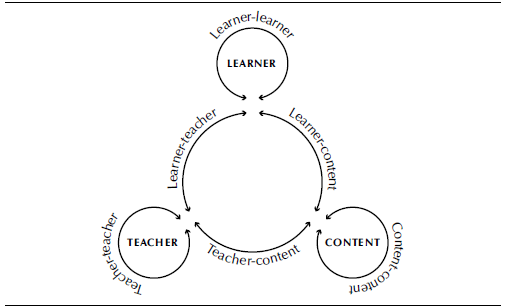
I’ve been fascinated by the role of interaction all of my career as both a student, a researcher and a teacher. Michael Moore’s famous article details the role of  the ‘big three’ (student-student, student-content, student-teacher) interactions and influenced Randy Garrison and I to explore the other 3 possibilities (teacher-teacher, teacher-content and content-content interactions).  I’ve written a number of summary articles, a recent article on interaction in MOOCs  and note that interaction serves as the primary indicator of ‘presence’ in the Community of Inquiry (COI) Model.

anderson-learner-teacher-content-theory-p58

Many, many research articles have shown significant and positive relationships between interaction and a host of outcomes including persistence, achievement and enjoyment. However, these studies are almost always correlational and sometimes based exclusively on student perceptions. These are useful methodologies but marred by challenges of proving causation. Did the interaction cause the positive outcomes (causation) or do motivated students both interact more and get better marks (correlation)?

Thus, I was pleased to see an interaction study in the latest issue of IRRODL that used a quasi-experimental study to examine the impact of student-teacher interaction. The article:

Cho, M., & Tobias, S. (2016). Should Instructors Require Discussion in Online Courses? Effects of Online Discussion on Community of Inquiry, Learner Time, Satisfaction, and Achievement. The International Review Of Research In Open And Distributed Learning, 17(2). doi:http://dx.doi.org/10.19173/irrodl.v17i2.2342

The study was set in the context of a US undergraduate, fully online course with between 25-30 students in each of three sections taught by the same instructor. In the first instance there was no discussion. In the 2nd, the teacher posted a weekly discussion question and students were obliged to post at least one answer and one comment per week (typical forced participation that brought down the wrath of friend Jon Dron in a recent post). In the final section the teacher actively participated in the weekly discussions. In all cases the teacher was readily accessible via email.

A strength of the study was the multiple measures of interaction effects. These included:

  1. completion of the COI Inventory – a Likert-scale, perception instrument derived from the original indicators of teaching, social and cognitive presence).
  2. Student satisfaction measured by 3 lLkert questions
  3. Time on task as represented by login time to the LMS
  4. Student achievement as measured by final grade. The authors wisely excluded the marks for participation awarded in instance2 and 3.

Perhaps the least surprising outcome was that perceptions of social presence were significantly different with, as expected, higher perceptions of social presence in the more interactive instances. Also not surprising is that teaching presence increased in the 3rd instance, but not significantly.

The results became both interesting and surprising on the final 3 measures.  In each of the three course sections, each with markedly different amounts of interaction, there were NO significant differences in terms of time on task (logged into Blackboard), student satisfaction or student achievement. There was a small (but not significant ) increase in student satisfaction in the 3rd instance with enhanced teacher participation.

The discussion section of this paper is also very good. They note that time requirements for participation required in the forums in instances 2 and 3 did not end up costing students more time – at least as measured by Blackboard logins.  Finally, they note the obvious – teacher participation did not lead to increased achievement – despite the assumed time commitment required of the teacher.

These results tend to reduce support for the importance a number of the types of student and teaching presence described and promoted in the COI model. But the results provide support for the ideas I promoted in my Interaction Equivalency Theory.  I proposed there that given high levels of one of the three levels of interaction, the other two could be reduced without loss of academic achievement.  I also noted in my 2nd thesis of that work that likely increased satisfaction would results if more than one of the three forms were used (in this study, there was an increase but it was not significant in student satisfaction across the instances) but that it would come at increased cost (usually time to both teachers and students).

The study also did not look at attrition, perhaps because the numbers were small. I know from experience at Athabasca, when teaching and peer interaction is drastically reduced in self paced and continuous enrolment designs, that attrition almost always increases.

This excellent study concludes with recommendations for practice which include the note that student-student and student-teacher interaction are just choices and shouldn’t be considered to be hallmarks of all online (or classroom) courses. Good learning design counts!

A Fourth Presence for the Community of Inquiry Model?

A Fourth Presence for the Community of Inquiry Model?

The Community of Inquiry has emerged as the most widely referenced (the seminal 1999 article approaches 3,000 citations) and arguably the most widely used model for constructivist based e-learning design and research. I’ve always thought that it’s greatest strength is its simplicity (only 3 major, but interacting components) and the way the model can readily be used by teachers to devise and evaluate online learning courses and by researchers to guide the development of research questions and data collection strategies.

In the late 90’s we were interested in showing empirically that emerging ‘new’ forms of interactive distance education could support the type of high quality learning that is possible (though certainly not always available) in classrooms. We wanted to provide evidence for Randy Garrison’s claim that this was a new mode of teaching and learning that was education at a distance – not high tech, traditional cognitive behavioural style distance education. Thus, we focused on a key component of constructivist learning –social presence. We also picked up on Randy’s earlier work (based on Ennes, Paul and Lipman’s work) on critical thinking to devise the phases of cognitive presence. Finally, though Walter Archer, Randy and myself were all active in informal adult learning, we realized that the activity we were focusing on took place in institutional contexts with students studying in degree programs. Thus, we wanted a focus on the critical design, facilitation and subject matter expertise components of teaching presence.

Perhaps we quit too early, as this post argues next, but we had created a parsimonious model that was easily illustrated in the now famous COI Venn diagram. I also recall the fluidity with which new indicators were added to each of the presences as we poured over the transcripts from asynchronous computer conference based courses.   In early days, it was easy to add, delete or reword indicators, but the three presences seemed to us then to account for all the major themes of successful online courses. A special call out here to Liam Rourke who worked as a graduate student on this project, and was responsible for much of this early identification and classification work. The COI work was especially enhanced with the development by Ben Arbaugh and colleagues of the COI survey, which made it much easier to gather perception data to measure each of the three presences.

We have never argued that the model identifies all possible components of successful formal education – either online or in the classroom. And perhaps not surprisingly, it wasn’t long before additions (and a few deletions) were suggested. For example, David Annand, (2011) suggested that social presence wasn’t really needed for effective teaching and learning.

A number of researchers picked up on the need for the contextual or interface “presence” and in the case of distance education for the participants to master the mediating technology. Gilly Salmon (2000) in her famous 7 step e-learning moderation model sees such technical support as a key component of each of her moderation steps. I was never that impressed with these arguments as every context – including classrooms, uses some combination of asynchronous and synchronous media to support teaching and learning. Thus, the “presence” of the media and the need for and skill with which teachers and learners adapt to it is a minor factor that is unique to each teaching and context and I thought would needlessly complicate the COI model.

First came the close to convincing arguments from Peter Shea and his colleagues that the COI model lacked awareness of the critical role that the learner plays in formal education. We all realize that the same learning context and interventions can affect different students with vastly different effect. Thus, Shea and Bidjerano (2010) postulated the need for Learner Presence to account for these important learner set of variables in either online or classroom education.

Marti Cleveland-Innes, Prisca Campbell (2012) and other of Marti’s colleagues next argued that “emotional presence” was notably absent from the original COI model. My rather lame excuse that 3 males from Alberta, were very unlikely to posit the existence of emotional presence, since “real men” in Alberta, don’t do ‘emotion’. Rienties and Rivers (2014) picked up on these ideas of emotional presence in a review study – Measuring and Understanding Learner Emotions: Evidence and Prospects. They who directly added a fourth element to create what technically is now no longer a Venn diagram since it does not show all possible interactions of all 4 components.   It is now a Euler model – see http://math.stackexchange.com/questions/1475/why-can-a-venn-diagram-for-4-sets-not-be-constructed-using-circles).

The most recent suggestion for a fourth presence comes from Lam (2015) who validated the existence of the original three presences, and then coined a new term for the type of learner agency that resonates with Shea’s “learning presence. Unfortunately she described this new addition to the COI as “Autonomy Presence”. Wikipedia explains that Autonomy comes from Ancient Greek: αὐτονομία autonomia from αὐτόνομος autonomos from αὐτο- auto- “self” and νόμος nomos, “law”, hence when combined, is understood to mean “one who gives oneself one’s own law” (Wikipedia). The word is used largely in the context of independence and freedom to make one’s own decisions. In educational context, this “autonomy” is valued to some degree, but as all students know, is severely curtailed by the edicts and wishes of the teacher. The indicators that Lam uses to identify and classify autonomy presence are however becoming increasingly important as the Internet provides additional or supplemental resources and communities that students can use to enhance, augment and validate their learning. (see below)
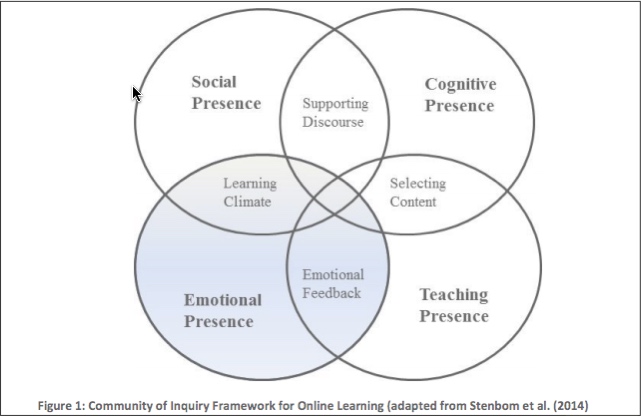
ishot-256

Terumi Miyazoe and I (2015) discussed this empowerment and the ability for students to increase student-student and student-content interaction in the context of my interaction equivalency theory in our 2015 paper Interaction Equivalency in the OER and Informal Learning Era.

It strikes me that the critical elements of learner, interface and autonomous presence flow directly from Alberta Bandura’s (1989) work on agency in which he described three types of agency in social cognitive theory. These are autonomous, mechanical and emergent interactive agency (p. 1175). The word agency evolved from Medieval Latin agentia “active operation,” Certainly the capacity for “active operation” can include most of the elements of interface presence since being productively active implies control over the environment. Shea’s reminder of the importance of the learning presence in the control of “active operation” is also subsumed in agency.

So my own suggestion in the search for the ‘missing’ element(s) in the COI model is to add agency presence to the COI trinity. This term is simpler than autonomous, builds on the seminal work of Bandura and captures the components mentioned by both Shea and Lam.

But where does that leave emotional presence? I argue that emotion is included in social presence (for example the indicator use of affective language) elements and in agency presence in line with both Bandura’s autonomous interaction – the capacity to recognize and use the power, insights and liability of emotional responses and his emergent agency in which emotions can be used to reach insights not accessible to those denying their existence or unable to deal with them effectively.

I haven’t validated this model empirically but it would likely include and consolidate many of the elements identified by Lam in her autonomous presence and Shea in his learning presence. And hopefully this addition would bring the COI model more in line with the emergent and networked resource ideas of modern connectivist theories.

References

Annand, D. (2011). Social presence within the community of inquiry framework. The International Review of Research in Open and Distributed Learning, 12(5), 40-56.

Bandura, A. (1989). Human agency in social cognitive theory. American psychologist, 44(9), 1175.

Cleveland-Innes, M., & Campbell, P. (2012). Emotional presence, learning, and the online learning environment. The International Review of Research in Open and Distributed Learning, 13(4), 269-292.

Lam, J. (2015). Autonomy presence in the extended community of inquiry International Journal of Continuing Education and Lifelong Learning, 81(1), 39-61.

Miyazoe, T., & Anderson, T. (2015). Interaction equivalency in an OER, MOOC and informal learning era. Best of Eden 2013 Issue – EURODL. http://www.eurodl.org/?p=special&sp=articles&inum=7&article=695.

Rienties, B., & Rivers, B. A. (2014). Measuring and understanding learner emotions: Evidence and prospects. Learning Analytics Community Exchange.

Salmon, G. (2000). E-moderating: The key to teaching and learning online. London: Kogan Page.

Shea, P., & Bidjerano, T. (2010). Learning presence: Towards a theory of self-efficacy, self-regulation, and the development of a communities of inquiry in online and blended learning environments. Computers & Education, 55(4), 1721-1731.
 

Little Free Librarian Inspects Little Free Library

Little Free Librarian Inspects Little Free Library

I had some fun with the little clay model that I posed for in the market in Tianjin, China.  The artist used multi-coloured modelling clay with amazing skill to create caricatures for his customers.

Since then my statue has been guarding the house from the fireplace mantel, but last week, he got bored, and wanted to check out the Little Free Library.

SAMSUNG CAMERA PICTURES

Browsing the stacks

While he was growing the stacks, I took these pictures.

SAMSUNG CAMERA PICTURES

Little Librarian (in bottom left)


Self-paced MOOCs and Blended Learning

Self-paced MOOCs and Blended Learning

One of the challenges in designing any educational program is balancing the need for individual freedom (of pace, space, relationship, technology and other freedoms that Jon Dron and I have described in Teaching Crowds) with the benefits of social learning. Maximizing freedom leads down a path of individualized and self-paced programming. It may be possible to Have your cake and eat it too, but incorporating social activities into self-paced programming presents many challenges to designers, teachers and students. In this post I want to describe promising developments in self-paced MOOCs for use in blended learning contexts

One of the advantages of blended learning and its variation of a “flipped classroom” is the mix of event based programming with student freedom to shift at least space and time during the asynchronous, online portions of the course. However, aggregating, creating and curating the content and activities for the online portions of this model can present challenges for teachers and especially those with limited levels of network literacy. The growing number of Open Educational Resources and content, not specifically designed for education, but with an open license certainly helps meet this need. I’ve often thought that MOOCs or portions of MOOCs could be ideal material for this task. They often display production quality beyond a single, underfunded teacher/producer and student exposure to well-known academic experts and good teachers can enhance the learning experience. However, two challenges have, to date, frustrated extensive use.

The first challenge relates to access. Most MOOC content and especially that produced by commercial companies is copyright protected and often hides behind passwords or is only accessible a limited number of times during a year. The second challenge also relates to scheduling in that the majority of MOOCs have been paced, meaning the start and finish dates are set by the MOOC provider and these dates rarely match with the scheduling needs of blended learning programs.

Progress is being made on both fronts. The recent “State of the Commons” report celebrates the continuing increase in amount of content licensed with a variety of Creative Commons licenses. This material can legally be included in blended learning courses. On the second front more and more MOCCS are moving to a self-paced delivery format or they are offered as self-paced resources after their debut as a paced course.

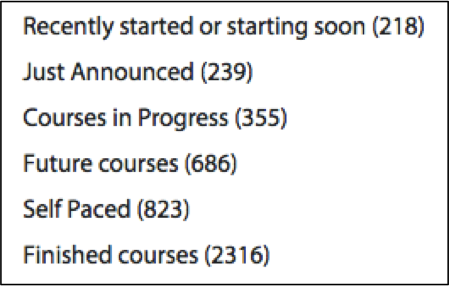
This shift is illustrated by data from Class Central, which provides a directory of MOOC offerings from many providers.

self-paced moocs

As can be seen there are 2,316 finished MOOC courses. Presumably none of the content from these courses is available for re-use. However, there is a significant and growing number of courses that are offered in self-paced format. Udacity has been delivering its mostly science orientated programming using self-pacing almost since their inception. But it is CoursEra who is demonstrating the shift towards self-paced programming most clearly. No doubt they see potential revenue (from completion certificates and revenue generating eye-balls) disappearing as soon as the course has finished.

A very limited of educational institutions (for example Athabasca and Thompson Rivers in Canada, Open University of the Netherlands and Open PolyTech in New Zealand) offered self-paced courses for years. Predictably, course completion in self-paced courses is always less than in event paced courses. However, as CoursEra and other MOOC suppliers are realizing, self-paced courses offer distinct advantages to some students. As described in my earlier post, we have attempting for years to provide “compelling, but not compulsory” learning activities that include social learning opportunities for our self-paced students at Athabasca. These effort have not been overly successful and integration within the administrative structure of self-paced institutions remains challenging. (see for example the challenges uncovered by one of my Doctoral Students, Jan Thiessen in her thesis Self-Paced study at a Distance.

Nonetheless, the much larger context of blended learning, may more easily incorporate self-paced resources in their blended programing. A number of studies have looked at MOOC use in flipped or blended classrooms – (Bruff, Fisher, McEwen, & Smith, 2013; Holotescu, Grosseck, Cretu, & Naaji, 2014; Milligan, Littlejohn, & Margaryan, 2013). Generally they conclude that the social glue from the classroom does a nice job of pacing and providing social interactions between and among students and instructors. Yousef, Chatti, Ahmad, Schroeder, & Wosnitza (2015) also do a nice job of showing how learning analytics can also be used by students to monitor the course and their performance.

Thus, I think self-paced MOOCs will continue to find a valuable role in the ongoing (if SLOW!) evolution of Universities and adult education and learning generally. The classroom experience can motivate and pace while providing an instructor the opportunity to personalize, regionalize or in other ways add value to the MOOC. And finally, let’s never forget the potential of this type of blended intervention to save instructor time.


References


Bruff, D. O., Fisher, D. H., McEwen, K. E., & Smith, B. E. (2013). Wrapping a MOOC: Student perceptions of an experiment in blended learning. MERLOT Journal of Online Learning and Teaching, 9(2), 187-199.

Holotescu, C., Grosseck, G., Cretu, V., & Naaji, A. (2014). Integrating MOOCs in Blended Courses. Paper presented at the The International Scientific Conference eLearning and Software for Education.

Milligan, C., Littlejohn, A., & Margaryan, A. (2013). Patterns of engagement in connectivist MOOCs. MERLOT Journal of Online Learning and Teaching, 9(2).

Yousef, A. M. F., Chatti, M. A., Ahmad, I., Schroeder, U., & Wosnitza, M. (2015). An Evaluation of Learning Analytics in a Blended MOOC Environment. The European MOOC Stakeholder Summit.


Retirement is like being on sabbatical – only longer

Retirement is like being on sabbatical – only longer

As my first “academic” term as a retiree draws to a close, I’m reflecting on what it actually was like to be retired. We hear all the stories (about men especially) who get terribly bored, follow their wives around the house, get addicted to golf or some other bad habit – but it hasn’t been that way for me – yet!

I know some of my colleagues have basically “moved on” and completely dropped the academic and scholarly parts of their lives once finally “packing it in”. But I didn’t think that would happen to me. I guess I still find lots of things of interest in education, lots I don’t know, technology improving AND I don’t need an expensive lab, grad students or postdocs to feel a part of it.

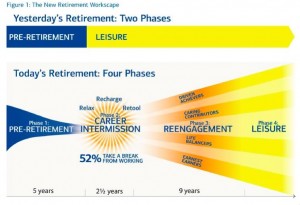
I also didn’t really experience (yet) what Merrill Lynch describe as a ‘career intermission’

ishot-250

Mostly retirement is like being on sabbatical. When I’ve been privileged to go on sabbatical, my teaching and administration roles have been eliminated but I’ve always kept my grad students, done the odd key-note, travelled a bit more than usual, done more hiking and biking and had more time for reading and music – both for fun and academically. However, usually I have some big sabbatical project hanging over my head- like a book that NEEDS to be finished or a garage that NEEDS to be built.

This fall has been like that. I did three keynotes (Brazil, Oklahoma and Denmark), a fair bit of biking (despite having my favorite bike stolen (sigh)) and tried to play my hammer dulcimer every day. I managed to get one of my remaining grad students through defense, and yes, there were two big projects – both of which finally draw near to conclusion.

First of these was a 2 day-a-week consulting job leading a task force to develop a teaching and learning plan for the School of Business at the University of Alberta. I had worked for the University of Alberta before coming to Athabasca University as an academic, EdTech type, change agent – with little real success in the change department. When I returned fifteen years later I found not much had changed – despite or in spite of networked pedagogy, crowd technologies, open access, MOOCs and lots of other potential. Nonetheless, I enjoyed the experience and produced what I hope is a visionary but DOABLE agenda for enhancing teaching and learning at the School.

The second big job was to lead a task force on financial issues for our small Unitarian congregation. Unitarian- Universalists are the mostly highly educated religious denomination in North America, but among the lowest per capita contributors. We have been running deficits for years and it was time to re-think giving and spending. We haven’t resolved the issue but produced 20 pages of facts and comparisons to other social and religious organizations and discussions on various methods to balance the budget.

What I really like about December on sabbatical or retired, is that I have no term papers, essays or final projects to mark and no grades to submit.

Finally, I think I forgot to mention that I’ve become a cover boy for the senior set here in Edmonton. I know it’s not Time Magazine or the Rolling Stone, but I made the front cover of the Edmonton Senior.

So retirement has been great. I look forward to the Solstice Celebrations now fast approaching and wish you a very relaxing and invigorating holiday season.

European MOOCs – Special Issue of IRRODL

European MOOCs – Special Issue of IRRODL

ishot-248

We certainly are past the famed “Year of the Mooc” but there availability and I will argue impact on adult education is far from past. This week’s special issue edited by Markus Deimann, Sebastian Vogt adds many new insights – a few of which I’ll comment on in this post.

The first article MOOCs and the Claim of Education for All: A Disillusion by Empirical Data by German authors Matthias Rohs and Mario Ganz works within a critical paradigm to address issues of inequality and lack of opportunity to debunk the notion that MOOCs are “education for all.” The article is well written and has some good conceptual information on Knowledge Gap Theory, but I didn’t find their survey results either original or surprising. I don’t think that finding that most people in Germany who take MOOCs on Adult Education are themselves adult educators and already have University degrees is at all surprising, nor a valid criticism of MOOCs. The notion that MOOCs attract niche audiences is not surprising nor alarming. They also lament the increase in 2-tier MOOCs whereby students wishing to get a certificate and be tested in their learning, are required to pay a fee.   However, I think to be viable a MOOC needs some revenue stream and this model still allows the learner to browse or consume with no cost.

The 2nd article Opportunities and Threats of the MOOC Movement for Higher Education: The European Perspective, by a host of well-known European authors provides an EU centric look at the opportunities and threats of MOOCs. The study uses a twitter hash tag data-collection technique which provides a unique way to do a type of Delphi study, but the participation rate and number of tweets is surprisingly low. No surprises are the opportunities for innovation and collaboration and the (mostly unrealized) potential to move this learning opportunity into valid and widely accepted credentialing of learning outcomes. Conversely the threat (again NOT a surprise coming from Europe) is too much bureaucracy and vested interest in bridging the chasm separating formal and informal education.

The third article by Abram Anders, Theories and Applications of Massive Online Open Courses (MOOCs): The Case for Hybrid Design is the only article not by a European author. The article does a nice job of trying to categorize the pedagogy underlying MOOCs. It is always nice to see our own work referenced (Anderson & Dron, 2011) and Anders uses our 3 generations of DE pedagogy to map a third “hybrid model” MOOC based on social constructivism. This adds a middle ground between Stephen Downe’s distinction between cMOOCs and xMOOCs.

The next article Setting-up a European Cross-Provider Data Collection on Open Online Courses describes the start-up phase of the EU- funded MOOCKnowledge project. The article is a call to action for large-scale data collection amongst MOOC providers to gather a host of demographic, motivational, employment and other data from participants. One can almost see the resulting path analysis studies that could arise from their proposed data collection model for predicting outcomes of MOOC participation such as completion and satisfaction.

The next article adds to the long debate amongst distance educators as to what constitutes open, in so-called open education systems. Obviously, MOOCs are central to this discussion – even though we have witnessed evolving meanings of the Open in Massive Open to include student cost, paid text books, use and non use of copyright protection, rigid time pacing and other dimensions of openness. In Dimensions of Openness: Beyond the Course as an Open Format in Online Education Christian Dalsgaard, Klaus Thestrup argue for three dimensions of openness transparency, communication, and engagement. They revisit Dalsgaard’s earlier work equating transparency with persistence such that student contributions are not hidden behind passwords or destroyed at the end of a course. The article is a good summary of the divisive issues that still divide proponents of MOOCs and other forms of distance education as “open” seeks a viable home amidst economic, privacy, control and assessment opportunities and challenges.

A group of researchers from Ireland next present a classic case study of a single institution, Dublin City University and their attempts to rationalize and develop a MOOC. This is a challenge that has sparked debate in probably every University in the world. Should we do a MOOC and IF we decided to how would we do it? The article takes a cue from the much older debate of picking the best LMS to the detailing the criteria for selection and brief reviews of nine potential MOOC platforms. This is the first comparison that I have seen that tries to categorize the strengths and weaknesses of each platform for the best “strategic fit” with the Dublin requirements. This is a very useful overview of how one university comes to grips with the potential benefits, the cash, opportunity costs and contextualized type of tools needed for a successful implementation. The article will be very useful for any institutions still wondering if there should be a MOOC or two in their educational strategy.

In the second article from EU Home project the authors present results from a series of annual surveys assessing institutional attitude and experience with MOOCs. The article is interesting as it charts the changes in attitude and practice over the past two years. Further it displays differences between European and US universities. There aren’t too many surprises in the data but it certainly shows that though MOOCs have North American roots, the current and present focus – at least at the institutional level is shifting to a global perspective.

I’ve always had a soft spot in my heart and mind for the local study centre. My first full time job in distance education was as Director of Contact North and I was charged with setting up dozens of community learning centres in small and often isolated towns in Northern Ontario. My PhD work examined students’ perspectives of learning in these distributed communities and this was the genesis of the work that my supervisor Randy Garrison and I did to develop the Community of Inquiry model. Thus my interest in the 7th article Using MOOCs at Learning Centers in Northern Sweden. In an era when educational programming is as easily delivered to the home or office as to a formal learning centre, it is useful to read about the experience of people who take the time and expense to gather together physically to learn. The article recounts the long Swedish history of “Learning Circles” and provides concrete suggestions for using MOOCs as the content piece of learning – leaving social constructivist engagement to happen face-to-face in a community learning centre.

The next article from Portugese authors is a case study of an iMOOC on Climate Change: Evaluation of a Massive Open Online Learning Pilot Experience. iMOOC is yet another variation on the MOOC sub- categorizations theme that brings some of the expertise and tools from “normal” formal online education to MOOCs. The case study shows high levels of persistence (relative to most MOOCs) and the general success of the model. I was especially interested to see the use of ELGG platform for the social components and integration with Moodle which was used largely as a content provider. Jon Dron and my work on Athabasca Landing, based an ELGG platform, that we created to work in a similar fashion as the persistent social glue to the content provided by Moodle.

The final paper, A MOOC on Approaches to Machine Translation provides another case study of a successful MOOC – this time from Catalonia. The MOOC used the popular open source Canvas platform and the researchers provide lots of graphical displays of demographics, persistence, motivation and perceptions of value.

So what do I conclude? First, if one thought that MOOC was synonymous with American culture and venture capitalists, these notions will be disabused by the refreshing look at MOOC experiences from a European perspective. The special issue editors Markus Deimann and Sebastian Vogt from Germany did a good job of shepherding these 10 high-quality articles through the IRRODL review process and helped IRRODL realize a bit more the ‘International’ in its name.   Thanks to the editors and each of the authors.

Second, the issue in total provides a host of practical examples of the way MOOCs have evolved both technologically and pedagogically. As we all experience, it is hard to keep up with EVERTHING, but even a skim reading of this issue will update and show how MOOCs have ridden the roller coaster of hype, through the trough of disillusion and are now ascending to find there rightful place in a world in great need of quality lifelong learning.