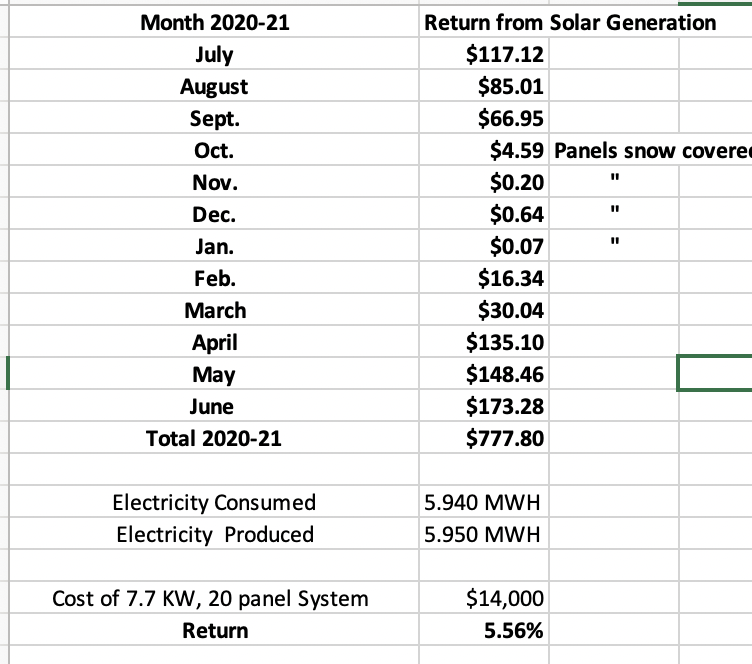
Almost two years ago I installed solar collectors on our Edmonton home and garage. Neither location was perfect- one facing WSW rather than South and one partially covered with shadow from trees an a neighbouring house. Nonetheless, I was able to install 20, 385 watt panels for a total capacity (under full sun) of 7.7KW. The total cost was around $18,000 Can and I received about $4,000 government incentive – so $14000 investment. For the first few months I stuck with my old supplier and saw minimal returns and terrible documentation of my micro-generation.
So last year I switched to a small energy coop the Alberta Cooperative Energy which has a great deal for micro-producers. I sell (and buy) electricity to the grid at a much higher rate ($.25 KWH) when my collectors are producing during the summer- yielding a nice monthly payment. During the winter I revert to standard rates in Alberta (~.06 KWH).
The annual bills from ACE revealed that we had used 5.940 MWHs from the grid and generated 5.950 MWHs to put back in! Self sufficiency – sort of. Of course in dark and cold Northern Alberta winter, we were consuming much more than we produced.
A further look at bills showed the financial payback detail. The first full year produced an annual return of 5.56%! Too bad the panels were snow covered for 4 months!
This return is tax free and appeals to my inherently frugal mentality.
I hope this data inspires others to make their own solar investments.
My friend Lloyd Marshall posted the image below to Facebook last week. It prompted this post reflecting on “the spiritual but not religious” meme we hear regularly in post-church society.
Let me begin by noting that I am an atheist. It god did exist, she would be way to busy starting new universes to worry about my sins or to be interfering in our lives. But I am also a Unitarian Universalist and thus choose to live (at least part of the week) in a religious fishbowl.
Let me start by explaining that Unitarian Universalists have hundreds of years of “religious” history, but have also long made room for atheists, agnostics, humanists and a variety of other non-theists. Unitarian Universalist (UUs) are non- credal – a religious term that means that we don’t have to believe any particular set of believes. Modern UUs do affirm seven principles. You will likely agree that they are pretty “motherhood and apple pie” type statements that almost any decent and well-meaning person ascribes to. For example the 7th principle is “respect for the interdependent web of all existence of which we are a part.” This principle acknowledges our interdependence with all components of life, thus endorsing a positive ecological understanding of our place in nature and further, it encourages us not to screw it up! UUs also acknowledge six ‘roots” of our beliefs and actions – ranging from acknowledging the value of rationality and science, to affirming knowledge from “earth centred” or pagan religions.
So, why do a choose to live within a fish-bowl rather than swim freely as implied in the cartoon? My Father (a devote Baptist and golfer) used to quip that “certainly a person can experience God on a golf course rather than a church – but do they?” I don’t describe myself as a particularly spiritual person, but I do enjoy singing with others, listening to Bach, being in ‘sacred’ spaces and listening to inspiring speakers – in churches, on the radio and on podcasts. So, attending a UU Sunday service gives me a special place to go to and many of the things I enjoy happen there.
But most importantly I like the fishbowl for the community that swims with me in the bowl. Now, I am NOT saying that all UUs are bosom buddies – some drive me nuts! But, if I think of those individuals who I count as friends and that I see on a more or less regular basis, likely half of them I’ve met at UU churches. I also like the community because it empowers me and amplifies my effort to do more than I could by myself. UUs have a fairly strong sense of social justice – our tag line at Westwood is to “rest, grow and serve the world”. That service ranges from fund raising, to supporting women’s shelters and services for the homeless. I also donate money outside of the UU community, but I get more inspired and educated by noting and USUALLY supporting the social justice issues that are highlighted at Westwood. Finally, the fishbowl community gives me a place to stretch my mind. For example, I lead the monthly FreeThinkers’ Book Club at Westwood – a time and place that we discuss some very interesting books and at the same time enjoy each other’s company and in pre-covid times, homemade cookies!
For some the fish bowl also creates a safe space and churches have long offered sanctuary to the oppressed. I’m fortunately not feeling personally unsafe, but I do know others who value the acceptance and safety to swim as the type of fish they really are in the UU fishbowl.
I might also add that unlike real fishbowls, UU buildings have an exit door. An old joke is that UU’s are the only people that god trusts enough to take summers off from Sunday services. Unlike the Baptist church that I grew up in, UUs seem to come and go with some regularity. Many play active leadership roles and then seem to drift away or disappear. And that is OK.
So does the fishbowl restrict or distort my life in the sea? I prefer to think that it serves as a fine set of swim goggle allowing me to see the ocean and the creatures that abide within it more clearly. Or as a yellow submarine:
“And our friends are all aboard
Many more of them live next door
And the band begins to play
Each day brings news of more cancellations of social events. In many areas schools have closed and it seems as likely as not, that many campus based schools will be closing for ???? days/weeks. This is the black swan event that most financially pressed colleges didn’t really have the energy to think about. But now it is upon us. This creates both opportunity and challenge. In this post provide personal recommendations for an emergency move to online education. The unprecedented opportunity to learn from a crash course on distance education in a networked era.
The good news is that digitization is already in place across most campuses – likely both students and faculty are enrolled in an institutional Learning Management System (LMS) – (if not this should be a top administrative priority) or an institutional wide network on Google or another provider. There are a host of private and open source environments that would likely jump at the chance to host your course – perhaps even for free. Doing so is likely a very bad idea – unless there is absolutely no institutional system to safeguard emails, recordings and confidential marks. This is NOT the time to blazing innovation on the latest social software platform. Rather it is a time to get a course up running very quickly.
You can think of your course on the LMS as your own mini learning environment or classroom. When you think of the activities that go on in your campus classroom now, try to find a tool that allows you to meet that same, or very similar learning goals and learning activities – only online. For example, if you regularly use student presentations you can teach students how to be presenters on a webconference or to record and then share videos they can make with their phones. A good place to start looking for tools is the tool library in your MOODLE, BlackBoard, or Canvas LMS. It likely has tools for small groups discussions, quizzes, blogs, micro blogging, collaborative writing, gallery of photos and more.
Some wealthier and larger institutions may have classroom lecture capture systems that can be used to record your lectures, Oh yeah – your campus is closed. A simpler idea is to record a video – at home using your laptop with the built in microphone. This does not yield high definition television quality video – but it works. Again if you are lucky your institution has a contract with a video streaming service- if not you can always use YouTube.
These recorded and streamed videos of course are available 7X24, but watching video doesn’t have the same engagement and commitment value that arises when class and teacher gather online in real time. Especially, if you are taking an existing campus course online, a great tool to use is webconferencing. Web conferencing supports the real time presentation of content that defines many classrooms. However, in addition it supports student break out groups, text discussions, comments and questions and a host of quiz and drawing tools.
In education we have a long history of video conferencing (as distinct from webconferencing) courses. These courses using dedicated classrooms and very expensive technology – most of which was prone to breakdown. Current web conferencing tools like ZOOM, Adobe Connect, Big Blue Button and others can overcome many of the restraints of older technologies. These systems are great for classes up to around 60 students. The technology itself may scale beyond 60, but managing large lecture theatre takes more skill than seminar or classroom sized groups. Do remember that all of the students will likely not show up for each scheduled class. This is fine as you can record the interactions, and they can replay them when they wish to do so.
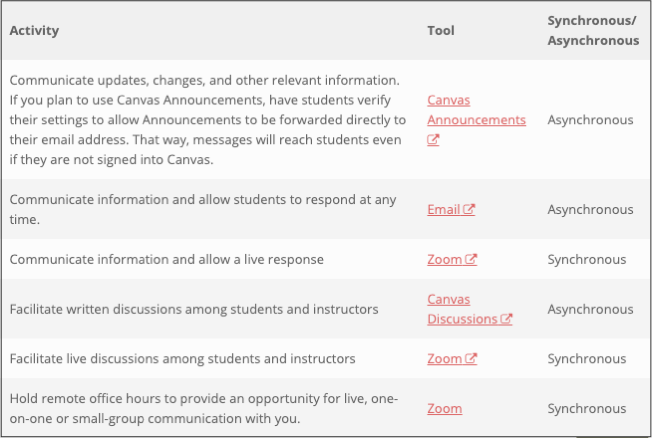
In the screen shoot above from Cornell University you can see how only three tools (Canvas LMS, Zoom webconferencing, and email), that are readily available to all teaching staff, can cover almost all the communications demands of a quality online education.
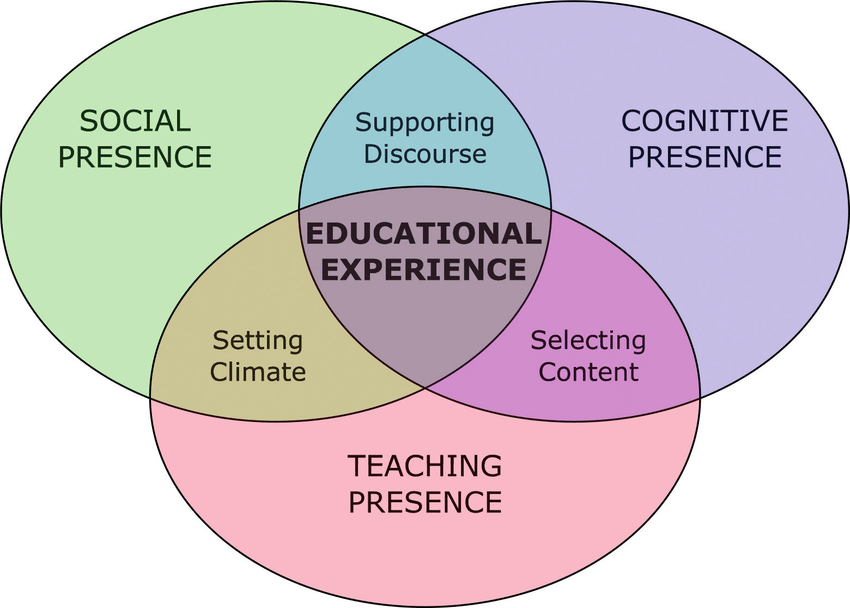
When designing and talking about online courses, I often think of the Community of Inquiry Model (COI) developed by Randy Garrison, Walter Archer at the beginning of the online course era. The strength of the COI model is its simplicity and capacity to act as guiding heuristic for online teachers. The model suggests that quality learning happens when three educational components (teaching, social and cognitive presence) are present in the online environment.
In an emergency online course, it is important for the teacher to quickly develop and nourish teaching presence. This means being present and especially in the first few days or weeks to be online daily. Second is to insure continuity of the course by posting dates and learning tasks for the remainder of the term. Although many courses run asynchronously, a great way to kick start teaching and social presence in an emergency course is with a real time class, using webconferencing tools described above. At minimum, the teacher should record a video, explaining how the course will continues in the near future.
Social presence creates a sense of security, support and humour. It is done by providing a space for students to meet and greet online, to ask questions, to chat about concerns with each other – as well the professor. The LMS is well developed to handle this informal interaction – think of causal conversation outside the physical classroom as well as creating a comfort zone where students can readily ask questions and express concerns.
Finally cognitive presence is the reason the course continues. The teacher stimulates cognitive presence by creating dynamic presentations, asking triggering questions for both individuals and small groups, monitoring interactions to clear up any misconceptions and challenges students to find ways to create applied knowledge from the information they are acquiring in the class.
Emergency courses often don’t have the luxury of time to create new content. Thus, the savvy teacher quickly checks out available open educational resources, that can be incorporated into the course. Teacher’s often think of OERs only as open textbooks and indeed, there are thousands of open text books available for free download and editing. In addition, there is a growing number of simulations, games, lab exercises, videos and graphics free for the asking. If you are fortunate there may be a dedicated OER support unit on your campus that you can contact for help finding resources. However there are many OER repositories and George Mason University runs a free OER Metafinder searchable data base.
The coming months will see lots of uncertainty and financial challenges for many, however these viruses tend to come and eventually to go. Hopefully the experience, for both students and teachers, will provide a healthy does of online education literacy.
In the perennial seasonal debate about the best kind of Solstice/Christmas tree we have been around the choices labyrinth. From the trees we harvested on our own land near Joussard, to ones we’ve purchased at the local Kinsman lot, to cheap ones from IKEA, through to a few years with a rummage-sale artificial tree – we’ve hosted many a tree Each option has usually conflicting eco and money encumbrances. Not to denigrate any other choice, but I think we have found a near perfect solution – at least for us.
Each year, for the past five seasons ,I have harvested the crowns from a seven-cedar hedge that we planted 20 years ago. Standing precariously on our recycled wooden stepladder and armed with Susan’s Jr. Forest Warden pruning saw, I detach two of the tallest crowns. In the picture below you see in the middle, Solstice Tree 2020, waiting for its big day inside, next year.
The individual tree crowns are a whee bit skinny, so I now harvest two crowns and wire them together.
Despite the fact that it took Susan some time to get the bead garlands “just right”, even when I thought they were ‘good enough” two hours earlier, I think the tree looks great!
We don’t want the cedar hedge to grow too tall, so as to block the solar panels and of course the zero cost appeals to my frugal nature. Add to that the zero transportation costs and the fun of growing your own, makes me think we have the perfect Solstice Tree.
Happy Solstice, Christmas and any other tradition that your are celebrating this season.
Last summer I was asked to join a “quality audit” team that had been created by the Commonwealth of Learning and contracted by the University of South Africa (UNISA) to do a Trail Audit. This process involved a trip to London and this month a trip to Petoria, SA. In this post I talk about UNISA, about my experiences (to which I am not accustomed) in business class and a brief encounter with the South African medial system.
The University of South Africa
The first thing you might notice from the picture below and when driving into Petoria from Johannesburg airport, is the imposing campus of the UNISA. This is the main campus in Petoria which is augmented by a network of regional offices and campuses spread throughout the country. Unisa boast over 340,000 students making it the largest university in the Southern hemisphere. All of the undergraduates work from home, businesses or regional offices. Thus, the campus houses faculty, a huge printing press, library and offices for graduate students – of which there are also thousands.
The University will be audited in 2020 by the Council on Higher Education (CHE) which is the accreditation and regularity agency of the Government of South Africa. In preparation for this Quality audit, the University contracted with COL to undertake a pre-trial quality audit.
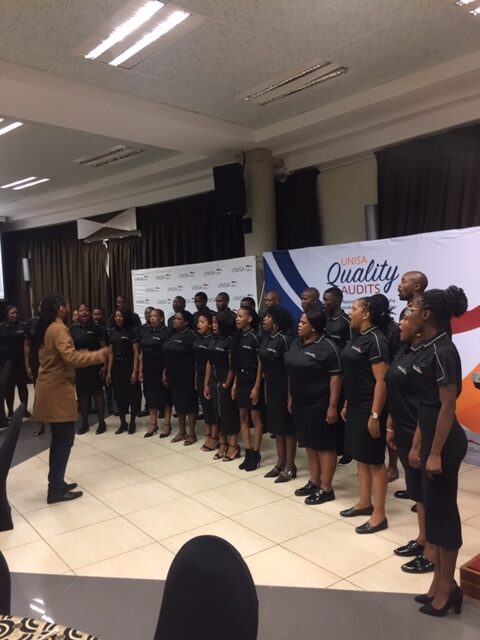
UNISA Choir entertains
Unisa was the first university in South Africa from which all of the other universities spun off. Unisa was established by the Brits in 1873 after the University of London model in which no teaching is does, but they set curriculum and examine students who learn however they can. Nelson Mandela is their most famous grad. In 1947 the University started creating print packages, thus becoming the worlds’ first distance eduction institution. They have begun huge (34% of all postsecondary students in South Africa) and largest university in Africa. They are struggling to move from an Open and Distance Learning (ODL) university to an Open and Distance Electronic Learning (ODeL) university – with a zillion challenges. One of which is figuring out if they should abandon their printing presses (largest print shop in the southern hemisphere). The print shop has a warehouse sized “Vault” in which they guard the final exams, since they are terrified of ”leaks” , by which Mafia types obtain final exams and sell them a few days before the exams are written – all across the country on the same exam days. They have testing centres in Johannesburg that sit 2,000 students, at a time, 3 sessions a day. This places them – like most higher education institutions very vulnerable to academic fraud.
Our 6 person team was led by the President of COL and consisted of Professors from South Africa, Tanzania, India, Mauritius and Canada. and with interest in quality standards, technology, student support, African universities and African Open Universities. During the week of our visit we interviewed about 300 people – from President to many students, on main campus and 5 regional centres. The idea of hiring a group of outsiders to audit a whole Universities quality standards just doesn’t happen in Canada, so I really didn’t know what to expect. A really striking feature of the project was the posters, banners, meals, banquets and pomp and circumstances about this audit and our visit . Quite surprising to see notes on our arrival displayed all over the campuses we visited.
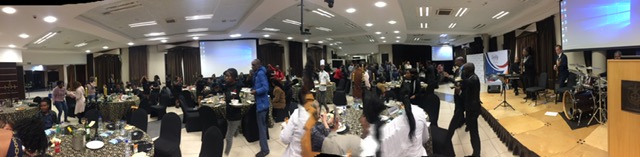
Gala Goodbye banquet with Jazz Quartet
The University (and the 5 particular programs that we selected for detailed review) undertook a self-evaluation (300 + pages of text) before our arrival. On the final afternoon we provided our initial findings to a cast of a few hundred. This presentation focused on areas lsuch as quality assurance measures, teaching and learning (my area), technology used, research capability etc. etc. Our report seemed to be well received – but how much credibility can you give to a self evaluation and 5 day visit by group of outsiders? Now we go home and pour through the notes from 2 scribes hired to record everything and then create (and have them verify) a final report. The report will have both commendations (what we impressed by) and recommendations (suggestions for improvement).
Adventures in Business Class.
Last March I had Speaking trip to South Africa as an invited keynote speaker at UNISA’s annual research week. Thus, I was well aware of the challenges of 23 hours in the air and another 10 so getting to, and switching airports. Thus, the offer to repeat the journey this month- but in business class was a real incentive. I got to savour the service on three different airlines (Westjet, KLM and Virgin Air). The trip from Edmonton in December involves travelling through two nights. Of course they treat business class passengers with a lot more choice and comfort than I’m used to in coach. I relaxed and actually fell asleep in 3 types of “sleeping pods”. The biggest surprise was opening the duffle bag at my seat on Virgin Air, thinking it would be the too small blanket that I would wrestle myself under. But no! It was a pair of flannel pyjamas – Like I am going to get into pyjamas and walk down the aisle – NOT!
The food was great – they even had a standup bar with snacks on the 747! But I didn’t do much but read, NOT drink too much, watch a couple of good movies and then sleep! I arrived at 11:00 PM Sunday and we had our first meeting at 7:30 AM the next day, so I didn’t have any time for jet lag. Getting a good sleep on the airplane seems to have almost eliminated jet lag – at least on this trip for me!
Now getting to the hard part – the carbon footprint. You may have read the data that the extra carbon cost of business class and I don’t doubt it is true. So I have little excuse, except to hope that our recommendations will impact the lives of 340,000 students at UNISA. And that that will make a difference.
My Encounter with South Africa and It’s Health Care System
South Africa is (at least by Canadian standards) a pretty scary place. Very visible poverty and unemployment are clearly visible. The protection industry is thriving guards (mostly unarmed), barbed wire, police cars and groups of people in the streets are everywhere. Alongside the poverty are miles of gated and fenced (and I mean big fences) communities. Thus there are many living in pretty severe poverty, while the evolving middle class (both whites and blacks) lives at least partially in a culture of fear. The scary irony is that the country (with its opportunities!) attracts thousands of economic refugees daily from other African countries.
I also had an adventure with the South African medical system. Two days after my arrival I started getting a pain in my lower leg, this continued into a purple rash that kept growing. I figured I better get it checked in case it was flesh eating disease or something worse! UNISA staff took me to the University Health clinic where the nurse suggested I should see a doctor. The clinic referred me to a hospital, but my hosts figured it would be too long of a wait so we travelled way into the burbs to a health clinic where I had an appointment with two doctors. It was weird entering the strip mall clinic (open 24 hours a day) and seeing signs in both Africans and English and staff of all races – expect the doctors that I saw were both white.
They pretty quickly diagnosed the rash as shingles, but they also did all kinds of pressing and pushing, blood test, heart stuff etc. I walked out with 3 prescriptions and a bill for about $100 Canadian total. Ironically, I had had a shingles c=vaccine four years ago, but I have come understand the chicken pox/shingles virus (they are the same critter) can erupt at any time from those who have chicken pox in their lifetime. I didn’t really understand the contagion issue with shingles at the time and so thought it best to cancel my one-day safari trip to see the lions. Fortunately it rained anyways, but we were told that when it rains when visitors come, it is a very good omen!
So South Africa seems to have a great health care system – IF you have money. This clinic was nearby the gated community where the black vice president who was hosting us lived, so we dropped him off at his home. He had a card to open the gate and let us drive into his house, but when we went to leave, the guards wouldn’t let me and the black driver out!! We had to drive back to the VP’s house and get him to verify that we hadn’t ransacked his house.
My flight home was uneventful- the best kind.
I hope you have enjoyed this brief chronicle of the trip.
This post was written by my older brother Dennis Anderson. He inspired my (much more modest) series of adventures my younger brothers Kent and Craig and himself. Dennis notes that getting old isn’t for the timid, but leaves openings and opportunities for some great outdoor adventures.
The Evolving Backpacker
Brothers Anderson: Kent, Dennis, Craig and Terry. Sept. 2018
The Evolving Backpacker by Dennis Anderson.
I am happy and blessed by the fact that my parents instilled in our family a love for the out of doors. For me as a young adult growing up in Southern Alberta and then moving to the interior of BC this meant that I had ample opportunities to spend time in a number of our wonderful National Parks – and in those days one didn’t need permits to just head off back packing or canoeing on over night treks.
For me this meant exploring various sections of the Great Divide Trail in Jasper, Banff, and Yoho National Parks; canoeing the Bow River from Lake Louise to Calgary; completing the Bowron Lake canoe circuit in the central interior; hiking the West Coast and Juan de Fuca Marine trails on Vancouver Island; and most recently exploring the Coastal Mountains off of Princess Louisa Inlet on the Sunshine Coast. All of these pursuits involved hauling a considerable amount of equipment – tent, stoves, food, sleeping bag and foamie, and of course clothing to handle weather fair and foul.
As I have gracefully aged (I say) I still maintain my passion for outdoor pursuits, however they no longer entail my 40 – 45 lb. back pack! A few years ago, I discovered the joys of Hut Hopping in the European Alps. For those of you who have yet to experience a European mountain hut, the term hut is a misnomer. These ‘huts’ are more like luxury lodges which often include private accommodations, terrific cuisine, and of course a place to down a celebratory cool or warm refreshing drink after an exhilarating walk. The real clincher is that for many overnight excursions involving these facilities you only have to pack clothing, snacks, and a sleeping sack – your own personal sheet, and this can all very easily be done with a pack that weighs under 20 lbs.
This approach has worked exceptionally well for me on a recent Tour de Mont Blanc (through France, Italy, and Switzerland) and in the Stubai Alps of Austria. More recently my wife and I have discovered the next ‘pack lightener approach’. This spring we did the Jesus Trail in Israel – a 65 KM walk from Nazareth to Capernaum. For this trip we used a tour company that pre booked our accommodation, provided us with a detailed trail guide, and moved our luggage for us each day. We only had to hoist a small day pack that contained water, our snacks, and clothing for unexpected weather conditions, and then walk to our next pre-booked lodging to find our luggage. This is definitely a very civilized way to go for folks who are still mobile and interested in ‘doable’ walking adventures.
Are there any caveats? Yes, in our experience, the guide book for the Jesus Trail we figure was written and walked (timed) by a 21-year-old who had just completed his or her mandatory Israeli military service and physical training. It was very difficult to meet the posted way marker times. The Tour de Mont Blanc, and the Stubai Rucksack Route we felt were timed by 20-year-old Germans who run mountain trails for fun. In both of our Alpine guides we found that we were adding another 1/2 of the posted time to get an adequate estimate of the length of the hikes in hours. In Israel we did the KM’s but it left little time for the ‘optional’ side trips that were recommended and often sounded interesting.
What have we learned? It is still great to get out-side and be in the great out of doors however we are no longer youngsters. Figure out how far you want to walk in a day and what is potentially on the route and then try to plan your own day. Remember, references to ‘allowed time for museums’ are done by folks who don’t like to read! Guide books are only for ‘guiding’. This may result in adding an extra day or two to the outing, however this little adaptation can make or break an experience, and at this stage of our lives, every little thing to make life easier and more enjoyable is worth considering.
Happy trekking or whatever you pursue to make life full and meaningful in your retirement!
I’ve spent a few hours reading and thinking about pedagogy and LARGE student numbers in anticipation of my upcoming work on a Commonwealth of Learning quality assessment team headed for University of South Africa (UNISA). For those not familiar with UNISA it is the world’s oldest, exclusively (single mode) distance education university and a mega-university (330,000 students).
My UNISA friend Paul Prinsloo referred me to a couple of recent works by Thomas Hulsmann. Thomas is a German academic who spent a few years post-retirement at UNISA. Hulsmann has an extensive publication record that focuses on cost effectiveness of various DE delivery. He has published a COL review (Hulsmann, 2016) The Impact of ICT on the Costs and Economics of Distance Education: A Review of the Literature in which he examines the costs of distance education (in many forms from correspondence to e-learning).
I was intrigued to find in his literature review the identification of the shift in my perspective from earlier days when Randy Garrison and I developed the Community of Inquiry model. He notes my shift from a focus on “traditional” student-teacher interaction (constructivist paradigm) to are more pragmatic “any interaction can work” – as in my Interaction Equivalency Theorem. He even highlights the only time that Randy and I shared (in print) differences of opinion about “big distance education“. Anyways, I am pleased to know that my PhD supervisor, colleague, Dean and co-author Randy Garrison and I remain good friends – even if we have diverged in pedagogical terms,
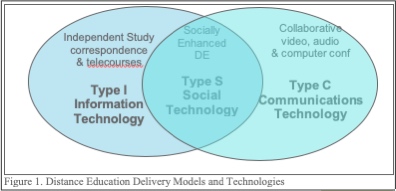
In this review Hulsmann revisits his earlier work identifying interaction as the key cost variable and identifies two distinct models of interaction. Type I is interaction with Information (or content – from books, to web sites, to simulations and everything in between). Type C is for Communications with humans (usually focused on expensive student- teacher interaction). Type I interaction is scalable in that variable costs do not rise with additional students. In contrast Type C communications costs with teachers increase with every student enrolled.
I then moved to a 2016 article Hulsmann wrote with Shabalala (Hülsmann & Shabalala, 2016) to look at cost issues associated with ten “signature courses” developed at UNISA. These ten courses added formative feedback (time consuming for tutors) and attempted to support computer conference interactions amongst students. By North American standards the course numbers (each tutor responsible for 3 classes of 60 students each) were very high and the workload for mostly part-time tutors to complete both conference moderation and marking far exceeded what they were paid for. Hulsmann and Shabalala again use his Type I and Type C lens to show that interaction (of any type) is expensive and not always possible in educating very large numbers of students – at an affordable cost. They do note (and I heartedly agree) that the use of multiple-choice quiz questions, with feedback, could have provided the formative assessment without increasing tutor workload, as is done routinely in MOOCs.
They also hint, but don’t develop the possibility that students could provide their own network support. The course designers were influenced by Heutagogy thinking and assumed (hoped??) that students would be able to become self-directed knowledge seekers and builders. However the primary technique used was reported as having the tutor pull back from active ‘teaching’. Not a challenging assignment for overworked tutors!
The signature courses had some success. The courses resulted in higher grades and higher completion than normal UNISA courses, but the sustainability of the model is questionable.
This discussion of interaction costs took me back to a chapter I published in 2008 (Anderson, 2008) Social Software technologies in distance education: Maximizing student freedoms. I wrote this chapter partially in response to Hulsmann’s model. I introduced an emergent type of interaction that I labelled as type S – for Social Interaction. It was entertaining to review this 12 year old work and my overview of the promise (without today’s perils) of social networking as a type of interaction that goes beyond Hulsman’s type C. Social networking thrives on many-to-many interactions and benefits from networked effects, crowd evaluations, persistence beyond a single course and the near ubiquity of relatively low cost availability- even in many developing countries. I illustrated the place of Type S below.
In the nearly decade that I and Jon Dron developed a type S system (Athabasca Landing) we never really won the institutional (or many teachers’) support that we had hoped for, but the system persists today.
I remain convinced that we need to develop learning activities and the skill and motivations of both teachers and learners to exploit the potential of type S interaction. Equipping students with the tools and the skills to develop networks for both learning and personal support is of critical importance – not only for cost effective distance education, but also for effective life-long learning.
Bibliography
Anderson, T. (2008). Social Software technologies in Distance Education: Maximizing Learning Freedom. In Evans. T, M. Haughey, & D. Murphy (Eds.), International Handbook of Distance Learning (pp. 167–184). Bingley, UK: Emerald.
Hulsmann, T. (2016). The Impact of ICT on the Costs and Economics of Distance Education: A Review of the Literature. Retrieved from http://oasis.col.org/handle/11599/2047
Hülsmann, T., & Shabalala, L. (2016). Workload and interaction: Unisa’s signature courses – a design template for transitioning to online DE? Distance Education, 37(2), 224–236. https://doi.org/10.1080/01587919.2016.1191408
The Economist USA – April 20, 2019, has an article on urban development that gives an interesting analysis that can usefully be applied to my home community of Riverdale. The article Sorry, We’re full looks at the context of San Fransisco – one of the most expensive neighbourhoods in the world, but with striking similarities to Riverdale ‘discussions’ during the past year or so.
Riverdale is a small river valley community bordering on downtown Edmonton. It once was home to coal miners and other working class families. Extensive residential development on the former industrial brickyard has taken place. In addition more than half of the original houses have now been replaced by infills. This has resulted in social media fuelled arguments and discussions about population density, green space and affordability in Riverdale.
The Economist article describes three perspectives that residents tend to look at potential development issues. The first group are referred to as the “Landed Gentry” – those who got in earlier when prices were lower and are striving to maintain the existing culture and land values in the community. The second group are referred as “Left Wing Activists” to whom gentrification is to be avoided by creating affordable living opportunities for all citizens. Finally, there is the “Market-Orientated Urbanists” who want us to fix the housing shortage by building more. Ironically each of these three types jockey for the title of liberal and even progressive.
Each of us has components of all three characterizations lurking in our psyche, but it isn’t too hard to label myself and most of my neighbours that are active in the community or on social media.
All three have valid arguments.
Only by willing to compromise and treating each other with respect in the process, will we arrive at the best combinations of housing and thus community in Riverdale, San Fransisco and many other places faced with growing populations.
In this post I capture a few mages and a few tales about Little Free Libraries (LFL) – inspired by the installation of my 4th LFL yesterday.
As you may recall from previous posts in this blog, I’ve taken an interest in building and stewarding these free libraries. Likely you have seen one or more in your neighbourhood, and hopefully you have made a few withdrawals and deposits.
LFLs are great communities builders. I’ve had a many a pleasant chat with those stopping by and it is fun just to watch visitors check the collection and try to decide if they should take a book or two. Gratifying is as well, when a car pulls up and out comes a box of books. Our home LFL has only seen an empty shelf (of 3 shelves) or one occasion – more often there are books fitted in horizontally on top of other books as the shelves are full. I occasionally cull books, but not often.
Yesterday, I was surprised with a delightful poem left by an anonymous reader.
I love the “For Freedom” at the end and of course, the pseudonym of “the book READistributor” is priceless.
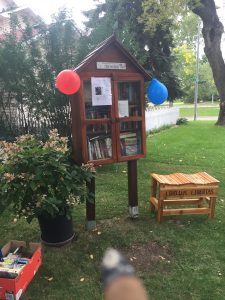
LFL#1 Celebrates it 1st Birthday in 2017.
This ‘home’ library (LFL#1) was built from wood salvaged from the origional house on this property – but had to wait 20 years until I had time and energy to build it!
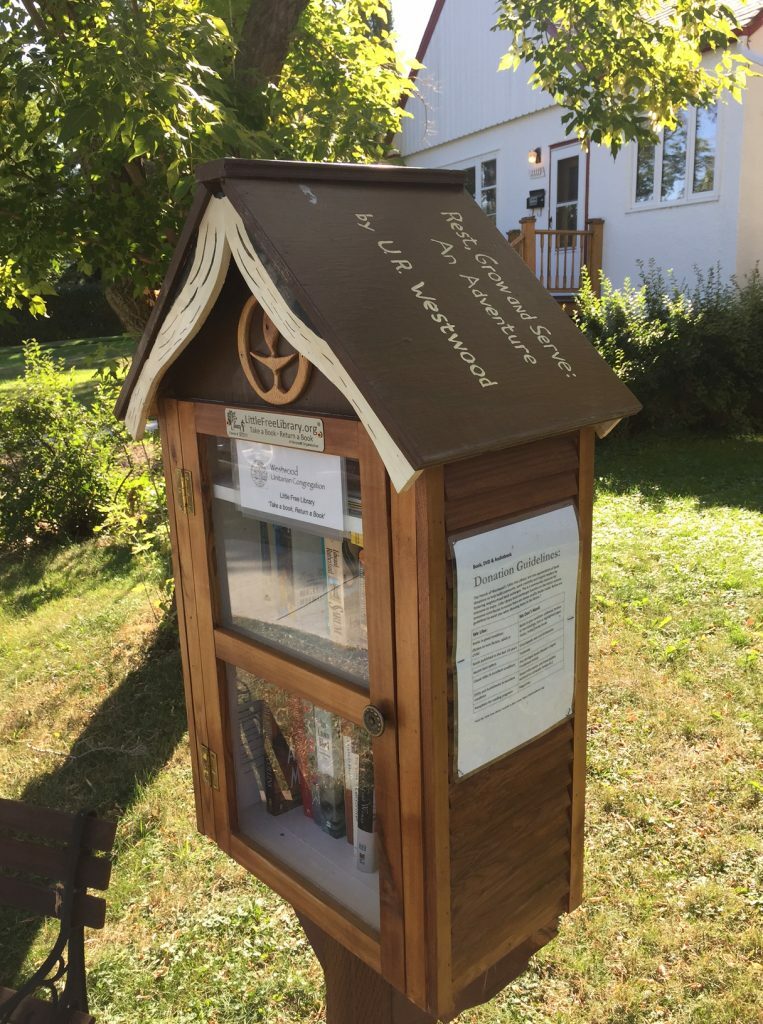
The second one I built for the Westwood Unitarian Congregation that we attend. It is a bit smaller, but features a roof shaped like an open book, sheltering the library. The book book needed a title and author and given that Westwood’s motto is to “Rest, Grow and Serve the World”. The book title is Rest, Grow and Serve: An Adventure by U. R. Westwood. Pretty cute eh!
LFL#2 at Westwood Unitarian
LFL#3 (below) was an upper kitchen cabinet. It was sided with oak flooring that Susan had made me drag home 12 years ago. I thought it looked better with the door upside down.
It has needed a repair. I had not fastened the roof permanently, as the owner might want a bird attic suite. I would be good to better to be able to lift off the roof and clean between tenants. But who wants the roof to come off – as it threatens in the photo below.
Little Free Library #3
LFL#4 was a gift to my friends Marj and Dennis Foth. Dennis was the Dean at University of Alberta- my first academic job. Marj started 20 years ago the Unprepareds Music Group. We gather once a month and each do a piano, cello, vocal or hammered dulcimer song or two. They are also major supporters of our Westwood Unitarian Congregation, so #4 got a carved sign and launched as Biblio Foth Free Library.
I covered the exterior of LFL#4 with lap siding that I cut from a pile of 2X4 cutoffs left from the garage wall project. I couldn’t find a kitchen cupboard with a matching glass door, so I bought a door and added small strips on the side of the opening to make it fit.
Marj Foth and myself installing Biblio Foth
None of these Little Free Libraries are perfect they all seem ‘good enough’ – like most of my carpentry!
By coincidence, the order for LFL#5 came in last week- and it’s taking shaping in the shop.
In this post I review an article that provides the first systematic review of the Interaction Equivalency Theory (EQuiv) that I formulated 15 years ago. The article is:
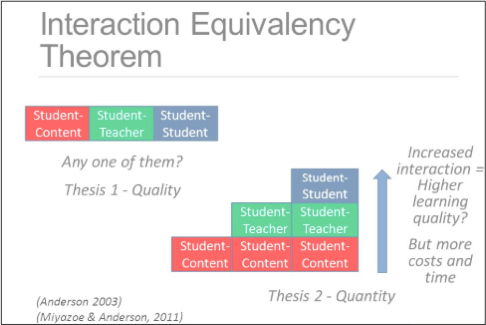
In 2003 I published an article in which I wrestled with the increased capacity for interaction that was becoming available to those of us designing online courses. I realized that synchronous, asynchronous, text, video, voice, mutli media, “smart” content and many more tools and toys were becoming available and flogged by ed tech companies. I also realized that many of these tools were expensive both in terms of money to purchase and support and in the time they took for both students and teachers to first learn to use, and then to effectively use. Perhaps I was being both simplistic and reductivist, but I speculated that though interaction is critically important in distance education, it can take many forms and further that one form can substitute for another. Building on Michael Moore’s notions of student-student, student-teacher and student-content interactions, I gave a very fancy name (Anderson’s Interaction Equivalency Theory) to the idea that if you could have a high level of one of these student interactions, you could reduce or even eliminate the other two. I further contented that adding the remaining two forms, may increase learning and persistence, but it would be more expensive (time and money).
The article was submitted and published:
Anderson, T. (2003a). Getting the mix right again: An updated and theoretical rationale for interaction. The International Review of Research in Open and Distance Learning, 4(2), 1-9. https://doi.org/10.19173/irrodl.v4i2.149
I got a few comments on the article and gradually noticed that others were quoting the article (not all positively) and a few researchers were using it in their conceptual rationale for their work. I see today that Google Scholar lists 934 citations to the article. So I was pleased with its modest interest and use. But I wasn’t even convinced myself it was entirely true. Like too many educational (and theological) theories, it could be used to explain a result in hindsight, but it is very challenging to design and implement experiments that could falsify the theory.
Partially to increase the validity and value of research in education that does not necessarily use control groups and other positivist methods, systematic reviews have recently become more widely used (for example see Martin, F., Ahlgrim-Delzell, L., & Budhrani, K. (2017). Systematic Review of Two Decades (1995 to 2014) of Research on Synchronous Online Learning) Thus, I was really pleased to see the first systematic review of the Equiv. Theory.
The Graham & Massyn (2019) article comes from Connie Graham’s PhD Thesis and is authored with her supervisor Liezel Massyn from the University of the Free State, Bloemfontein, South Africa.
Systematic Review Methodology
Like any good research project, this one starts with the research question . “How can the EQuiv be used to enhance interaction opportunities of non-traditional doctoral students?” It then provides the selection keywords (key words like doctoral education, EQuiv, interaction, non traditional students etc.) that were used to query the major journal databases and dissertation indices. The papers were further weaned to to focus on ones in which interaction and non-traditional doctoral students were highlighted, with or without the EQuiv Theory.
The context of this research is also of considerable personal interest to me, as I helped design, taught and researched with ‘non-traditional’ EdD students, studying at a distance, at Athabasca University. The paper is really three mini-systematic reviews rolled into one. The first is a review of issues related to non-traditional doctoral students. This section reviews studies that relate to completion, supervisor- student relationships, risk factors for dropout etc. The next section reviews interaction requirements in education in general and specifically with doctoral students. The final section reviews the EQuiv theory itself.
1. Doctoral studies with non traditional students
The doctoral research hones in on the often mythical relationship between the student and the supervisor. The the teacher’s role in this relationship has been described as “mentor” “master” ‘supervisor’. Graham & Massyn use the term ‘master-apprentice’ to describe the ideal form of this relationship. This relationship originally evolved on campus-based universities. At its best the student not only acquires content knowledge but also is socialized into the profession. This is accomplished by regular planned and spontaneous interactions between master and the apprentice doctoral students. This master/apprenticeship relationship is used in the training of doctoral candidates to help them to gain a deep understanding and opportunity to participate in the culture of their discipline tribe. This model/design has hundreds of years of university replication baring evidence that it can work. However, the Internet came along and caused us learn how to use mediated communications to create Equiv learning and socialization outcomes.
If we look at a typical doctoral student in the USA and in Canada today, they are studying all or some of their program online. In addition there are a myriad student-student online support interactions using social media. These students don’t often sit around the graduate coffee room and don’t get to be personally present when the cultural activities of the discipline are presented. However, they may (or may not) be meeting regularly with their supervisor via Skype, be following each others tweets and blog posts, and be following similar research topics or developments in their respective networks and forwarding them to each other. In addition they may be networking with professors and other graduate students around the world thus creating a new form of connected doctoral student.
Neither the “sitting at the knee” master-apprentice model nor the “connected model” works out in reality. Today the master is as often not on campus and private office conversations seem hard to arrange. Doctoral students have many demands on their time from vocation, family and health and are not readily available to benefit from face-to-face encounters.
On the other end, the master is often using different tools (University versus commercial provision) or prides themselves on NOT being on social media. Thus, the amount of personal interaction and socialization is extremely varied in today’s doctoral programs. This article begs the question, If the traditional student-teacher (master-apprentice) interaction is impaired does the Equiv theory help us to design compensatory interactions?
2. Interaction in Doctoral Education- especially at a distance
The second section deals with interaction in education with a focus on non traditional doctoral students. It is a good overview of this critical role of interaction in all modes of formal education. The usual student-teacher, student-student and student-content interactions are reviewed. I especially liked the section on student-institution interactions. I’ve usually considered this a subsection of student-content interaction. Especially for doctoral students an efficient and comprehensive web site or portal is critical to answer detailed procedural questions that every student bumps into. How many people of the candidacy examination committee? Which of the Faculty members would be the best member of my supervision committee? In days past these questions could be answered by informal conversation among grad students or hints from “the master”. But today a good web site is much more effective .
3. Interaction Equivalency
The third section of the review (longest and one of most interest to me) is on interaction equivalency. The review notes the earlier work by Simonson, Schlosser, & Hanson, 1999, that describes the necessity for distance education students having the “equivalent” experience in education as their campus based colleagues. This use of the equivalency in Simonson et al’ article is not what I had in mind. Distance education is not ‘equivalent’ to campus education in the sense that some experiences both on campus and off are not experienced by those not engaged in that mode. A lecture is NOT identical to a videocast, but they may have identical outcomes. Demanding literal ‘equivalence’ denies the unique affordances of both the live performance and highly mediated interactions.
The review then does a really good job of explaining the theory with some of the diagrams created by my colleague Terumi Miyazoe.
Graham and Massyn found a total of 25 papers directly using the Equiv theory that they summarize. The authors create a table in which they categorize and give examples of 12 different characteristics of the research papers such as learning method, type of students, interactions etc. None of the studies seem to directly falsify or uniquivacably support the theory, but most give a sense that it is a useful tool to think through a problem. As expected, the results are a bit inconclusive or as they state in the conclusion “the literature on the EQuiv is contextual, relative, and inconclusive.” This is not surprising as the Equiv is perhaps best used as a diagnostic or mnemonic aide to design and learning enhancement. One of the authors noted correctly that we never really provided a precise way to measure “high” or “low” levels and thus researchers have been forced to create their own metrics. And really, this is all I really wanted from the “theory”. Equiv is a designers’ (or teacher’s tool) that can and has inspired some empirical research but perhaps is best classed and measured by its efficacy as a design tool.
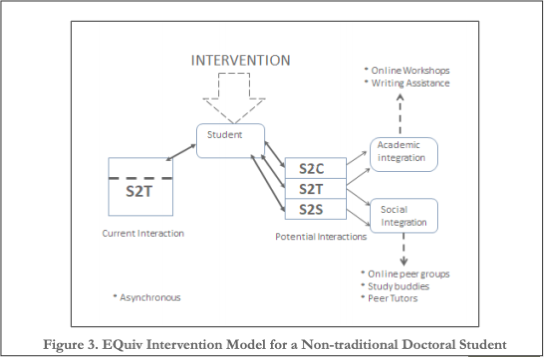
In the summary, Graham and Massyn present a new graphic that illustrates the Equiv in doctoral studies.
The dotted line shows potential (or likelihood) of challenges in quantity and quality of interactions with teacher that are routinely faced by non traditional, distance students. The diagram shows how an intervention, with enhanced S2S, S2T or S2C interaction, can address this deficiency and lead to social and academic integration and thus successful educational experiences.
To conclude, congratulations to Graham and Massyn for a useful contribution to the Equiv and by extensive online learning literature. As they note its use in the important and growing area of doctoral research, at a distance, is very under researched and there is lots of interest and room for ideas on how to make this experience more effective – for students, teachers and institutions.