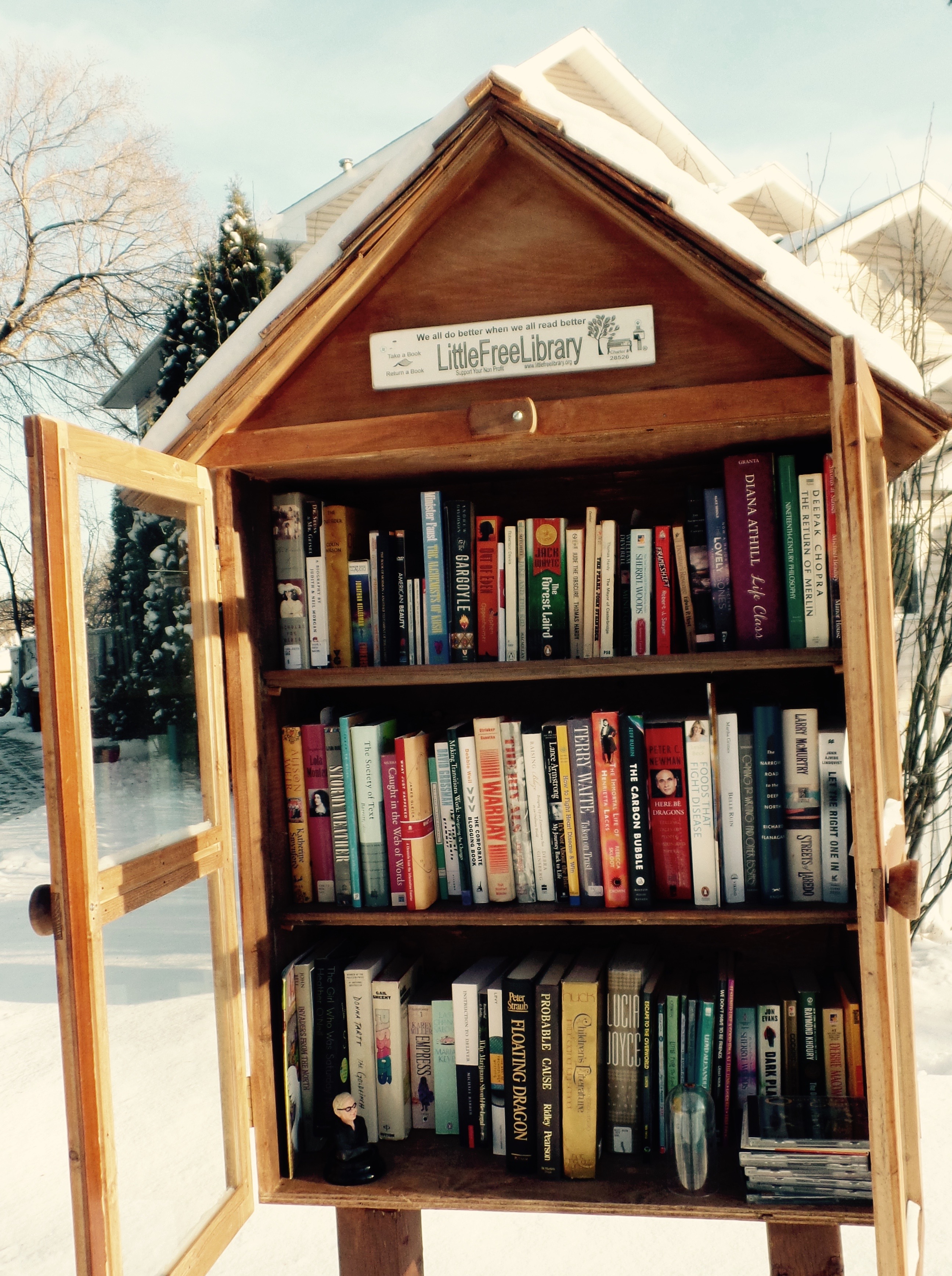
Little Free Librarian Inspects Little Free Library

Little Free Librarian Inspects Little Free Library

I had some fun with the little clay model that I posed for in the market in Tianjin, China.  The artist used multi-coloured modelling clay with amazing skill to create caricatures for his customers.

Since then my statue has been guarding the house from the fireplace mantel, but last week, he got bored, and wanted to check out the Little Free Library.

SAMSUNG CAMERA PICTURES

Browsing the stacks

While he was growing the stacks, I took these pictures.

SAMSUNG CAMERA PICTURES

Little Librarian (in bottom left)


Self-paced MOOCs and Blended Learning

Self-paced MOOCs and Blended Learning

One of the challenges in designing any educational program is balancing the need for individual freedom (of pace, space, relationship, technology and other freedoms that Jon Dron and I have described in Teaching Crowds) with the benefits of social learning. Maximizing freedom leads down a path of individualized and self-paced programming. It may be possible to Have your cake and eat it too, but incorporating social activities into self-paced programming presents many challenges to designers, teachers and students. In this post I want to describe promising developments in self-paced MOOCs for use in blended learning contexts

One of the advantages of blended learning and its variation of a “flipped classroom” is the mix of event based programming with student freedom to shift at least space and time during the asynchronous, online portions of the course. However, aggregating, creating and curating the content and activities for the online portions of this model can present challenges for teachers and especially those with limited levels of network literacy. The growing number of Open Educational Resources and content, not specifically designed for education, but with an open license certainly helps meet this need. I’ve often thought that MOOCs or portions of MOOCs could be ideal material for this task. They often display production quality beyond a single, underfunded teacher/producer and student exposure to well-known academic experts and good teachers can enhance the learning experience. However, two challenges have, to date, frustrated extensive use.

The first challenge relates to access. Most MOOC content and especially that produced by commercial companies is copyright protected and often hides behind passwords or is only accessible a limited number of times during a year. The second challenge also relates to scheduling in that the majority of MOOCs have been paced, meaning the start and finish dates are set by the MOOC provider and these dates rarely match with the scheduling needs of blended learning programs.

Progress is being made on both fronts. The recent “State of the Commons” report celebrates the continuing increase in amount of content licensed with a variety of Creative Commons licenses. This material can legally be included in blended learning courses. On the second front more and more MOCCS are moving to a self-paced delivery format or they are offered as self-paced resources after their debut as a paced course.

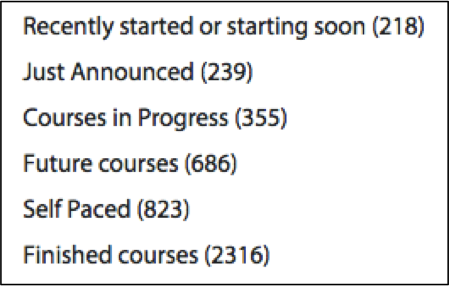
This shift is illustrated by data from Class Central, which provides a directory of MOOC offerings from many providers.
self-paced moocs

As can be seen there are 2,316 finished MOOC courses. Presumably none of the content from these courses is available for re-use. However, there is a significant and growing number of courses that are offered in self-paced format. Udacity has been delivering its mostly science orientated programming using self-pacing almost since their inception. But it is CoursEra who is demonstrating the shift towards self-paced programming most clearly. No doubt they see potential revenue (from completion certificates and revenue generating eye-balls) disappearing as soon as the course has finished.

A very limited of educational institutions (for example Athabasca and Thompson Rivers in Canada, Open University of the Netherlands and Open PolyTech in New Zealand) offered self-paced courses for years. Predictably, course completion in self-paced courses is always less than in event paced courses. However, as CoursEra and other MOOC suppliers are realizing, self-paced courses offer distinct advantages to some students. As described in my earlier post, we have attempting for years to provide “compelling, but not compulsory” learning activities that include social learning opportunities for our self-paced students at Athabasca. These effort have not been overly successful and integration within the administrative structure of self-paced institutions remains challenging. (see for example the challenges uncovered by one of my Doctoral Students, Jan Thiessen in her thesis Self-Paced study at a Distance.

Nonetheless, the much larger context of blended learning, may more easily incorporate self-paced resources in their blended programing. A number of studies have looked at MOOC use in flipped or blended classrooms – (Bruff, Fisher, McEwen, & Smith, 2013; Holotescu, Grosseck, Cretu, & Naaji, 2014; Milligan, Littlejohn, & Margaryan, 2013). Generally they conclude that the social glue from the classroom does a nice job of pacing and providing social interactions between and among students and instructors. Yousef, Chatti, Ahmad, Schroeder, & Wosnitza (2015) also do a nice job of showing how learning analytics can also be used by students to monitor the course and their performance.

Thus, I think self-paced MOOCs will continue to find a valuable role in the ongoing (if SLOW!) evolution of Universities and adult education and learning generally. The classroom experience can motivate and pace while providing an instructor the opportunity to personalize, regionalize or in other ways add value to the MOOC. And finally, let’s never forget the potential of this type of blended intervention to save instructor time.


References


Bruff, D. O., Fisher, D. H., McEwen, K. E., & Smith, B. E. (2013). Wrapping a MOOC: Student perceptions of an experiment in blended learning. MERLOT Journal of Online Learning and Teaching, 9(2), 187-199.

Holotescu, C., Grosseck, G., Cretu, V., & Naaji, A. (2014). Integrating MOOCs in Blended Courses. Paper presented at the The International Scientific Conference eLearning and Software for Education.

Milligan, C., Littlejohn, A., & Margaryan, A. (2013). Patterns of engagement in connectivist MOOCs. MERLOT Journal of Online Learning and Teaching, 9(2).

Yousef, A. M. F., Chatti, M. A., Ahmad, I., Schroeder, U., & Wosnitza, M. (2015). An Evaluation of Learning Analytics in a Blended MOOC Environment. The European MOOC Stakeholder Summit.

 

Retirement is like being on sabbatical – only longer

Retirement is like being on sabbatical – only longer

As my first “academic” term as a retiree draws to a close, I’m reflecting on what it actually was like to be retired. We hear all the stories (about men especially) who get terribly bored, follow their wives around the house, get addicted to golf or some other bad habit – but it hasn’t been that way for me – yet!

I know some of my colleagues have basically “moved on” and completely dropped the academic and scholarly parts of their lives once finally “packing it in”. But I didn’t think that would happen to me. I guess I still find lots of things of interest in education, lots I don’t know, technology improving AND I don’t need an expensive lab, grad students or postdocs to feel a part of it.

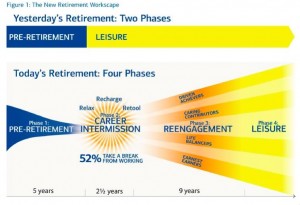
I also didn’t really experience (yet) what Merrill Lynch describe as a ‘career intermission’

ishot-250

Mostly retirement is like being on sabbatical. When I’ve been privileged to go on sabbatical, my teaching and administration roles have been eliminated but I’ve always kept my grad students, done the odd key-note, travelled a bit more than usual, done more hiking and biking and had more time for reading and music – both for fun and academically. However, usually I have some big sabbatical project hanging over my head- like a book that NEEDS to be finished or a garage that NEEDS to be built.

This fall has been like that. I did three keynotes (Brazil, Oklahoma and Denmark), a fair bit of biking (despite having my favorite bike stolen (sigh)) and tried to play my hammer dulcimer every day. I managed to get one of my remaining grad students through defense, and yes, there were two big projects – both of which finally draw near to conclusion.

First of these was a 2 day-a-week consulting job leading a task force to develop a teaching and learning plan for the School of Business at the University of Alberta. I had worked for the University of Alberta before coming to Athabasca University as an academic, EdTech type, change agent – with little real success in the change department. When I returned fifteen years later I found not much had changed – despite or in spite of networked pedagogy, crowd technologies, open access, MOOCs and lots of other potential. Nonetheless, I enjoyed the experience and produced what I hope is a visionary but DOABLE agenda for enhancing teaching and learning at the School.

The second big job was to lead a task force on financial issues for our small Unitarian congregation. Unitarian- Universalists are the mostly highly educated religious denomination in North America, but among the lowest per capita contributors. We have been running deficits for years and it was time to re-think giving and spending. We haven’t resolved the issue but produced 20 pages of facts and comparisons to other social and religious organizations and discussions on various methods to balance the budget.

What I really like about December on sabbatical or retired, is that I have no term papers, essays or final projects to mark and no grades to submit.

Finally, I think I forgot to mention that I’ve become a cover boy for the senior set here in Edmonton. I know it’s not Time Magazine or the Rolling Stone, but I made the front cover of the Edmonton Senior.

So retirement has been great. I look forward to the Solstice Celebrations now fast approaching and wish you a very relaxing and invigorating holiday season.

European MOOCs – Special Issue of IRRODL

European MOOCs – Special Issue of IRRODL

ishot-248

We certainly are past the famed “Year of the Mooc” but there availability and I will argue impact on adult education is far from past. This week’s special issue edited by Markus Deimann, Sebastian Vogt adds many new insights – a few of which I’ll comment on in this post.

The first article MOOCs and the Claim of Education for All: A Disillusion by Empirical Data by German authors Matthias Rohs and Mario Ganz works within a critical paradigm to address issues of inequality and lack of opportunity to debunk the notion that MOOCs are “education for all.” The article is well written and has some good conceptual information on Knowledge Gap Theory, but I didn’t find their survey results either original or surprising. I don’t think that finding that most people in Germany who take MOOCs on Adult Education are themselves adult educators and already have University degrees is at all surprising, nor a valid criticism of MOOCs. The notion that MOOCs attract niche audiences is not surprising nor alarming. They also lament the increase in 2-tier MOOCs whereby students wishing to get a certificate and be tested in their learning, are required to pay a fee.   However, I think to be viable a MOOC needs some revenue stream and this model still allows the learner to browse or consume with no cost.

The 2nd article Opportunities and Threats of the MOOC Movement for Higher Education: The European Perspective, by a host of well-known European authors provides an EU centric look at the opportunities and threats of MOOCs. The study uses a twitter hash tag data-collection technique which provides a unique way to do a type of Delphi study, but the participation rate and number of tweets is surprisingly low. No surprises are the opportunities for innovation and collaboration and the (mostly unrealized) potential to move this learning opportunity into valid and widely accepted credentialing of learning outcomes. Conversely the threat (again NOT a surprise coming from Europe) is too much bureaucracy and vested interest in bridging the chasm separating formal and informal education.

The third article by Abram Anders, Theories and Applications of Massive Online Open Courses (MOOCs): The Case for Hybrid Design is the only article not by a European author. The article does a nice job of trying to categorize the pedagogy underlying MOOCs. It is always nice to see our own work referenced (Anderson & Dron, 2011) and Anders uses our 3 generations of DE pedagogy to map a third “hybrid model” MOOC based on social constructivism. This adds a middle ground between Stephen Downe’s distinction between cMOOCs and xMOOCs.

The next article Setting-up a European Cross-Provider Data Collection on Open Online Courses describes the start-up phase of the EU- funded MOOCKnowledge project. The article is a call to action for large-scale data collection amongst MOOC providers to gather a host of demographic, motivational, employment and other data from participants. One can almost see the resulting path analysis studies that could arise from their proposed data collection model for predicting outcomes of MOOC participation such as completion and satisfaction.

The next article adds to the long debate amongst distance educators as to what constitutes open, in so-called open education systems. Obviously, MOOCs are central to this discussion – even though we have witnessed evolving meanings of the Open in Massive Open to include student cost, paid text books, use and non use of copyright protection, rigid time pacing and other dimensions of openness. In Dimensions of Openness: Beyond the Course as an Open Format in Online Education Christian Dalsgaard, Klaus Thestrup argue for three dimensions of openness transparency, communication, and engagement. They revisit Dalsgaard’s earlier work equating transparency with persistence such that student contributions are not hidden behind passwords or destroyed at the end of a course. The article is a good summary of the divisive issues that still divide proponents of MOOCs and other forms of distance education as “open” seeks a viable home amidst economic, privacy, control and assessment opportunities and challenges.

A group of researchers from Ireland next present a classic case study of a single institution, Dublin City University and their attempts to rationalize and develop a MOOC. This is a challenge that has sparked debate in probably every University in the world. Should we do a MOOC and IF we decided to how would we do it? The article takes a cue from the much older debate of picking the best LMS to the detailing the criteria for selection and brief reviews of nine potential MOOC platforms. This is the first comparison that I have seen that tries to categorize the strengths and weaknesses of each platform for the best “strategic fit” with the Dublin requirements. This is a very useful overview of how one university comes to grips with the potential benefits, the cash, opportunity costs and contextualized type of tools needed for a successful implementation. The article will be very useful for any institutions still wondering if there should be a MOOC or two in their educational strategy.

In the second article from EU Home project the authors present results from a series of annual surveys assessing institutional attitude and experience with MOOCs. The article is interesting as it charts the changes in attitude and practice over the past two years. Further it displays differences between European and US universities. There aren’t too many surprises in the data but it certainly shows that though MOOCs have North American roots, the current and present focus – at least at the institutional level is shifting to a global perspective.

I’ve always had a soft spot in my heart and mind for the local study centre. My first full time job in distance education was as Director of Contact North and I was charged with setting up dozens of community learning centres in small and often isolated towns in Northern Ontario. My PhD work examined students’ perspectives of learning in these distributed communities and this was the genesis of the work that my supervisor Randy Garrison and I did to develop the Community of Inquiry model. Thus my interest in the 7th article Using MOOCs at Learning Centers in Northern Sweden. In an era when educational programming is as easily delivered to the home or office as to a formal learning centre, it is useful to read about the experience of people who take the time and expense to gather together physically to learn. The article recounts the long Swedish history of “Learning Circles” and provides concrete suggestions for using MOOCs as the content piece of learning – leaving social constructivist engagement to happen face-to-face in a community learning centre.

The next article from Portugese authors is a case study of an iMOOC on Climate Change: Evaluation of a Massive Open Online Learning Pilot Experience. iMOOC is yet another variation on the MOOC sub- categorizations theme that brings some of the expertise and tools from “normal” formal online education to MOOCs. The case study shows high levels of persistence (relative to most MOOCs) and the general success of the model. I was especially interested to see the use of ELGG platform for the social components and integration with Moodle which was used largely as a content provider. Jon Dron and my work on Athabasca Landing, based an ELGG platform, that we created to work in a similar fashion as the persistent social glue to the content provided by Moodle.

The final paper, A MOOC on Approaches to Machine Translation provides another case study of a successful MOOC – this time from Catalonia. The MOOC used the popular open source Canvas platform and the researchers provide lots of graphical displays of demographics, persistence, motivation and perceptions of value.

So what do I conclude? First, if one thought that MOOC was synonymous with American culture and venture capitalists, these notions will be disabused by the refreshing look at MOOC experiences from a European perspective. The special issue editors Markus Deimann and Sebastian Vogt from Germany did a good job of shepherding these 10 high-quality articles through the IRRODL review process and helped IRRODL realize a bit more the ‘International’ in its name.   Thanks to the editors and each of the authors.

Second, the issue in total provides a host of practical examples of the way MOOCs have evolved both technologically and pedagogically. As we all experience, it is hard to keep up with EVERTHING, but even a skim reading of this issue will update and show how MOOCs have ridden the roller coaster of hype, through the trough of disillusion and are now ascending to find there rightful place in a world in great need of quality lifelong learning.