The real cost of solar and wind energy
December 2025
Let me begin this post by emphasizing that I am a BIG supporter of renewable energy – wind, solar and hydro. I think it is critically important for human and ecosystem survival to reduce (and certainly not increase) the amount of CO2 we dump into the atmosphere.
However, many fellow environmentalists underestimate the cost of solar and wind and refuse to look at viable zero carbon solutions due to ideological blinders.
The headlines often proclaim that the cost of electricity per kilo watt hour (KWH) is now cheaper for solar than for almost any other means to produce grid quantities of energy. However, this initial low-cost installation masks real and increasing costs. These costs are related to the familiar restraint that ‘sometimes the wind doesn’t blow and the sun doesn’t shine’. Other times the wind blows stronger, and the sun shines longer than our capacity to effectively put this energy to use. When this happens those managing the grid are forced to shut down portions of the alternate energy production. In a sense wasting the energy and at best not producing the electricity that the technologies could be producing. This is referred to as ‘energy curtailment’ – when alternate energy production is intentionally reduced so as not to overload the grid.
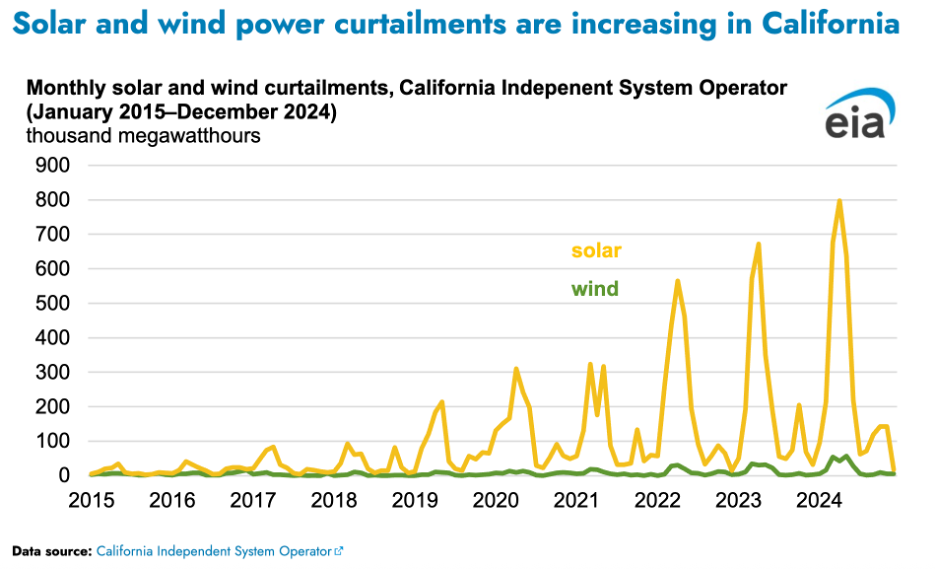
Estimates of the global amount of curtailment vary and are increasing annually. Globally curtailments are estimated at about 3% (Novan & Wang, 2024) of total alternate energy production. However, there are huge regional and national variations and further, the amount of curtailment has been increasing as more energy from wind and especially solar comes on line. See figure 1
Thus reliable, 24 hour a day backup power must be built to match with large wind and solar generation. The use fossil-fuel producers to serve as backup is very expensive. No one wants to build a methane or coal fueled plant that only operates for a portion of the day. Almost all power coal, petroleum and nuclear power plants only become efficient when producing at near capacity levels, 24 hours a day.
So how do we integrate and even expand wind and solar energy without having to waste increasing amount of energy? An obvious answer is to increase the size (think national or contentment or intercontinental scale) grids such that wind or sun in one region can be matched with cloudy conditions, doldrums or nighttime in other areas. But this can be very expensive, and transportation of electricity is not without cost. A second option is to build very large batteries that can store this excess energy until it is needed. But we know from the costs (money and environmental) of creating batteries for electric cars and trucks that battery construction is not inexpensive and not without environmental cost. Further, the scale needed for grid batteries is much larger, than for vehicles. A third and viable solution in some regions is hydro storage. Pumping water uphill to storage lakes and then using the downflow to power generators when more power is needed. Unfortunately, not every geography has large wind and solar capacity located close to hills or mountains where this water can be stored.
If one were to talk to the Alberta Premier or members of her government, the perfect solution is to burn more of Alberts’s ‘clean’ natural gas – which I prefer to call methane. These proponents seem to think that burning methane (or other petroleum products), coupled with the environmental cost and energy expenditures to bring these to market, though much cleaner than coal, is harmless. However, the major contributor to rising CO2 levels in Canada is oil and methane mining, production and distribution.
Is there an Alternative?
So where does that leave us? Maybe tidal power in very specific locations or the elephant in the room – nuclear power generation.
We all fear major blowout or explosions and release of harmful radiation from nuclear power plants. There has been three major and very well publicized nuclear accidents in 50 plus years of nuclear power generation. Chernobyl (1986) with 79 confirmed deaths, 3,000 est. from long term radiation deaths, Three Mile Island (1979) – 0 deaths; Fukishimo (2011) 1 confirmed, 2,300 deaths from stress and evacuation. These numbers are tiny compared to the 120,000 deaths annually in the USA alone (National Institute of Health, 2023) from air pollution caused by coal energy production. Yes, nuclear waste must be disposed of and uranium mines need to be cleaned up when they cease production, but again compared to coal or oil, these are minor challenges.
So why don’t we use nuclear technology more? Ignoring the conspiracy theories (perhaps true) that big oil and petro states do NOT want to see the end of petroleum burning, There are more than a few challenges that must be overcome before widescale use.
The most frequently sited reason is that the construction of nuclear power stations is expensive and take a long time – or at least they used to. In North America, only 1 commercial nuclear plant has been commissioned in the 25 years of this century, thus the data we use to calculate costs and time required, is based on 20th century technology and construction techniques. These two Plant Vogle reactors came online in 2023-24, years late and 3 times over budget for a cost of about $15,000 US per KWH. By comparison equally large South Korean and Chines reactors are coming online for between $1,800-$2,300 per KWH. The Koreans have also built commercial scale reactors in less than 3 years. (data from ChatGPT)
The hype machine has, in the past few years, been championing the potential of new types of nuclear reactor SMRs (Small Modular Reactors). These systems promise all sorts of potential benefit – factory manufacture using standardized components, recycling of spent fuel, passive safety systems that guarantee shut down in case of any environmental or man-made emergency and low-cost transportation by truck, rail or ship. These SMRs are also designed and sized for all sorts of commercial, mining, residential and military applications.
These “potential” reactors, especially those with radically different designs, from the pressurized water-cooled designs in use today, have been criticized because so few (only one so far in China) have been constructed and are in operation today. Of course, USA, UK and Russia have been building small reactors for decades to power war ships and submarines. But commercial power production cannot rely on zillion dollar defense budgets.
Rather than innovate, governments and industry has focused for the past 4 decades on building safer (backups, for the backups, for the backups) older designs rather than innovating and building new reactors using new technologies. This is changing. But resistance is still strong.
Looking specifically at the Alberta context, where I live, we are home to the Alberta oil sands, third largest proven oil reserves in the world and the largest single producer of CO2 emissions in Canada. The high cost of extraction and processing, coupled with the added CO2 produced when the product is burned in homes and highways, means Alberta has a HUGE carbon footprint. Trial ballons for nuclear power in Northern Alberta have been raised twice but opposition from the petro industry, environmentalists and at best tepid support from government has, to date, stalled any real planning much less construction.
The Environmental Movement is Changing Course on Nuclear (slowly).
After shutting down all the nuclear plants in Germany, the government was forced to reactivate a number of coal mines due to the Russian oil and methane curtailment. The Germans as well as most EU countries are rethinking their energy production strategies. The Green party in Finland has adopted a pro-nuclear power policy but most other green parties in Europe remain opposed. Green Peace remains opposed as does the Canadian Coalition for Nuclear Responsibility. However the Canadians for Nuclear Energy are strong nuclear power advocates and especially of the Canadian designed and built CANDU reactors.
Summary
Nuclear power isn’t perfect – no energy source is pollution free. However, some (wind, solar, hydro and nuclear) power generation systems do not directly produce C02 minimal other harmful emissions. Thus, if we are to continue building a society that enjoys (and is dependent) on power generation for sustainability and convenience – we must continue to deploy carbon free production systems – including nuclear. Wind and solar need reliable backup.
References:
Novan, K., & Wang, Y. (2024). Estimates of the marginal curtailment rates for solar and wind generation. Journal of Environmental Economics and Management, 124, 102930. https://doi.org/10.1016/j.jeem.2024.102930