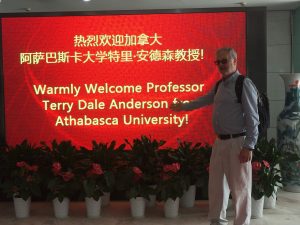
Final days in China

Final days in China

I’ve had a great time here in Wuxi, learned lots, met new friends and hopefully helped a class of grad students enlarge their research perspective using design-based research.  I also did two presentations here at Jiangnan University for faculty and students. The first was on Publishing in International Academic Journals and the second on MOOC Possibilities.

The Master’s degree class ended with the First China-Canada Student Poster conference. Each of 8 student groups created (in English) and presented (In Chinese) their proposals for a design based research project. Each project had to have a discussion of the context,
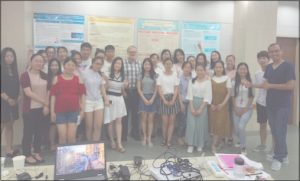
Final Day of Class with Poster Conference

a description of the intervention, the means of assessing learning, answering of research questions and a start at development of design principles from lessons learned.  I’m not sure if any of these projects will actually be enacted, but I think it was useful to explore research designs beyond the positivist paradigm that defines current research study here.  Of course, every good conference ends with a social and I ordered in pizza and pop for all.

I also made time, with a few new friends, to visit Shanghai. We visited the Shanghai Tower which has recently opened and brags of being the second tallest building in the world.  As
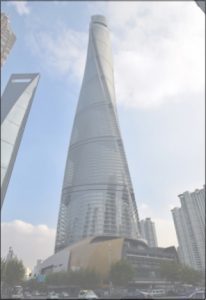
Shanghai Tower

expected the view from the 125 floor observation deck was spectacular – but if only the smog didn’t obscure the vista!  I was impressed with the eco-friendliness, the elevators (40 MPH) and the design of the building. The whole building twists 120 degrees as it ascends, making for interesting lines and greatly reducing the wind forces on the tower. Given increasing number of global weather extremes this is important for such enormous structures.  The Tower also gathers and recycles all rainwater and has over 200 wind turbines in the top section of the tower to generate electricity.

We also visited a famous EdTech researcher (Prof Gu) at East China Normal University in Shanghai and talked about her editing of a new journal, distance education woes and the possibility of me making longer visits to that campus.

So what’s to learn?  My visit this time was in the more prosperous and populated parts of China, however, like Canada, there is a much more to see and learn about than visiting in large cities.  The people I met were really hard working, seemed relatively happy and clearly focussed on succeeding and building their own and China’s continued prosperity. Despite the pervasiveness of mobile media, traditional values like respecting elders and those with authority remain firmly entrenched. There seems to be lots of support for the current President and little open discontent with anything -including the air quality.  There is also great complacency with the way the “rules” for everything from travel, to media, to employment regulations seem to arbitrarily change and most I talked to are more concerned with knowing and following whatever the current rules are than in opposing them. Of course, perhaps western ideas of open discontent are sparse because they are clamped down on by authorities. Nonetheless, those waiting for the Chinese to rise up against their ‘undemocratic’ government will likely have a VERY long wait.

By using a VPN, I was able to use all of the Internet tools that I have access to in Canada – and I had more time on my own to get papers, presentations finished ans watch Netflix!   Reading in the  China Daily press (owned of course by the government) I learned that China is enacting new sets of Internet controls and supposedly engaged in public consultations.  The blocking of Google sites and most social media, has resulted in the growth of equivalent Chinese applications – some of which like cell phone payment systems are much more popular (and better?) than those used in Canada. However, China has a national goal to be A (or THE) world leader in technology development by 2050 and is investing appropriately. The recent exit of the US from global climate agreements provides even more incentive and opportunity for China to play a world leading role in this and other tech-enhanced ventures.  Unfortunately, I think the blocking of some educational sites (notably Google Scholar, but also Slideshare, YouTube and others) is counter-productive to China’s aspirations. I hope that “public consultation” (whatever that means) will result in more selective opening of certain sites and especially those with large educational and research value.

My wise older brother commented after my earlier post on my encounters with the Chinese medical system, that I had better be careful about too strong advocacy of pay for service medicine. My experience was minor and paid for easily by my Western income. What impressed me was the speed and efficiency of their system.  But I am also aware that for many, the fees that were ‘pocket change’ for me, are real obstacles for others. I didn’t see a single pan handler or beggar here in China, but I did see a display at a mall of pictures of a very young boy and his Aunt soliciting money  to pay for his cancer treatments. So, despite the challenges we have funding health services in Canada I remain convinced that full, public funding is the best alternative for everyone’s health and well-being.

So home tomorrow and I’ll be glad to see Sue, the ol’ neighbourhood and old friends. Thanks for reading. – comments welcomed.

A trip to Nanjing

A trip to Nanjing

Last weekend I accepted an invitation to visit and present a talk at the Jiangsu Open University in Nanjing. Nanjing is one of China’s larger cities strategically located on the Yangtze River. The Yangtze River delta was the centre of both economic power and political power for many hundreds of years and was the first capital of The Republic of China after the abdication of the last Emperor in 1912.

My host (and former PhD Student) Zhijun Wang (and her Mother and 16 month son) boarded

Zhijun Wang, Mother and son

the high speed train for the one hour trip from Wuxi. As most other travellers have noted the High speed train network in China is not only the largest, but arguably the smoothest and fastest train system in the world. We zoomed through the countryside at speeds (displayed on monitors in each car) of well over 300 KM/hour and of course we left within 1 minute of scheduled departure times.

My first “tourist” stop was to visit the Presidential palace complex where the Republic’s founding Father and  first President Sun Yat-Sen and his cabinet  lived and worked.  The tour, through mostly empty office buildings, was a bit sparse on useful stories and the crowds (Chinese are great tourists in their own country) and heat were both a bit oppressive. Nonetheless the compound had some nice gardens and ponds and one got a sense of the optimism and pride of a people first released from autocratic rule of successive dynasties of Emperors.  There was surprisingly little discussion of the civil war that shortened the life of this first republic nor the eventual triumph of the Chinese Communist Party led by Mao Tse Tung in 1949.

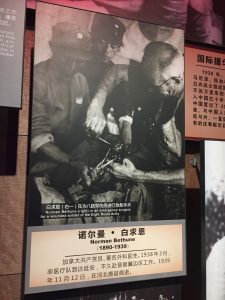
The next morning our host from Jiangsu took us to two adjoining museums focussed on wars ending with the Allied victory in World War Two.  The first Museum of the War of Chinese People’s Resistance Against Japanese Aggression  covered the global battle against fascism as expressed through aggression by Japan, Germany and Italy. The museum featured lots of photographs, equipment, maps and videos from the

Picture of Norman Bethune at work in China

extended War with, as expected, major coverage of battles that took place on Chinese soil. I of course noted the few mentions of Canadian involvement and the picture and story of Canadian Norman Bethune (pronounced in Chinese as BA-Tu-N). Everyone I have talked to here remembers memorizing Mao’s poem eulogizing  Bethune that is still required study in primary classrooms throughout China. The picture below notes the official stance on China towards peace.

Peace Declaration Plaque

I am aware that China is becoming increasing proactive in global issues, not alike other countries as their wealth has increased, but China’s knows as well as any country the horrors of war and invasion.

The second Museum was dedicated to the infamous “Rape of Nanjing”  in 1937 when Japanese soldiers invaded the City and went on a 30 day spree of murder, rape and theft.

Horrors of Massacre of Nanjing

Estimates place the number of dead at 300,000. The museum was fittingly quite quiet and very sobering – despite the crowd.  Besides showing the effect of this assault on the people of Nanjing, the museum provided many photos, newspaper reports and stories of heroic sanctuary provided  by foreigners who stayed after the Japanese began their occupation. I was pleased to see that Ontario Legislature, just this month,  declared Dec 13 as the official date to honour those who suffered and died during the “Massacre of Nanjing”  the first (but sadly not the last) genocide of the 20th Century.

Finally another huge lunch and we drove to the Nanjing Museum. This is 2nd largest Museum in China and we certainly did not tour all the 70,000 sq metres of displays. I mostly wanted to see the history sections – right back to dinosaurs, early copper and bronze age archeology and to full-sized rooms of Nanjing in the early 20th Century. I left the rooms full of various dynasty pottery for another day.

Later that evening I was treated to a nice banquet by the Dean of the University (who sadly spoke no more English than I speak Chinese) but through Zhijun’s translation I found a bit more about this University. Like other Open Universities in China, Jiangsu is LARGE -over 200,000 students and 8,200 staff.  China’s 5 Open Universities (sadly like other Universities globally) are perceived by their campus colleagues as being inferior in terms of research and student quality (whatever that is). Entrance to China’s University system is perceived as being essential for financial success, yet only around 30% or so of students who write the dreaded 2 day Gougou entrance examinations in Grade 12 are offered a position at a campus University. Thus, the Open Universities, though still having (lower) entrance requirements, offer the only opportunity for postsecondary education for well over a million Chinese students. The main delivery model seems to be television (Jiangsu does 2 hours a day on public networks) and now increasing video delivered via Internet. Students also meet in classes with tutors once a week, but never attend a campus. Examinations are held in local learning Centers. I began to be more than just a bit concerned with the language gaps and knowing just what was expected of me in this visit and beyond.

The next morning we arrived at the University to be greeted with a big welcome sign and

Welcoming Poster at Entrance of University

with much pomp I was welcomed to the Vice President’s conference room (The President was away). After a brief (translated) chat, I was given a tour of the multiple TV studios and massive computer room and then was presented with a Certificate (and major photo op) declaring me to be a Chair Professor of Jiangsu Open University.

I then did my presentation to a crowded room – mostly about Athabasca University and a variety of innovations in Distance Education that I had been involved with at Athabasca (topic chosen by them). I was introduced by the Vice President and heard later,that she had introduced me as the ‘Norman Bethune of Distance Education’!!  I  think that comparison is FAR overrated as Bethune’s trip to and work in China was a world of difference from my mostly luxury trip and minor contributions here. Fortunately, again Zhijung translated from my slides for the audience. I have no idea how many of the audience could understand my English.

Of course, the lecture was video taped and transmitted to a number of their learning Centres.  As normal in China, the ending prompt for questions for comments didn’t result in too much discussion, but a few interesting question. One was from a remote site and maybe mirroring some of my own concerns with video delivery, I couldn’t understand the question! Oh well.

Next, the Vice President and I were chauffeured across the street to another banquet. Finally, we talked about what they wanted from me – which turned to be “as many visits as I could manage” and some lectures.  I think what they want most is association with a ‘big name’ in western distance education.  They also noted they would be happy to discuss with me my requirements for expenses and “lecture fees”. Although everyone was very polite and generous with their time and compliments,  I was reluctant to commit to more than I was prepared to deliver (did I mention the air quality in Nanjing – think BAD!). However, I did promise to return early next spring (hopefully with Susan). I know well how long winter can be in Edmonton.

After a send-off (with the customary envelope full of 100 RMB bills) it was back to the train station and home of Wuxi.